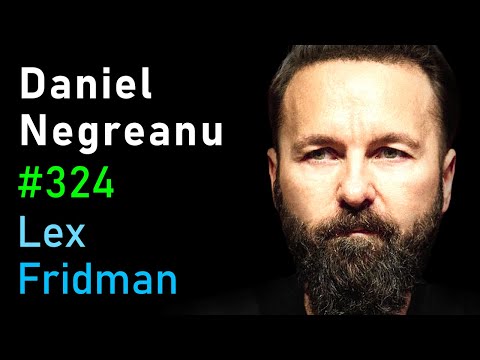
Daniel Negreanu: Poker | Lex Fridman Podcast #324
Daniel Negreanu (guest), Lex Fridman (host), Narrator, Narrator
In this episode of Lex Fridman Podcast, featuring Daniel Negreanu and Lex Fridman, Daniel Negreanu: Poker | Lex Fridman Podcast #324 explores daniel Negreanu Dissects Poker Psychology, Strategy, Variance, and Life Lex Fridman and Daniel Negreanu explore modern poker through psychology, game theory, and human nature, showing how much of winning is about people rather than cards. Negreanu explains profiling opponents, reading physical and verbal tells, and balancing game theory optimal (GTO) play with exploitative strategies to maximize profit. They dive into examples of unorthodox high-stakes play, the brutal variance of tournaments, and the mental resilience needed to withstand long losing stretches. The conversation broadens into ethics, money, cheating, fame, love, and how lessons from poker translate to life decisions and personal growth.
Daniel Negreanu Dissects Poker Psychology, Strategy, Variance, and Life
Lex Fridman and Daniel Negreanu explore modern poker through psychology, game theory, and human nature, showing how much of winning is about people rather than cards. Negreanu explains profiling opponents, reading physical and verbal tells, and balancing game theory optimal (GTO) play with exploitative strategies to maximize profit. They dive into examples of unorthodox high-stakes play, the brutal variance of tournaments, and the mental resilience needed to withstand long losing stretches. The conversation broadens into ethics, money, cheating, fame, love, and how lessons from poker translate to life decisions and personal growth.
Key Takeaways
Winning poker is as much about picking the right opponents as playing the right cards.
You can be the seventh-best player in the world and still be the sucker if you sit with the top six; players like Dan Bilzerian win big by consistently playing against much weaker fields.
Get the full analysis with uListen AI
Effective players build detailed mental models and profiles of everyone at the table.
Negreanu logs tendencies, jobs, attitudes toward luck, and emotional patterns in his phone, then tailors his bluffing and value bets to each person’s psychology instead of playing a one-size-fits-all style.
Get the full analysis with uListen AI
Modern poker demands thinking in ranges, not single hands, and balancing value with bluffs.
Rather than guessing a specific hand, pros estimate the full range an opponent could hold, narrow it as the hand progresses, and choose actions based on how their own range should behave in that spot.
Get the full analysis with uListen AI
GTO is a baseline; the real edge comes from exploitative deviations.
Solvers show mathematically unexploitable strategies, but humans aren’t robots; Negreanu deliberately departs from GTO when he identifies opponents who bluff too much, fold too much, or fear him, and then leans hard into that exploitation.
Get the full analysis with uListen AI
Unorthodox aggression can be powerful if you understand how others misadjust.
Players like Michael Adamo bet far larger than solvers recommend, pushing opponents out of their comfort zones and capitalizing when they either overfold from fear or ‘take a stand’ in bad spots.
Get the full analysis with uListen AI
Resilience and honest self-assessment are critical to surviving variance.
Negreanu describes brutal stretches—like losing over $1 million at the WSOP while often being a statistical favorite—and stresses the need to separate bad luck from bad decisions, vent emotion briefly, then reset and return focused.
Get the full analysis with uListen AI
Poker’s deeper lessons mirror life: don’t chase early wins blindly, and know when to fold.
He compares gamblers to lab mice dying chasing past cheese, warns against “beginner’s luck” delusions, and emphasizes using your 20s to take risks, build skills, and learn when to walk away from bad games, careers, or relationships.
Get the full analysis with uListen AI
Notable Quotes
“You could be the seventh-best player in the whole world, but if you're playing with the other six, you're the sucker.”
— Daniel Negreanu
“Everything everyone does at the poker table conveys information.”
— Daniel Negreanu
“If you believe the lie that more is always better, then you can never truly arrive.”
— Daniel Negreanu
“The most dangerous version of myself is a deep understanding of game theory with my wisdom of many years and being comfortable just being myself at the table.”
— Daniel Negreanu
“Most people who try to play poker professionally are going to fail.”
— Daniel Negreanu
Questions Answered in This Episode
How can an aspiring player practically start building accurate opponent profiles without becoming overwhelmed or paranoid?
Lex Fridman and Daniel Negreanu explore modern poker through psychology, game theory, and human nature, showing how much of winning is about people rather than cards. ...
Get the full analysis with uListen AI
Where is the sweet spot between studying solvers for GTO insight and preserving your own intuitive, exploitative style?
Get the full analysis with uListen AI
How do you personally distinguish, in real time, between a downswing driven by bad luck and one driven by poor strategic choices?
Get the full analysis with uListen AI
Are there ethical lines in choosing games and opponents—for example, when does playing much weaker or drunk recreational players become predatory rather than just smart business?
Get the full analysis with uListen AI
Which single mental habit outside of poker (sleep, journaling, exercise, meditation, etc.) has had the biggest impact on your performance at the table and your resilience during downswings?
Get the full analysis with uListen AI
Transcript Preview
You could be the seventh-best player in the whole world, like literally seventh-best player, but if you're playing with the other six-
Yeah.
... you're the sucker.
(laughs)
You are the, you are the, like the worst player in the game, right?
Yeah.
So, like, there's a lot of players, for example, like the Dan Bilzerians of the world, right? He's not a top-level player like, you know, these guys you see on TV, but he probably makes more money than they do, because he plays with people that are far below his skill level. So part of the, part of the skill of being a poker player is finding situations where you're profitable, you know, regardless of your skill level.
The following is a conversation with Daniel Negreanu, one of the greatest poker players of all time. This is the Lex Fridman Podcast. To support it, please check out our sponsors in the description, and now, dear friends, here's Daniel Negreanu. Everything everyone does at the poker table conveys information. So let me ask sort of the big overview question: what are the various sources of information that you project and others project at the table that convey information?
Well, there's several different things. There's the ones that are conscious and then there's the ones that are subconscious, right? Like on the conscious level, it might be something someone says, right? You know, you ask them a question and they say, "Oh," you know, "you shouldn't call me here. You should." So there's the verbal tells. There's also the more, you know, subconscious stuff: body posture, right, the eyes, the throat, the pulse, um, various things that are, you know, less controllable. I find I use a combination of both to try to gain information. But generally, when I have somebody more comfortable, they give off more. When, like everyone has a different approach. Phil Ivey likes to intimidate. I go the other way. I want my opponents to be relaxed, so that they'll give me more in that regard.
So Phil Ivey likes to perturb the system, like mess with it to see what comes out?
I think Phil has an aura about him where he wants you to know-
Yeah.
... that he's watching you. Be afraid. Be uncomfortable. Because when you're uncomfortable, I got you, right? And that's sort of his shtick where he, you know... And people do, like when you sit at a table with Phil Ivey, it's intimidating.
He likes to rule by fear, and you like to rule by, uh, what is it, love?
That's a really good way to put it. I never (laughs) had anyone put it like that, but it makes a lot of sense, yeah. You know, fear Phil Ivey, and then-
Yeah.
... with me, it's fine. Don't worry.
Yeah.
I'll take your money, but you're gonna enjoy it.
Install uListen to search the full transcript and get AI-powered insights
Get Full TranscriptGet more from every podcast
AI summaries, searchable transcripts, and fact-checking. Free forever.
Add to Chrome