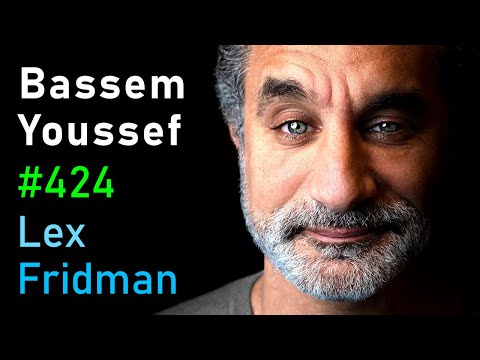
Bassem Youssef: Israel-Palestine, Gaza, Hamas, Middle East, Satire & Fame | Lex Fridman Podcast #424
Bassem Youssef (guest), Lex Fridman (host), Narrator, Narrator, Lex Fridman (host), Narrator, Narrator
In this episode of Lex Fridman Podcast, featuring Bassem Youssef and Lex Fridman, Bassem Youssef: Israel-Palestine, Gaza, Hamas, Middle East, Satire & Fame | Lex Fridman Podcast #424 explores bassem Youssef on war, propaganda, power, comedy, and exile Lex Fridman speaks with Egyptian-American comedian and former heart surgeon Bassem Youssef about Israel-Palestine, the Gaza war, propaganda, antisemitism, and how power dehumanizes both victims and perpetrators.
Bassem Youssef on war, propaganda, power, comedy, and exile
Lex Fridman speaks with Egyptian-American comedian and former heart surgeon Bassem Youssef about Israel-Palestine, the Gaza war, propaganda, antisemitism, and how power dehumanizes both victims and perpetrators.
Bassem recounts his high-risk Piers Morgan interviews after October 7, the personal stakes involving his Palestinian in-laws, and his broader critique of media narratives, military technology, and U.S. and Israeli policy.
He reflects on his rise and fall as the “Jon Stewart of the Middle East,” interrogation and exile from Egypt, bombing as a new immigrant comic in America, and rebuilding a career in English and Arabic standup.
Throughout, they explore religion, jihad and martyrdom, the psychology of hate, the corruption of democracies by money, and whether younger generations and new media can still bend history toward justice despite rising polarization and technological lethality.
Key Takeaways
Asymmetry of power shapes both reality and narrative in Israel-Palestine.
Bassem argues that Israel’s overwhelming military, political, and diplomatic advantage means Palestinians have little real leverage, and Western discourse that equates ‘both sides’ obscures who can actually change conditions on the ground.
Get the full analysis with uListen AI
Propaganda works by dehumanizing and distracting from present suffering.
He dissects how sensational claims (e. ...
Get the full analysis with uListen AI
Technology and AI are making killing easier, cheaper, and psychologically distant.
From drones and precision bombs to AI targeting systems like “The Gospel,” he warns that remote warfare plus biometric surveillance turn real people into abstract targets, hollowing out moral responsibility and setting the stage for more extreme backlash.
Get the full analysis with uListen AI
Satire can expose propaganda but becomes dangerous under authoritarian power.
Bassem’s Egyptian show thrived when mocking the Muslim Brotherhood, but once the army and Sisi took over, even indirect satire became life-threatening, leading to repeated cancellation, legal persecution, and eventual flight from Egypt.
Get the full analysis with uListen AI
Victimhood is seductive but corrosive, whether for individuals or nations.
He resists framing himself as a victim (of Egypt or Hollywood) and criticizes how states weaponize historical trauma—particularly the Holocaust—to justify present abuses, arguing this fuels antisemitism and harms Jews globally as well as Palestinians.
Get the full analysis with uListen AI
Media capture and moneyed interests are hollowing out democracy.
Bassem contends U. ...
Get the full analysis with uListen AI
Personal insecurity and ‘outsider’ status can fuel both ambition and art.
From being the poor kid in a rich school, to a doctor with a lisp on TV, to a middle-aged immigrant bombing at open mics, he shows how feelings of inadequacy, if not allowed to calcify into bitterness, can drive risk-taking, reinvention, and sharp comedy.
Get the full analysis with uListen AI
Notable Quotes
“If I hate you, that's great, but if I have a story to support that hate, ah, that's even better.”
— Bassem Youssef
“When you dehumanize a group of people, you first have to dehumanize yourself.”
— Bassem Youssef (paraphrasing Holocaust survivor Yehuda Bauer / Mahor Meyer’s idea)
“When the military came in, people were walking to me like, ‘Don't speak about Sisi. Don't speak about the army. We love you now, but don't…’”
— Bassem Youssef
“If you're afraid of something, make fun about the fact that you're afraid of it.”
— Jon Stewart (as quoted by Bassem Youssef)
“It doesn't matter now who you vote into power. They will not listen to you. They would listen to the people who paid them to be there.”
— Bassem Youssef
Questions Answered in This Episode
How can we acknowledge both Israeli and Palestinian trauma without letting either side’s historical victimhood justify ongoing abuses in the present?
Lex Fridman speaks with Egyptian-American comedian and former heart surgeon Bassem Youssef about Israel-Palestine, the Gaza war, propaganda, antisemitism, and how power dehumanizes both victims and perpetrators.
Get the full analysis with uListen AI
What concrete mechanisms—legal, financial, or technological—could realistically hold powerful militaries and states accountable for civilian deaths?
Bassem recounts his high-risk Piers Morgan interviews after October 7, the personal stakes involving his Palestinian in-laws, and his broader critique of media narratives, military technology, and U. ...
Get the full analysis with uListen AI
To what extent should comedians and artists feel responsible for political consequences when they satirize those in power under authoritarian regimes?
He reflects on his rise and fall as the “Jon Stewart of the Middle East,” interrogation and exile from Egypt, bombing as a new immigrant comic in America, and rebuilding a career in English and Arabic standup.
Get the full analysis with uListen AI
How can ordinary people distinguish between legitimate reporting, state-aligned propaganda, and performative ‘citizen journalism’ in the age of TikTok and X?
Throughout, they explore religion, jihad and martyrdom, the psychology of hate, the corruption of democracies by money, and whether younger generations and new media can still bend history toward justice despite rising polarization and technological lethality.
Get the full analysis with uListen AI
Is there any credible path to a political settlement in Israel-Palestine when both Palestinian and Israeli leaderships have incentives to maintain a state of perpetual conflict?
Get the full analysis with uListen AI
Transcript Preview
If I hate you, that's great, but if I have a story to support that hate, ah, that's even better.
Uh, one of your favorite words, "jihad." (laughs)
(laughs) That's my favorite hobbies.
(laughs)
It doesn't matter now who do you vote into power. They will not listen to you. They would listen to the people who paid them to be there. When the military came in, people were walking to me, like pointing their fingers, like, "Don't speak about Sisi. Don't speak about the army. Huh? We love you now, but don't..." They would like that. So I called Jon Stewart just like, "I don't know what to do." And he said the most interesting thing ever and said, "If you're afraid of something, make fun about the fact that you're afraid of it."
The following is a conversation with Bassem Youssef, a legendary Egyptian-American comedian, the so-called Jon Stewart of the Middle East, who fearlessly satirized those in power, even when his job and life were on the line. Bassem is a beautiful human being. It was truly a pleasure for me to get to know him and to have this fun, fascinating, and challenging conversation. This is the Lex Fridman Podcast. To support it, please check out our sponsors in the description, and now, dear friends, here's Bassem Youssef. Your wife is half Palestinian, and I've heard you say that you've been trying to kill her.
(laughs)
But she keeps using the kids as human shields.
Yes.
So have you considered negotiating a ceasefire?
Well, the thing is every day, every minute of the day in a married life is a negotiation. Everything can blow up into a full-scale war, starting from a simple sentence like, "Good morning, what should we do with the kids today?"
Mm-hmm.
"What should we do with that piece of furniture?" Any sentence can lead you to heaven or to hell in the same time.
So you do negotiate with terrorists?
Oh, yeah, yeah, 100%.
You must.
Yeah. And for her, I am her terrorist too, so (laughs) it's equal. (laughs)
(laughs) Terrorists on both sides. On a more serious note, when you found out about the attacks of October 7th, what went through your mind?
If I'm allowed to use a curse word-
(laughs)
... I was like-
As many as possible.
... I was like, "Oh, shit." Part of my standup comedy is I describe a situation where I was in a restaurant with producers, and there was a bombing two blocks away in Chelsea, New York, in 2000, 2016. And of course, this is the like, "Damn, what's gonna happen to us now?"
Mm-hmm.
And, and, and there's like two different reactions. There's like the white reaction, which is like, "Oh my God, I hope nobody is hurt. This is terrible. I hope everybody's okay." And there's the Arab reaction, "What's his name? What is his name? What is the name?" You know, because you know what's gonna g- come. It's kinda got, it's... I was scared what's gonna really happen in that area, and it's like, "Oh my God, it's gonna be horrible." And the way that it was reported, I, I didn't know how to handle this. So I basically, I went into hiding for a few days, three or four days, and I talked about Piers Morgan, uh, team talking to me two times, three times. I was like, "No, I can't. How can I even defend that? How can you defend the rape, the decapitated babies, and whatever?" And then I started kind of looking in the news a little bit, and then I started seeing people coming on the shows and saying things that I know as an Arab, as a Muslim, as someone from that region, that it's not true. But I didn't know how to s- how, what to say, how to say it. So I said, by the third time when they asked me, I said like, "Fine, put me on." And I went there. It was more of a (laughs) , figuratively speaking, a suicide mission. And (laughs) ...
Install uListen to search the full transcript and get AI-powered insights
Get Full TranscriptGet more from every podcast
AI summaries, searchable transcripts, and fact-checking. Free forever.
Add to Chrome