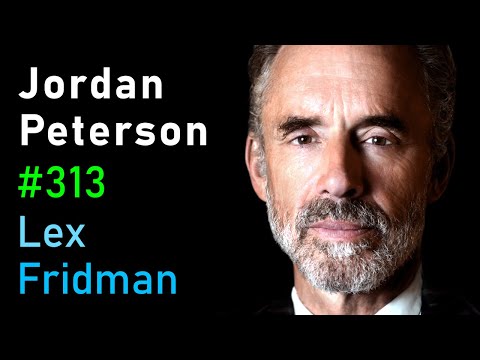
Jordan Peterson: Life, Death, Power, Fame, and Meaning | Lex Fridman Podcast #313
Lex Fridman (host), Jordan Peterson (guest), Lex Fridman (host)
In this episode of Lex Fridman Podcast, featuring Lex Fridman and Jordan Peterson, Jordan Peterson: Life, Death, Power, Fame, and Meaning | Lex Fridman Podcast #313 explores jordan Peterson and Lex Fridman Confront Suffering, Beauty, and Meaning Lex Fridman and Jordan Peterson explore how beauty, faith, suffering, and responsibility shape a meaningful life, using religious symbolism, philosophy, and personal experience as recurring anchors.
Jordan Peterson and Lex Fridman Confront Suffering, Beauty, and Meaning
Lex Fridman and Jordan Peterson explore how beauty, faith, suffering, and responsibility shape a meaningful life, using religious symbolism, philosophy, and personal experience as recurring anchors.
Peterson argues that beauty is a “terrible” but essential pointer to the divine, that true science and genuine ethics both require humility before transcendent reality, and that voluntary confrontation with death, hell, and chaos is psychologically transformative.
They examine fame, power, and political leadership, discussing how fear, ideology, and technological arrogance can corrupt individuals and societies, using examples from environmental policy, totalitarian regimes, Ukraine, and contemporary culture wars.
The conversation closes with practical advice: start by ordering your immediate world, take on responsibility, become the kind of person others would want to love, and treat life itself as a radical, loving commitment rather than a purely cynical truth-seeking exercise.
Key Takeaways
Treat beauty and awe as signals, not decorations.
Peterson maintains that profound beauty—cathedrals, great paintings, masterworks—functions like the burning bush: it unites form and transformative fire and points beyond itself toward the divine and to ideals worth emulating.
Get the full analysis with uListen AI
Define God as the highest pattern you strive to imitate.
Instead of a purely propositional deity, Peterson frames God psychologically as the distilled pattern of all that we truly admire and aim to emulate; your real ‘god’ is the ultimate axiom guiding your choices, whether or not you name it religiously.
Get the full analysis with uListen AI
Voluntary confrontation with suffering is transformative; avoidance is corrosive.
Using the crucifixion and ‘descent into hell’ as a psychological model, Peterson argues that redemptive growth requires willingly facing death, tragedy, and your own capacity for evil, rather than being passively traumatized or numbed by them.
Get the full analysis with uListen AI
Humility before what you don’t know is central to both science and ethics.
He claims authentic science rests on faith in a corrective transcendent reality—valuing disconfirming evidence above your theory—and that ideological certainty, whether in technocracy or politics, signals dangerous hubris rather than rigor.
Get the full analysis with uListen AI
Ideological ‘solutions’ that use fear and compulsion are red flags.
Peterson’s critique of climate policy, famine risk, and certain environmental movements centers on this principle: if confronting a ‘dragon’ turns leaders into terrified tyrants willing to sacrifice the poor now for hypothetical future gains, they are not trustworthy guides.
Get the full analysis with uListen AI
Build meaning from the ground up by ordering what’s nearest to you.
His practical method for depression and aimlessness begins with extremely small, concrete acts—cleaning a drawer, making your bed, fixing one daily interaction—and letting modest, repeatable wins aggregate into large life change.
Get the full analysis with uListen AI
Become the ‘ideal date’ rather than hunting for an ideal partner.
On relationships, Peterson flips the usual question: instead of asking how to find the perfect partner, focus on becoming a disciplined, honest, attentive, playful person others would naturally want to be with; many romantic problems dissolve at that deeper level.
Get the full analysis with uListen AI
Notable Quotes
“If you gaze into the abyss long enough, you see the light, not the darkness.”
— Jordan Peterson
“Beauty is a terrible pointer to God.”
— Jordan Peterson
“You create the world by the way you live it.”
— Jordan Peterson
“The line dividing good and evil cuts through the heart of every human being.”
— Aleksandr Solzhenitsyn, quoted and discussed by Lex Fridman and Jordan Peterson
“The highest value is love and truth is its handmaiden.”
— Jordan Peterson
Questions Answered in This Episode
If ‘God’ is the pattern of what we most admire and imitate, how should secular and religious people rethink their deepest commitments and daily habits?
Lex Fridman and Jordan Peterson explore how beauty, faith, suffering, and responsibility shape a meaningful life, using religious symbolism, philosophy, and personal experience as recurring anchors.
Get the full analysis with uListen AI
Where is the line between courageous confrontation of suffering and self-destructive immersion in darkness, especially for people drawn to ‘stare into the abyss’?
Peterson argues that beauty is a “terrible” but essential pointer to the divine, that true science and genuine ethics both require humility before transcendent reality, and that voluntary confrontation with death, hell, and chaos is psychologically transformative.
Get the full analysis with uListen AI
How can societies design environmental and technological policies that are ambitious and precautionary without becoming authoritarian or sacrificing the vulnerable?
They examine fame, power, and political leadership, discussing how fear, ideology, and technological arrogance can corrupt individuals and societies, using examples from environmental policy, totalitarian regimes, Ukraine, and contemporary culture wars.
Get the full analysis with uListen AI
In practical terms, what does it look like to voluntarily ‘descend into hell’ in one’s own life without being overwhelmed or traumatized?
The conversation closes with practical advice: start by ordering your immediate world, take on responsibility, become the kind of person others would want to love, and treat life itself as a radical, loving commitment rather than a purely cynical truth-seeking exercise.
Get the full analysis with uListen AI
How much of who we become is determined by our small, repeated five‑minute choices versus our big life decisions and external circumstances?
Get the full analysis with uListen AI
Transcript Preview
Battle not with monsters, lest ye become a monster.
Yeah.
And if you gaze into the abyss, the abyss gazes also into you.
Right. But I would say, bring it on. If you gaze into the abyss long enough, you see the light, not the darkness.
Are you sure about that?
I'm betting my life on it.
The following is a conversation with Jordan Peterson, an influential psychologist, lecturer, podcast host, and author of Maps of Meaning, 12 Rules for Life, and Beyond Order. This is the Lex Fridman Podcast. To support it, please check out our sponsors in the description and now, dear friends, here's Jordan Peterson. Dostoevsky wrote in The Idiot, spoken through the character of Prince Myshkin, that beauty will save the world. Solzhenitsyn actually mentioned this in his, uh, Nobel Prize-
Mm-hmm.
... acceptance speech. What do you think, uh, Dostoevsky meant by that? Was he right?
Well, I guess it's the divine that saves the world, let's say. You could say that by definition, and then you might say, well, are there pointers to that which will save the world or that which eternally saves the world? And the answer to that, in all likelihood is yes, and that's maybe truth and love and justice and the classical virtues. Beauty, perhaps in some sense, foremost among them. It's a, that's a difficult case to make, but definitely a pointer.
Which direction is the arrow pointing?
Well, the arrow's pointing up, and no, I think that that which it points to is what beauty points to. It transcends beauty. It's more than beauty.
And that speaks to the divine?
It points to the divine. Yeah, and I would say, again, by definition, 'cause we could define the divine in some real sense. So one way of defining the divine is what is divine to you is your most fundamental axiom? And you might say, "Well, I don't have a fundamental axiom." Then I would say, "That's fine, but then you're just confused 'cause you have a bunch of contradictory axioms." And you might say, "Well, I have no axioms at all." And then I'd say, "Well, you're just epistemologically ignorant beyond comprehension if you think that 'cause that's just not true at all."
So you don't think a human being can exist within contradictions?
Well, yeah. We have to exist within contradiction, but when the contradictions make themselves manifest, say, in confusion with regard to direction, then the consequence of that technically is anxiety and frustration and disappointment and all sorts of other negative emotions. But the cardinal negative emotion signifying multiple pathways forward is anxiety. It's an entropy signal.
But you don't think that kind of, uh, entropy signal can be channeled into, into beauty, into love? Why does beauty and love have to be clear, ordered, simple?
Well, I would say it probably doesn't have to be... It can't be reduced to clarity and simplicity, because when it's optimally structured, it's a balance between order and chaos, not order itself. If it's too ordered, if music is too ordered, it's not, it's not acceptable. It sounds like a drum machine. It's too repetitive. It's too predictable. It, it has to have, well, it has to have some fire in it-
Install uListen to search the full transcript and get AI-powered insights
Get Full TranscriptGet more from every podcast
AI summaries, searchable transcripts, and fact-checking. Free forever.
Add to Chrome