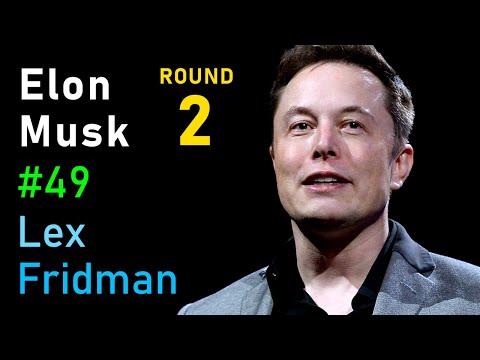
Elon Musk: Neuralink, AI, Autopilot, and the Pale Blue Dot | Lex Fridman Podcast #49
Lex Fridman (host), Elon Musk (guest), Narrator
In this episode of Lex Fridman Podcast, featuring Lex Fridman and Elon Musk, Elon Musk: Neuralink, AI, Autopilot, and the Pale Blue Dot | Lex Fridman Podcast #49 explores elon Musk on Neuralink, AI Safety, Tesla Autonomy, and Humanity’s Future Elon Musk and Lex Fridman discuss consciousness, artificial intelligence, and the risks and opportunities of digital superintelligence. Musk argues that AI will surpass human intelligence and stresses the urgent need for serious AI safety research and regulation. A major focus is Neuralink: its near‑term goal of treating brain and spinal disorders and its long‑term ambition to create a high‑bandwidth brain–computer interface that could let humans “merge” with AI. They close with reflections on Tesla Autopilot as a real‑world robotics experiment and on humanity’s fragile place in the cosmos, invoking Carl Sagan’s “pale blue dot.”
Elon Musk on Neuralink, AI Safety, Tesla Autonomy, and Humanity’s Future
Elon Musk and Lex Fridman discuss consciousness, artificial intelligence, and the risks and opportunities of digital superintelligence. Musk argues that AI will surpass human intelligence and stresses the urgent need for serious AI safety research and regulation. A major focus is Neuralink: its near‑term goal of treating brain and spinal disorders and its long‑term ambition to create a high‑bandwidth brain–computer interface that could let humans “merge” with AI. They close with reflections on Tesla Autopilot as a real‑world robotics experiment and on humanity’s fragile place in the cosmos, invoking Carl Sagan’s “pale blue dot.”
Key Takeaways
AI will likely outthink humans in every domain and can simulate consciousness convincingly.
Musk believes digital intelligence will surpass human cognition and be able to mimic human‑like consciousness so well that, by scientific standards, we may have to treat it as effectively conscious.
Get the full analysis with uListen AI
AI safety and regulation are lagging dangerously behind AI capability development.
He argues for a dedicated government agency overseeing AI, analogous to the FAA or FDA, warning that regulation typically arrives only after disasters—an approach that may be catastrophic with superintelligent systems.
Get the full analysis with uListen AI
Neuralink’s near‑term impact is therapeutic: treating serious brain and spinal conditions.
By reading from and stimulating individual neurons with high‑precision, long‑lasting electrodes, Neuralink aims to restore motor control, mitigate memory loss, and address conditions like stroke damage or spinal cord injuries.
Get the full analysis with uListen AI
In brain–machine interfaces, machines must adapt far more to the brain than vice versa.
Musk stresses that biological plasticity is limited compared to machine malleability, so most of the “learning” and protocol-finding will have to happen on the AI side to integrate smoothly with neural activity.
Get the full analysis with uListen AI
A high‑bandwidth brain–computer interface could become a “tertiary layer” of human cognition.
Building on the limbic system (primary) and cortex (secondary), Musk envisions a digital superintelligence layer that is vastly smarter yet can coexist benignly with our existing brain structures, potentially reducing AI existential risk.
Get the full analysis with uListen AI
Tesla Autopilot is both a convenience feature and a public introduction to robotics.
Features like Smart Summon expose the general public to real autonomous systems at scale, revealing both the promise and current limitations of AI while incrementally improving safety (for example, precise lane‑keeping and stop‑and‑go driving).
Get the full analysis with uListen AI
Human civilization is fragile and time‑bounded, strengthening the case for becoming multi‑planetary.
Reflecting on Sagan’s “pale blue dot,” Musk notes how close we may have come to never evolving consciousness at all, and argues that extending life to Mars and beyond is crucial insurance against civilizational collapse or planetary catastrophe.
Get the full analysis with uListen AI
Notable Quotes
“If you cannot test a hypothesis, then you cannot reach meaningful conclusion that it is true.”
— Elon Musk
“We are headed towards a future where an AI will be able to outthink us in every way. The answer is unequivocally yes.”
— Elon Musk
“From the aspect of the scientific method, it might as well be consciousness if we can simulate it perfectly.”
— Elon Musk
“If you cannot beat ’em, join ’em.”
— Elon Musk (on merging with AI via Neuralink)
“People generally like the fact that they have a limbic system and a cortex. I haven’t met anyone who wants to delete either one of them.”
— Elon Musk
Questions Answered in This Episode
If AI can perfectly simulate consciousness, should we grant it moral consideration and rights, and by what criteria?
Elon Musk and Lex Fridman discuss consciousness, artificial intelligence, and the risks and opportunities of digital superintelligence. ...
Get the full analysis with uListen AI
What specific forms of AI regulation could be both effective and fast‑moving enough to keep pace with private sector innovation?
Get the full analysis with uListen AI
How do we ethically balance Neuralink’s medical applications with its long‑term goal of cognitive enhancement and human–AI merging?
Get the full analysis with uListen AI
Could a tertiary digital layer of intelligence ever dominate or suppress the limbic and cortical layers despite initial benign design intentions?
Get the full analysis with uListen AI
In what concrete ways should the “pale blue dot” perspective reshape policy decisions about space exploration, climate, and global risk?
Get the full analysis with uListen AI
Transcript Preview
The following is a conversation with Elon Musk, part two. The second time we spoke on the podcast, with parallels, if not in quality, then in outfit, to the objectively speaking, greatest sequel of all time, Godfather Part II. As many people know, Elon Musk is a leader of Tesla, SpaceX, Neuralink, and The Boring Company. What may be less known is that he's a world-class engineer and designer, constantly emphasizing first principles thinking in taking on big engineering problems that many before him would consider impossible. As scientists and engineers, most of us don't question the way things are done. We simply follow the momentum of the crowd. But revolutionary ideas that change the world on the small and large scales happen when you return to the fundamentals and ask, "Is there a better way?" This conversation focuses on the incredible engineering and innovation done in brain computer interfaces at Neuralink. This work promises to help treat neurobiological diseases, to help us further understand the connection between the individual neuron to the high level of function of the human brain, and finally, to one day expand the capacity of the brain through two-way communication with computational devices, the internet, and artificial intelligence systems. This is the Artificial Intelligence Podcast. If you enjoy it, subscribe by YouTube, Apple Podcasts, Spotify, support on Patreon, or simply connect with me on Twitter, @lexfridman, spelled F-R-I-D-M-A-N. And now, as an anonymous YouTube commenter referred to our previous conversation, as the, quote, "Historical first video of two robots conversing without supervision," here's the second time, the second conversation with Elon Musk. Let's start with a easy question about consciousness. In your view, is consciousness something that's unique to humans, or is it something that permeates all matter, almost like a fundamental force of physics?
I don't think consciousness permeates all matter.
Panpsychists believe that.
Yeah.
There's a philosophical...
How would you tell? (laughs)
(laughs) That's true. That's a good point.
I believe in scientific method. I don't want to blow your mind or anything, but the scientific method is like, if you cannot test a hypothesis, then you cannot reach meaningful conclusion that it is true.
Do you think consciousness, understanding consciousness, is within the reach of science, of the scientific method?
We can dramatically improve our understanding of consciousness. You know, I would be hard-pressed to say that we understand anything with complete accuracy, but can we dramatically improve our understanding of consciousness? I believe the answer is yes.
Does an AI system, in your view, have to have consciousness in order to achieve human level or superhuman level intelligence? Does it need to have some of these human qualities like consciousness, maybe a body, maybe a fear of mortality, capacity to love, those kinds of silly human things?
(sighs) E- b- there's- it's- it's different... O- o- you know, there's this- there's the scientific method, which I very much believe in, where something is true to the degree that it is testably so. And- and otherwise, you're really just talking about, you know, preferences or un- untestable beliefs or that, you know, that kind of thing. So ends up being somewhat of a semantic question, where we are conflating a lot of things with the word intelligence. If we parse them out and say, you know, w- o- are we headed, uh, towards the future where an AI will be able to outthink us in every way? Then the answer is unequivocally yes.
Install uListen to search the full transcript and get AI-powered insights
Get Full TranscriptGet more from every podcast
AI summaries, searchable transcripts, and fact-checking. Free forever.
Add to Chrome