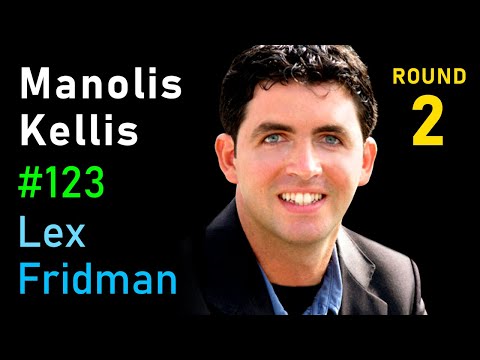
Manolis Kellis: Origin of Life, Humans, Ideas, Suffering, and Happiness | Lex Fridman Podcast #123
Lex Fridman (host), Manolis Kellis (guest), Narrator, Narrator
In this episode of Lex Fridman Podcast, featuring Lex Fridman and Manolis Kellis, Manolis Kellis: Origin of Life, Humans, Ideas, Suffering, and Happiness | Lex Fridman Podcast #123 explores from Cosmic Origins to Human Meaning: Manolis Kellis on Life Lex Fridman and Manolis Kellis range from the molecular architecture of life to the psychology and philosophy of being human. They discuss the genome and epigenome, evolutionary history, the likelihood and nature of alien life, and grand transitions in biology such as multicellularity, brains, and human civilization.
From Cosmic Origins to Human Meaning: Manolis Kellis on Life
Lex Fridman and Manolis Kellis range from the molecular architecture of life to the psychology and philosophy of being human. They discuss the genome and epigenome, evolutionary history, the likelihood and nature of alien life, and grand transitions in biology such as multicellularity, brains, and human civilization.
The conversation then shifts to timescales, mortality, interstellar futures, and what it means to truly live a human life rather than just run the “rat race.”
Kellis reflects on suffering, tragedy, love, passion, midlife crisis, and growth, arguing that embracing the full emotional spectrum—including pain and failure—is essential to meaning.
They close by discussing mentorship, academia, kindness, and two of Kellis’s teenage poems about love and goodbyes, tying scientific insight back to deeply personal human experience.
Key Takeaways
The epigenome is both a compression system and a conductor of cellular identity.
Kellis explains that the epigenome compacts two meters of DNA into each cell nucleus while also acting like a musical score and conductor, determining which subset of the 20,000 genes each cell will express to define its function.
Get the full analysis with uListen AI
Evolution operates across many hierarchical levels, not just individual organisms.
Selection acts on nucleotides, genes, cells, organs, organisms, and entire ecosystems; traits like altruism and cooperation likely evolved because groups and species that cooperated outcompeted those that didn’t, shaping our social instincts and tribalism.
Get the full analysis with uListen AI
Life is best defined as a self-reinforcing process that fights physics.
For Kellis, life begins when metabolic, compartmentalized, self-reinforcing systems (e. ...
Get the full analysis with uListen AI
Intelligence and life elsewhere may look nothing like ours, yet be discoverable.
He argues life on places like Europa is likely, and would be detectable by its non-random, physics-defying chemical and structural signatures—even if it’s non-DNA-based and unable to infect or compete with Earth life due to radically different environments.
Get the full analysis with uListen AI
The brain is a new layer that can override evolutionary programming.
Just as life supersedes physics, the human brain can supersede biology—it can choose not to reproduce, not to eat, or even to end life, demonstrating that our cognitive layer can intentionally oppose evolutionary imperatives.
Get the full analysis with uListen AI
Meaning comes from the journey, struggle, and fulfillment—not constant happiness.
Kellis criticizes a culture obsessed with happy endings and argues that embracing tragedy, failure, and emotional pain broadens our emotional range and makes us more complete; the goal is fulfillment and meaningful struggle, not perpetual joy.
Get the full analysis with uListen AI
Letting go of the rat race requires redefining goals and identity.
After achieving traditional academic milestones, Kellis experienced a midlife crisis and realized he wasn’t a “rat” in a maze; he now treats life as an “all-inclusive resort” of chosen challenges, focuses on long-term, unfinishable goals, and anchors his identity in values (kindness, curiosity, love) rather than metrics or status.
Get the full analysis with uListen AI
Notable Quotes
“Life challenges physics. It supersedes physics. It sort of fights against physics.”
— Manolis Kellis
“The brain supersedes life. We have a brain that can decide to not follow evolution's path.”
— Manolis Kellis
“Life is not about maximizing happiness. Life is about accomplishing something meaningful, and accomplishing that cannot come from a series of joyful moments.”
— Manolis Kellis
“If you know who you are, what other people say about you only teaches you about them.”
— Manolis Kellis
“Live every day as if it’s your last one, and make plans as if you’ll never die.”
— Manolis Kellis
Questions Answered in This Episode
How might redefining life as “fighting physics” change how we search for and recognize alien life?
Lex Fridman and Manolis Kellis range from the molecular architecture of life to the psychology and philosophy of being human. ...
Get the full analysis with uListen AI
If the brain can intentionally override evolutionary drives, what responsibilities does that give us in shaping our own future and our species’ trajectory?
The conversation then shifts to timescales, mortality, interstellar futures, and what it means to truly live a human life rather than just run the “rat race.”
Get the full analysis with uListen AI
How can individuals practically shift from a “rat race” mentality to a journey-focused life without abandoning ambition or excellence?
Kellis reflects on suffering, tragedy, love, passion, midlife crisis, and growth, arguing that embracing the full emotional spectrum—including pain and failure—is essential to meaning.
Get the full analysis with uListen AI
To what extent should we deliberately expose children—and ourselves—to tragedy and sadness to build emotional range and resilience?
They close by discussing mentorship, academia, kindness, and two of Kellis’s teenage poems about love and goodbyes, tying scientific insight back to deeply personal human experience.
Get the full analysis with uListen AI
How might extending human lifespan to centuries transform our sense of meaning, our relationships, and our willingness to undertake multi-generational projects like interstellar travel?
Get the full analysis with uListen AI
Transcript Preview
The following is a conversation with Manolis Kellis, his second time on the podcast. He's a professor at MIT and head of the MIT Computational Biology Group. He's one of the most brilliant, productive, and kind people I've had the fortune of talking to. A lot of my colleagues at MIT and former MIT faculty and students wrote to me after our first conversation with some version of, "Manolis is awesome, isn't he? I'm glad you guys are now friends." I am too, and I'm happy that he makes time in his insanely busy schedule to sit down and have a chat with me. Quick summary of the sponsors: Public Goods, Magic Spoon, and ExpressVPN. Please check out these sponsors in the description to get a discount and to support this podcast. As a side note, let me say that I just got back from talking to Joe Rogan on his podcast, my fifth time on there. I also got a chance to record a separate conversation with Joe on this podcast. We talked on both quite a bit about his journey and his advice for mine. One of the things that I think made his show special is that he just had fun and made choices that didn't get in the way of him having fun and loving life. I'm learning to do just that. It's tough since I'm naturally full of self-doubt and anxiety, but I'm learning to let go and have fun, even if my monotone, robotic voice sometimes sounds otherwise. (laughs) For Joe, that involved talking to his friends, comedians, especially ones that brought out the best in him. Duncan Trussell and the five-hour first episode on Spotify comes to mind as an example of that. Duncan has been a guest probably close to if not more than 50 times on Joe's podcast. My hope with amazing people like Manolis is to find my Duncan Trussell, my Joey Diaz, and yes, even my Eddie Bravo. Obviously, Joe and I are very different people, but ultimately both love life when we can interact often with people we love and who inspire us, make us smile, make us think, and make us have fun when we get behind the mic of a podcast, whether anyone is listening or not. If you enjoy this thing, subscribe on YouTube, review it with five stars on Apple Podcast, follow on Spotify, support on Patreon, or connect with me on Twitter @lexfridman. I also this time put a link in the description to a survey for this podcast on how I can improve and also an option if you like, I don't know why you would like to, but if you like to join an inner circle of people that help guide the direction of this podcast via email or occasional video chats. If you have a few minutes, please fill it out. As usual, I'll do a few minutes of ads now and no ads in the middle. I try to make these interesting, but I give you timestamps so you can skip. But still, please do check out the sponsors by clicking the links in the description. It's the best way, honestly, to support this podcast. This show is sponsored by Public Goods, an online store for basic health and household stuff. Their products have a minimalist black and white design that I find to be just clean, elegant, and beautiful. It goes nicely, at least I think so, with the design of Crew Dragon and the recent SpaceX NASA mission that sent two humans into space. To me, very few things are as inspiring as us humans reaching out into the unknown, the harsh challenges of space. Colonizing Mars may not have obvious near-term benefits, but I believe it will challenge our scientists and our engineers to create technologies whose impact will be immeasurable for us humans here on Earth, or those of us who, uh, choose to stay here on Earth. Personally, I'm kind of a longtime big fan of this planet. (laughs) Anyway, visit, uh, publicgoods.com/lex and use code LEX at checkout to get 15 bucks off your first order. This episode is also supported by Magic Spoon, low-carb, keto-friendly cereal. You might have heard on other videos that I eat keto mostly these days, so Magic Spoon is a delicious healthy treat on a hard workout day that fits into that crazy diet. Also, they're a sponsor of Episode 100 with my dad and got my dad to buy this cereal, and he now loves it, honestly just loves it. It's kind of funny actually. The deep heartfelt nature of that conversation and the silliness of the cereal captures my dad perfectly. Much of the hardship in his life he dealt with using wit and humor. His favorite flavor happens to be cocoa. Mine is too. He hasn't bought the Eight Sleep mattress yet, though my mom wants to, but he's all about this Magic Spoon cereal. I think it's his actually favorite sponsor of this podcast, probably because they chose to sponsor the episode he's on. Anyway, click the magic spoon.com/lex link in the description and use code LEX at checkout for free shipping, to let them know I sent you, and also indirectly to make my dad happy. This show is also sponsored by ExpressVPN. Get it at expressvpn.com/lexpod. They gave me a suggested opening line of, "Using the internet without ExpressVPN is like going to the bathroom and not closing the door." This is like GPT-3 suggesting to me how to be more human-like, and I'll honestly take all the help I can get. By way of life advice, let me tell you that you need a VPN to protect you from Russians like me. In fact, this podcast is a kind of hack of your biological network where I use my monotone, low-energy voice to convince you to buy a kind of expensive cereal as a way to influence the stability of the US economy. I use ExpressVPN on both Windows and Linux to protect myself if I ever do shady things on the internet, which of course I never do and never will.So, secure your online activity by going to expressvpn.com/lexpod to get a extra three months free, and to support this podcast. And now, here's my conversation with Manolis Kellis. What is beautiful about the human epigenome?
Install uListen to search the full transcript and get AI-powered insights
Get Full TranscriptGet more from every podcast
AI summaries, searchable transcripts, and fact-checking. Free forever.
Add to Chrome