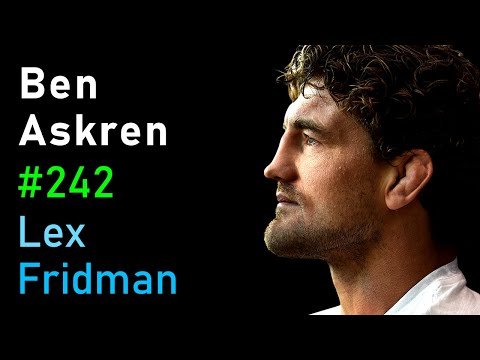
Ben Askren: Wrestling and MMA | Lex Fridman Podcast #242
Lex Fridman (host), Ben Askren (guest)
In this episode of Lex Fridman Podcast, featuring Lex Fridman and Ben Askren, Ben Askren: Wrestling and MMA | Lex Fridman Podcast #242 explores ben Askren on Wrestling Mastery, Losing, Khabib, and Bitcoin’s Future Ben Askren talks with Lex Fridman about his dominant wrestling and MMA career, including his run in Bellator and ONE Championship, and the psychology behind both winning and losing. He breaks down his fights with Jake Paul and Jorge Masvidal, explaining why those losses don’t define him and how he evaluates risk, money, and legacy. They dive deep into wrestling technique, training methodology, and talent development, including stories about Jordan Burroughs, Kyle Dake, Dagestani wrestling, and how to build great athletes. Askren also discusses crypto, why Bitcoin’s philosophy appealed to him as an ‘end the Fed’ guy, and how lessons from wrestling translate into broader life advice.
Ben Askren on Wrestling Mastery, Losing, Khabib, and Bitcoin’s Future
Ben Askren talks with Lex Fridman about his dominant wrestling and MMA career, including his run in Bellator and ONE Championship, and the psychology behind both winning and losing. He breaks down his fights with Jake Paul and Jorge Masvidal, explaining why those losses don’t define him and how he evaluates risk, money, and legacy. They dive deep into wrestling technique, training methodology, and talent development, including stories about Jordan Burroughs, Kyle Dake, Dagestani wrestling, and how to build great athletes. Askren also discusses crypto, why Bitcoin’s philosophy appealed to him as an ‘end the Fed’ guy, and how lessons from wrestling translate into broader life advice.
Key Takeaways
Treat single data points in performance as incomplete evidence.
Askren refuses to over-interpret one fight (like Jake–Woodley or Masvidal–Askren) as definitive; he stresses that one outcome doesn’t fully represent who is better over many iterations, or what would happen in rematches.
Get the full analysis with uListen AI
You can hate losing and still actively seek hard challenges.
He describes a lifelong balance: despising defeat but intentionally chasing tougher opponents and bigger tests, especially in youth, as the only way to reach true potential.
Get the full analysis with uListen AI
Technical evolution and curiosity keep champions at the top.
Using Jordan Burroughs as an example, Askren shows how constant reinvention—adding new attacks, refining hand fighting, improving defense—is driven by inquisitiveness, not just hard work or athleticism.
Get the full analysis with uListen AI
Training must move beyond basic drilling into structured sparring.
He outlines four phases—teaching, drilling, sparring, and live—and argues that past a basic proficiency, gains come from controlled resistance and situational sparring that force athletes to solve real problems, not from endless rote reps.
Get the full analysis with uListen AI
Styles and rule sets deeply shape how ‘greatness’ looks.
Askren notes that some athletes (e. ...
Get the full analysis with uListen AI
Wrestling’s structure builds skills that transfer directly to life and MMA.
He credits wrestling with instilling punctuality, work ethic, comfort with competition, and handling weight cuts—advantages that help wrestlers dominate in MMA and navigate adult responsibilities.
Get the full analysis with uListen AI
Bitcoin’s core value is distrust of centralized power, not quick profit.
Askren was drawn to crypto through ‘End the Fed’ thinking and sees Bitcoin as a solution for inflation, remittances, and the unbanked, particularly outside the U. ...
Get the full analysis with uListen AI
Notable Quotes
“He got me with one move. It’s not like he beat me.”
— Ben Askren (on the Masvidal flying-knee loss)
“You have to balance hating to lose with seeking out challenges.”
— Ben Askren
“If someone wins a world medal, of course we want that person on the team again—that’s why the system is built to reward them.”
— Ben Askren (on USA Wrestling’s trials structure)
“If I didn’t prove I was one of the greatest, I don’t deserve to be in that conversation. I know what I was, and I’m good with that.”
— Ben Askren (on GOAT talks in MMA)
“Who do you trust more with your money: politicians or engineers?”
— Ben Askren (on why Bitcoin appeals to him)
Questions Answered in This Episode
If Askren had entered the UFC in 2013, how differently might his legacy and the welterweight division’s history look?
Ben Askren talks with Lex Fridman about his dominant wrestling and MMA career, including his run in Bellator and ONE Championship, and the psychology behind both winning and losing. ...
Get the full analysis with uListen AI
How much of elite success in wrestling is talent versus the kind of obsessive, creative problem-solving Askren describes with ‘figures wrestling in his head’?
Get the full analysis with uListen AI
Could a truly high-level jiu-jitsu athlete who fully commits to wrestling ever match the transfer success wrestlers have had into jiu-jitsu and MMA?
Get the full analysis with uListen AI
What would a realistic ‘Askren Challenge’ series reveal about what actually matters most in long-duration wrestling: cardio, tactics, or pinning skill?
Get the full analysis with uListen AI
In practice, how should a young athlete or coach decide the right mix of drilling, sparring, and live work to maximize long-term development without burnout or injury?
Get the full analysis with uListen AI
Transcript Preview
The following is a conversation with Ben Askren, wrestler, MMA fighter, and a brilliant, opinionated, and fun personality in the world of martial arts. And yes, he occasionally likes to talk a little trash. Given his wild online antics and his boxing match with Jake Paul, some people may forget just how dominant he was in the sport of wrestling and in MMA for most of his career. In wrestling, he is a two-time NCAA Division I national champion and four-time finalist. In mixed martial arts, he went undefeated for 10 years with a record of 19 and 0 before losing to Jorge Masvidal with a flying knee that caught everyone by surprise. He's also into cryptocurrency, disc golf, and is the co-host of Flow Wrestling Radio Live. This is the Lex Fridman Podcast. To support it, please check out our sponsors in the description, and now here's my conversation with Ben Askren. Before we talk about your incredible wrestling career, your MMA career, let me ask you. I have to ask you. What did you think about the Jake Paul versus Tyron Woodley fight?
Uh, well, I thought... I mean, I'm obviously biased. I thought Tyron won. Um, I had five rounds of three. A- and again, this, maybe this is my bias in the way I was seeing it. I thought he was more effective with the striking and he was more aggressive and that Jake had more volume, um, but that was the only, like, thing I would give him, and I guess a lot of people just didn't see it that way. They thought he landed more, significantly more punches. I just didn't think any of them really did any damage.
It was a split decision.
Split decision, yeah. Mm-hmm.
Were you surprised?
Um, well, here's the thing with this. So the thing I said when I went in to fight him, I said, "We don't really... Maybe he's good, maybe he's not. We have no i-... We really have no idea to this point," you know? And so I knew Tyron was a lot better at boxing than I was, and so I thought, "Okay, Tyron's... There's definitely is a good likelihood that Tyron beats him up. Um, but there's a chance that Jake's kind of good at this." And I think that's kind of what played out, is he's kind of good at it, even if you saw it the way I saw it. He still was impressive in his showing and he's obviously put a lot of time into it, so he's, he's not bad (laughs) . We'll say it that much, you know?
But isn't it surprising to you that, like, a elite level athlete, combat athlete-
Mm-hmm.
... lost to somebody who just takes it really seriously, but is nevertheless not elite level?
Um, hmm. But, but I think boxing's a really specific rule set. Uh, so I'll speak about Tyron now myself. Tyron had, had good striking, but the... obviously, it was his first boxing match ever. Um, and within mixed martial arts, you have the, the fear of the take-down and the fear of the kick and fear of other things to go along with the punching. And so if you look at Tyron throughout his MMA career lots of times, what set up his punches were, like, level change fakes and a take-down. They dropped, boom, and then something comes over the top, right?
Install uListen to search the full transcript and get AI-powered insights
Get Full TranscriptGet more from every podcast
AI summaries, searchable transcripts, and fact-checking. Free forever.
Add to Chrome