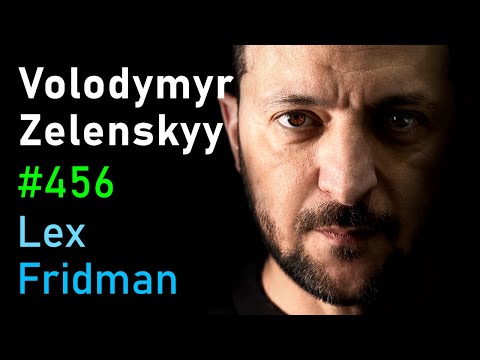
Volodymyr Zelenskyy: Ukraine, War, Peace, Putin, Trump, NATO, and Freedom | Lex Fridman Podcast #456
Lex Fridman (host), Volodymyr Zelenskyy (guest), Lex Fridman (English voice-over / interpreter) (host), Lex Fridman (English monologue segment) (host)
In this episode of Lex Fridman Podcast, featuring Lex Fridman and Volodymyr Zelenskyy, Volodymyr Zelenskyy: Ukraine, War, Peace, Putin, Trump, NATO, and Freedom | Lex Fridman Podcast #456 explores zelenskyy and Fridman debate war, peace, Trump, Putin, NATO, future Lex Fridman interviews Ukrainian President Volodymyr Zelenskyy in Kyiv about Russia’s invasion, the human cost of war, paths to peace, and Ukraine’s political future. They dive deeply into ceasefire scenarios involving Donald Trump and Vladimir Putin, the role of NATO and U.S. security guarantees, and why Zelenskyy believes strength must precede any negotiations. Zelenskyy defends Ukraine’s record on corruption and aid usage, pushes back on Russian propaganda, and explains how language, history, and personal loss shape his stance. The episode is framed by Lex’s reflections on language, translation, and his goal of using conversations—even with adversaries—to push toward peace.
Zelenskyy and Fridman debate war, peace, Trump, Putin, NATO, future
Lex Fridman interviews Ukrainian President Volodymyr Zelenskyy in Kyiv about Russia’s invasion, the human cost of war, paths to peace, and Ukraine’s political future. They dive deeply into ceasefire scenarios involving Donald Trump and Vladimir Putin, the role of NATO and U.S. security guarantees, and why Zelenskyy believes strength must precede any negotiations. Zelenskyy defends Ukraine’s record on corruption and aid usage, pushes back on Russian propaganda, and explains how language, history, and personal loss shape his stance. The episode is framed by Lex’s reflections on language, translation, and his goal of using conversations—even with adversaries—to push toward peace.
Key Takeaways
Zelenskyy insists any ceasefire must follow Ukrainian strength and real security guarantees, not precede them.
Drawing on failed past agreements (Normandy, Minsk, 2019 ceasefire), he argues that a quick ceasefire without NATO or equivalent guarantees would simply give Putin time to rearm and launch a larger, deadlier war later.
Get the full analysis with uListen AI
He views NATO membership—at least for currently Kyiv-controlled territory—as the most credible security guarantee.
Zelenskyy is open to partial NATO coverage (Ukraine minus occupied regions) as a pragmatic step, saying NATO membership would deter renewed Russian aggression and simultaneously constrain Ukrainian retaliation.
Get the full analysis with uListen AI
Zelenskyy supports Trump-led peace efforts but warns against trusting Putin’s intentions.
He says Trump has the power and leverage to pressure Putin to stop the war but calls it “naive” to expect Putin to want peace; in his view, only pressure and strength—not goodwill—will end the aggression.
Get the full analysis with uListen AI
Ukraine’s leadership frames corruption as a real but shrinking problem, with wartime aid mostly arriving as weapons, not cash.
Zelenskyy points to a dense anti-corruption architecture, prosecutions of oligarchs like Kolomoyskyi, and tight weapons controls; he also highlights Western logistical profiteering (expensive U. ...
Get the full analysis with uListen AI
Language has become a frontline of identity and resistance in Ukraine.
Although Russian is Zelenskyy’s native tongue, he insists on speaking mainly Ukrainian as a symbolic rejection of Russia’s claim to be defending Russian speakers, and to assert that Ukrainians are a separate nation, not “one people” with Russia.
Get the full analysis with uListen AI
Zelenskyy believes justice and memory—especially for killed civilians and children—make simple “forgive and forget” peace impossible.
He draws analogies to postwar Germany and argues that without accountability, reparations, and recognition of guilt, cycles of revenge and hatred will persist, regardless of formal ceasefires.
Get the full analysis with uListen AI
Postwar Ukraine’s strategy centers on digital government, energy and resource development, and deep Western investment.
He describes Ukraine’s advanced e-government (DIIA), plans for tax reform, and openness to U. ...
Get the full analysis with uListen AI
Notable Quotes
““Don’t rely on his will, Putin’s will, to stop. You won’t see it. Pressure him so that he is forced to stop the war.””
— Volodymyr Zelenskyy
““If we do not have security guarantees, Putin will come again.””
— Volodymyr Zelenskyy
““We want peace… but we cannot forgive those murderers who took our lives.””
— Volodymyr Zelenskyy
““This invasion was also at 4:00 in the morning. There were missile strikes on Ukraine. This is the same [as 1941].””
— Volodymyr Zelenskyy
““I’m simply a human being who seeks to find and surface the humanity in others.””
— Lex Fridman
Questions Answered in This Episode
Is Zelenskyy’s insistence on NATO or equivalent guarantees realistic, or does it risk prolonging the war by making negotiations harder?
Lex Fridman interviews Ukrainian President Volodymyr Zelenskyy in Kyiv about Russia’s invasion, the human cost of war, paths to peace, and Ukraine’s political future. ...
Get the full analysis with uListen AI
How should peace negotiators balance justice for war crimes and abducted children with the pragmatic need to stop the killing as soon as possible?
Get the full analysis with uListen AI
Could a Trump-mediated deal that excludes NATO membership but includes strong bilateral guarantees and sanctions triggers genuinely deter future Russian aggression?
Get the full analysis with uListen AI
To what extent is Western economic self-interest (e.g., logistics contracts, energy markets) shaping the narrative about Ukrainian corruption and aid usage?
Get the full analysis with uListen AI
After such deep trauma, what would meaningful reconciliation between ordinary Russians and Ukrainians look like in practice, if it is possible at all?
Get the full analysis with uListen AI
Transcript Preview
I hope the Kyiv airport will open soon. Then it will... It will be easier to fly in.
Yes. I think that the war will end and President Trump may be the first leader to travel here by airplane. I think it would be... It would be symbolic by airplane.
Again, January 25th, around that date, right?
(laughs)
Flying in-
Oh.
... meeting me at Air Force One.
That would be cool.
There is a perception of corruption. Uh, people like Donald Trump and Elon Musk really care, uh, about fighting corruption. Uh, what can you say to them to gain their trust that the money is going towards this fight for freedom, towards the war effort?
In most cases, we did not receive money, we received weapons. And where we saw risks, that something could be happening with weapons, we cracked down hard on everyone. And believe me, this is not only about Ukraine. Everywhere along the supply chain, there are some or other people and companies who wanna make money, they try to make money on the war. We did not profit from the war. If we caught someone, believe me, we cracked down hard on them. And, and we did that, we did that, and we will continue to do so because, because to this day, when someone says that Ukraine was selling weapons, and by the way, Russia was the one pushing this narrative, we always responded, "Our soldiers would kill such people with their own hands without any trial." Do you honestly think anyone could steal weapons by the truckload when we ourselves don't have enough on the front lines? And yet we have to provide proof to defend ourselves because when there's an abundance of such misinformation, distrust starts to grow. And you're right. People listen to various media outlets, see this, and lose faith in you. In the end, you lose trust, and with it, you lose support. Therefore, believe me, we are fighting more against disinformation than against particular cases. Although I still emphasize once again, at the everyday level, such things are still important. We catch these, these people, and we fight them. As if Putin wants to sit down and talk, but Ukraine does not. This is not true.
I think that, yes, he is in fact ready to talk.
Did you talk to him?
On the phone or what?
How do you normally talk to him?
I don't know. Normally by the sea. The same as with you. He invites you to the sea with me, just the three of us.
No, no, one of us may drown.
Who? Are you good at swimming?
Yes, I am a good swimmer.
You're a good swimmer. Well, if you think that the president of a country is completely crazy, it is really hard to come to an agreement with him. You have to look at him as a serious person who loves his country and loves the people in his country, and he conducts, yes, destructive military action.
Install uListen to search the full transcript and get AI-powered insights
Get Full TranscriptGet more from every podcast
AI summaries, searchable transcripts, and fact-checking. Free forever.
Add to Chrome