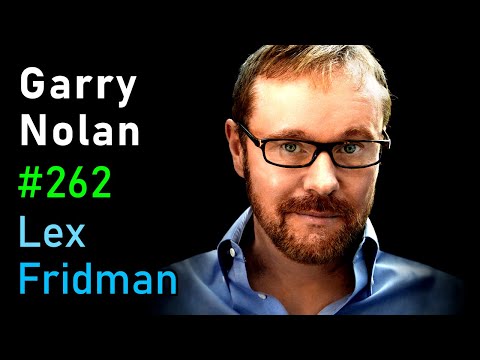
Garry Nolan: UFOs and Aliens | Lex Fridman Podcast #262
Garry Nolan (guest), Lex Fridman (host)
In this episode of Lex Fridman Podcast, featuring Garry Nolan and Lex Fridman, Garry Nolan: UFOs and Aliens | Lex Fridman Podcast #262 explores stanford scientist explores UFOs, alien contact, and human consciousness frontiers Garry Nolan, a Stanford professor and biotech entrepreneur, joins Lex Fridman to explore the intersection of rigorous biology, UFO phenomena, and the possibility of non-human intelligences. They discuss DNA and cells as computational systems, the likelihood and nature of alien civilizations, and how a superior intelligence might communicate with humans by manipulating perception rather than matter. Nolan reviews notable UFO cases, brain imaging of “experiencers,” anomalous materials, and government efforts to study UAPs, all while emphasizing skepticism, data, and scientific humility. The conversation closes with reflections on stigma in science, the value of pursuing anomalous data, and how recognizing we’re “not alone” might both humble and unite humanity.
Stanford scientist explores UFOs, alien contact, and human consciousness frontiers
Garry Nolan, a Stanford professor and biotech entrepreneur, joins Lex Fridman to explore the intersection of rigorous biology, UFO phenomena, and the possibility of non-human intelligences. They discuss DNA and cells as computational systems, the likelihood and nature of alien civilizations, and how a superior intelligence might communicate with humans by manipulating perception rather than matter. Nolan reviews notable UFO cases, brain imaging of “experiencers,” anomalous materials, and government efforts to study UAPs, all while emphasizing skepticism, data, and scientific humility. The conversation closes with reflections on stigma in science, the value of pursuing anomalous data, and how recognizing we’re “not alone” might both humble and unite humanity.
Key Takeaways
Treat DNA and cells as dynamic computers embedded in a computing universe.
Nolan argues that DNA isn’t just a static code but a layered, context-dependent computation that anticipates an environment; information about “who you become” is partly in DNA and partly in the world it expects, reframing biology as information processing within a computational cosmos.
Get the full analysis with uListen AI
Assume extraterrestrial life is abundant, but alien technology may be unrecognizable.
Given the scale of the universe, Nolan finds it improbable we’re alone, yet stresses that truly advanced civilizations might exist as information or ordered regions of spacetime, making their technologies and embodiments unlike anything we intuitively classify as “craft.”
Get the full analysis with uListen AI
UFO encounters may be controlled perturbations of human perception, not just hardware.
He highlights cases (e. ...
Get the full analysis with uListen AI
Anomalies should be treated as data, not proof—or dismissed outright.
From brain MRIs showing unusual basal ganglia connectivity in some high-functioning families to magnesium samples with odd isotope ratios, Nolan insists anomalies are “interesting data,” not conclusions, and that good science removes hyped cases while preserving genuine outliers for deeper study.
Get the full analysis with uListen AI
Scientific progress requires openness to taboo topics and resistance to shame.
Nolan describes being warned that studying UFOs would hurt his career, yet says it has expanded his network and impact; he frames shame as a social control mechanism that often blocks legitimate inquiry and urges young scientists to follow strong ideas despite establishment discomfort.
Get the full analysis with uListen AI
UAP transparency and systematic data collection are emerging but underfunded.
He sees recent U. ...
Get the full analysis with uListen AI
Recognizing non-human intelligence could be unifying and morally instructive.
Nolan believes evidence of something “else” watching or interacting with us could both humble humanity and highlight our shared identity relative to a larger cosmos, much like an island culture suddenly discovering other inhabited islands.
Get the full analysis with uListen AI
Notable Quotes
“If you ever wanted to believe in God, just look inside the cell.”
— Garry Nolan
“Speculation is just creativity. Speculation is the beginning of hypothesis.”
— Garry Nolan
“Somewhere in the rubble will be something interesting.”
— Garry Nolan
“Don’t talk about conclusions, just talk about the data.”
— Garry Nolan, recounting advice from Jacques Vallée
“It makes us both smaller but larger at the same time.”
— Garry Nolan
Questions Answered in This Episode
If advanced intelligences can directly manipulate human perception, what kinds of evidence would still be robust enough to convince us of their existence?
Garry Nolan, a Stanford professor and biotech entrepreneur, joins Lex Fridman to explore the intersection of rigorous biology, UFO phenomena, and the possibility of non-human intelligences. ...
Get the full analysis with uListen AI
How should scientists design studies and instruments to distinguish between internal psychological phenomena and externally induced anomalous experiences?
Get the full analysis with uListen AI
What ethical framework should guide governments if they possess transformative alien technology that could both revolutionize energy and be weaponized?
Get the full analysis with uListen AI
In what ways might treating biology and the universe as computational systems change how we approach medicine, AI, and the search for extraterrestrial life?
Get the full analysis with uListen AI
How can scientific institutions reduce stigma around fringe topics like UAPs while still filtering out pseudoscience and maintaining rigorous standards of proof?
Get the full analysis with uListen AI
Transcript Preview
... how would you, as a higher intelligence, represent yourself to a lesser intelligence?
Do you think they saw what they say they saw?
It didn't just start showing up in 1947.
How hard do you think it is for aliens to communicate with humans?
What do we believe in? We believe in technology. So you show yourself as a form of technology. Right? But the common thread is you're not alone and there's something else here with you and there's something that's, as you said, watching you.
You are a professor at Stanford studying the biology of the human organism at the level of individual cells. So let me ask first the big, ridiculous philosophical question. What is the most beautiful or fascinating aspect of human biology at the level of the cell to you?
The micromachines and the nanomachines that proteins make and become, that to me is the most interesting. The fact that you have this basically dynamic computer within every cell that's constantly processing its environment and at the heart of it is DNA, which is a dynamic machine, a dynamic computation process. People think of the DNA as a linear code. It's codes within codes within codes and it is the... Actually the epigenetic state that's doing this amazing processing. I mean if you ever wanted to believe in God, just look inside the cell.
So DNA is both information and computer?
Exactly.
How did that computer come about? A big... Continuing on the philosophical question, the... Is this both scientific and philosophical? How did life originate on Earth do you think? How did this at every level? So the very first step and the fascinating complex computer that is DNA, that is multicellular organism, and then maybe the fascinating, uh, complex computer that is the human mind.
Well, I think you have to take just one more step back to the complex computer that is the universe, right? All of the- the so-called particles or the waves that people think the universe is made of and, uh, appears, to me at least, to be a computational process and embedded in that is biology, right? So all the atoms of a protein, et cetera, sit in that computational matrix. From my point of view, it's computing something, it's computing towards something. It was created, in some ways, if you wanna believe in God, and I don't know that I do, but if you wanna believe in something, uh, the universe was created or at least enabled to allow for life to form.
Right.
And so the DNA, uh, if you ask where does DNA come from and you can go all the way back to Richard Dawkins and, uh, the selfish gene hypotheses. The way I look at DNA though is it is not a moment in time, it assumes the context of the body and the environment in which it's going to live in. So if you- if you wanna ask a question of where and how does information get stored, DNA, although it's only three billion base pairs long, contains more information than I think the entire computational memory resources of our current technology. Because who and what you are is both what you were as an egg all the way through to the day you die and it embodies all the different cell types and organs in your body. Uh, and so it's a computational, uh, reservoir of information and expectation that you will become. So actually I would sort of turn it around a different way and say, if you wanted to create the best memory storage system possible, you could reverse engineer what a human is and create a DNA memory system that is not just the linear version but is also everything that it could become.
Install uListen to search the full transcript and get AI-powered insights
Get Full TranscriptGet more from every podcast
AI summaries, searchable transcripts, and fact-checking. Free forever.
Add to Chrome