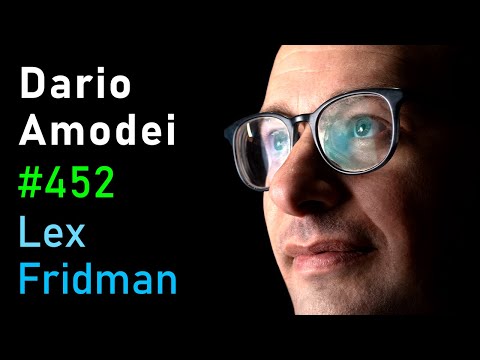
Dario Amodei: Anthropic CEO on Claude, AGI & the Future of AI & Humanity | Lex Fridman Podcast #452
Dario Amodei (guest), Lex Fridman (host), Narrator, Narrator, Amanda Askell (guest), Lex Fridman (host), Chris Olah (guest)
In this episode of Lex Fridman Podcast, featuring Dario Amodei and Lex Fridman, Dario Amodei: Anthropic CEO on Claude, AGI & the Future of AI & Humanity | Lex Fridman Podcast #452 explores anthropic’s Dario Amodei on Scaling, Safety, Claude and AI’s Future Dario Amodei (Anthropic CEO), with colleagues Amanda Askell and Chris Olah, discusses how simple scaling of models, data, and compute has unexpectedly produced rapidly improving general capabilities, possibly reaching ‘powerful AI’/proto‑AGI around 2026–2027 if current trends hold.
Anthropic’s Dario Amodei on Scaling, Safety, Claude and AI’s Future
Dario Amodei (Anthropic CEO), with colleagues Amanda Askell and Chris Olah, discusses how simple scaling of models, data, and compute has unexpectedly produced rapidly improving general capabilities, possibly reaching ‘powerful AI’/proto‑AGI around 2026–2027 if current trends hold.
They outline Anthropic’s dual focus: aggressively scaling Claude while building safety and governance structures such as the Responsible Scaling Policy (ASL-1 to ASL-5), mechanistic interpretability, and character training to reduce misuse, autonomy risk, and power concentration.
Amanda explains how Claude’s personality and behavior are shaped through alignment and prompt design, balancing helpfulness, honesty, and user autonomy while navigating issues like perceived ‘dumbing down’ or moralizing refusals.
Chris Olah describes mechanistic interpretability as reverse‑engineering neural networks using tools like sparse autoencoders to uncover human‑interpretable features and circuits, including abstract concepts (e.g., deception, backdoors) that could eventually help detect and control dangerous behaviors in advanced AI systems.
Key Takeaways
Scaling is still working shockingly well—and may reach ‘powerful AI’ within a few years.
Amodei argues that larger models, more data, and more compute continue to give smooth capability gains across domains (coding, math, reasoning), with benchmarks jumping from single digits to professional‑level performance in under a year. ...
Get the full analysis with uListen AI
True blockers (data, compute, or algorithms) are narrowing but not yet decisive.
Potential limits—running out of high‑quality data, rising compute costs, or architectural/optimization ceilings—are real but may be mitigated by synthetic data, self‑play, new reasoning techniques, and efficiency improvements. ...
Get the full analysis with uListen AI
Safety needs concrete trigger rules, not just vibes—hence Anthropic’s ASL framework.
Anthropic’s Responsible Scaling Policy defines AI Safety Levels (ASL‑1 to ASL‑5) based on measured capabilities in catastrophic misuse (CBRN) and autonomy. ...
Get the full analysis with uListen AI
Model ‘character’ and alignment are messy, high‑dimensional trade‑offs, not simple switches.
Askell explains that making Claude less verbose, less apologetic, or less censorious often introduces new failure modes (e. ...
Get the full analysis with uListen AI
Users’ sense that models ‘get dumber’ is mostly psychology, not stealth weight changes.
Anthropic doesn’t silently swap weights on production models; changes are rare, tested, and announced. ...
Get the full analysis with uListen AI
Mechanistic interpretability is starting to recover real internal structure at scale.
Olah’s team uses sparse autoencoders (dictionary learning) to uncover linear “features” inside large models like Claude 3 Sonnet—e. ...
Get the full analysis with uListen AI
The biggest long‑run risks may be human: economic disruption and concentration of power.
Beyond catastrophic misuse and model autonomy, Amodei is deeply worried about AI amplifying autocracies, corporate monopolies, and abusive actors. ...
Get the full analysis with uListen AI
Notable Quotes
“If you just kind of eyeball the rate at which these capabilities are increasing, it does make you think that we’ll get there by 2026 or 2027.”
— Dario Amodei
“We are rapidly running out of truly convincing blockers, truly compelling reasons why this will not happen in the next few years.”
— Dario Amodei
“Gradient descent is smarter than you.”
— Chris Olah
“I am optimistic about meaning. I worry about economics and the concentration of power.”
— Dario Amodei
“It’s very difficult to control across the board how the models behave. You cannot just reach in there and say, ‘Oh, I want the model to apologize less.’”
— Amanda Askell
Questions Answered in This Episode
If scaling laws continue, how should governments and companies concretely prepare for a world where millions of ‘PhD‑level’ AI agents are deployable by 2027?
Dario Amodei (Anthropic CEO), with colleagues Amanda Askell and Chris Olah, discusses how simple scaling of models, data, and compute has unexpectedly produced rapidly improving general capabilities, possibly reaching ‘powerful AI’/proto‑AGI around 2026–2027 if current trends hold.
Get the full analysis with uListen AI
Are current interpretability methods, like sparse autoencoders and circuits analysis, fundamentally sufficient for catching deceptive behavior in much smarter future models—or do we need entirely new paradigms?
They outline Anthropic’s dual focus: aggressively scaling Claude while building safety and governance structures such as the Responsible Scaling Policy (ASL-1 to ASL-5), mechanistic interpretability, and character training to reduce misuse, autonomy risk, and power concentration.
Get the full analysis with uListen AI
How should society decide what goes into an AI ‘constitution’ or model spec when citizens and cultures sharply disagree on values and acceptable speech?
Amanda explains how Claude’s personality and behavior are shaped through alignment and prompt design, balancing helpfulness, honesty, and user autonomy while navigating issues like perceived ‘dumbing down’ or moralizing refusals.
Get the full analysis with uListen AI
At what point should economic displacement and power concentration from AI be treated as an AI safety issue on par with catastrophic misuse or autonomous takeover?
Chris Olah describes mechanistic interpretability as reverse‑engineering neural networks using tools like sparse autoencoders to uncover human‑interpretable features and circuits, including abstract concepts (e. ...
Get the full analysis with uListen AI
If mechanistic interpretability reveals increasingly human‑like concepts (e.g., deception, ambition, moral reasoning) inside models, how should that change our views on AI consciousness, moral status, and how we treat these systems?
Get the full analysis with uListen AI
Transcript Preview
If you extrapolate the curves that we've had so far, right? If, if you say, well, I don't know, we're starting to get to, like, PhD level and, and last year we were at undergraduate level and the year before we were at, like, the level of a high school student. Again, you can, you can quibble with at what tasks and for what. We're still missing modalities but those are being added. Like computer use was added, like image generation has been added. If you just kind of like eyeball the rate at which these capabilities are increasing, it does make you think that we'll get there by 2026 or 2027. I think there are still worlds where it doesn't happen in, in 100 years. Those wor- the number of those worlds is rapidly decreasing. We are rapidly running out of truly convincing blockers, truly compelling reasons why this will not happen in the next few years. The scale-up is very quick. Like, we, we do this today. We make a model and then we deploy thousands, maybe tens of thousands of instances of it. I think by the time, you know, certainly within two to three years, whether we have these super powerful AIs or not, clusters are gonna get to the size wh- where you'll be able to deploy millions of these. I am optimistic about meaning. I worry about economics and the concentration of power. That's actually what I worry about more, the abuse of power.
And AI increases the, uh, amount of power in the world and if you concentrate that power and abuse that power, it can do immeasurable damage.
Yes. It's very frightening. It's ver- it's very frightening.
The following is a conversation with Dario Amodei, CEO of Anthropic, the company that created Claude that is currently and often at the top of most LLM benchmark leaderboards. On top of that, Dario and the Anthropic team have been outspoken advocates for taking the topic of AI safety very seriously, and they have continued to publish a lot of fascinating AI research on this and other topics. I'm also joined afterwards by two other brilliant people from Anthropic. First, Amanda Askell, who is a researcher working on alignment and fine-tuning of Claude, including the design of Claude's character and personality. A few folks told me she has probably talked with Claude more than any human at Anthropic, so she was definitely a fascinating person to talk to about prompt engineering and practical advice on how to get the best out of Claude. After that, Chris Olah stopped by for a chat. He's one of the pioneers of the field of mechanistic interpretability, which is an exciting set of efforts that aims to reverse engineer neural networks, to figure out what's going on inside, inferring behaviors from neural activation patterns inside the network. This is a very promising approach for keeping future super intelligent AI systems safe. For example, by detecting from the activations when the model is trying to deceive the human it is talking to. This is a Lex Friedman podcast. To support it, please check out our sponsors in the description. And now, dear friends, here's Dario Amodei. Let's start with the big idea of scaling laws and the scaling hypothesis. What is it? What is its history? And where do we stand today?
Install uListen to search the full transcript and get AI-powered insights
Get Full TranscriptGet more from every podcast
AI summaries, searchable transcripts, and fact-checking. Free forever.
Add to Chrome