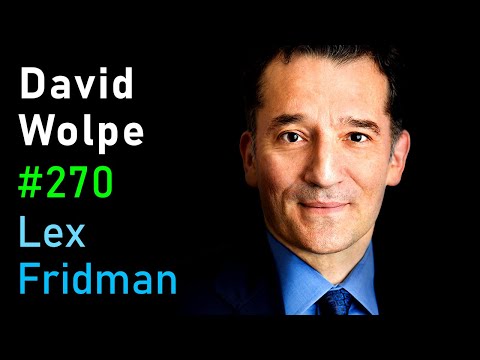
David Wolpe: Judaism | Lex Fridman Podcast #270
Lex Fridman (host), David Wolpe (guest)
In this episode of Lex Fridman Podcast, featuring Lex Fridman and David Wolpe, David Wolpe: Judaism | Lex Fridman Podcast #270 explores rabbi David Wolpe on God, Suffering, Meaning, and Modern Faith Lex Fridman speaks with Rabbi David Wolpe about Judaism’s view of God, the nature of faith, and how religious traditions evolve while retaining moral depth. They explore free will, consciousness, suffering, and the Holocaust, asking what religion can still offer in a scientific, often nihilistic age.
Rabbi David Wolpe on God, Suffering, Meaning, and Modern Faith
Lex Fridman speaks with Rabbi David Wolpe about Judaism’s view of God, the nature of faith, and how religious traditions evolve while retaining moral depth. They explore free will, consciousness, suffering, and the Holocaust, asking what religion can still offer in a scientific, often nihilistic age.
Wolpe reflects on friendships with prominent atheists like Christopher Hitchens and Sam Harris, arguing that religion’s ethical and communal power remains vital even when its stories are not taken as literal history.
They discuss contemporary controversies—from same‑sex marriage in Judaism to COVID-era public shaming and antisemitic violence—and how to maintain integrity, humility, and compassion amid tribalism and online outrage.
The conversation ends on mortality, hope, and Wolpe’s conviction that the meaning of life is to “grow in soul,” primarily through love, responsibility, and taking every human being’s inner life seriously.
Key Takeaways
In Judaism, the goal is relationship with God, not full comprehension.
Wolpe emphasizes that Jewish thought generally treats God as ultimately unknowable yet addressable—“God cannot be expressed, God can only be addressed”—shifting the focus from defining God to living in conscious relationship with the divine.
Get the full analysis with uListen AI
Scripture can be sacred without being literal history.
Wolpe argues that many biblical stories (like the Exodus) convey enduring spiritual truths even if they did not occur exactly as written; their power comes from being myths that are “always happening,” not from strict factuality.
Get the full analysis with uListen AI
Religious traditions can and must evolve ethically from within.
His decision to perform same‑sex marriages arose from core Jewish values such as human dignity (kvod habriot), showing how a tradition can use its own principles to critique and update inherited norms while remaining authentically itself.
Get the full analysis with uListen AI
Free will is hard to reconcile with strict materialism.
Wolpe contends that if genetics and environment fully determine behavior, genuine free choice disappears; he believes some non‑material (spiritual) dimension is required to make moral responsibility and freedom coherent.
Get the full analysis with uListen AI
Suffering and evil are tied to the gift and risk of freedom.
He suggests God cannot grant free will and then selectively block its worst uses (e. ...
Get the full analysis with uListen AI
Meaning and hope are the strongest antidotes to nihilism.
Drawing on Viktor Frankl and Ernest Becker, Wolpe argues that humans can endure incredible hardship if they believe their lives and actions matter; loss of meaning, not pain itself, is what most endangers a decent life.
Get the full analysis with uListen AI
Cultivating inner standards matters more than external approval in a noisy age.
He urges young people to read deeply, develop their own moral metric, and resist being wholly defined by social media tribes or influencers, so they can act from conscience rather than outrage cycles.
Get the full analysis with uListen AI
Notable Quotes
“You don't have to have a comprehension of God, you have to have a relationship to God, and those are not the same.”
— David Wolpe
“A myth is something that may not have happened, but is always happening.”
— David Wolpe
“If you're a thoroughgoing materialist, free will is impossible. There could be randomness, but randomness is not free will.”
— David Wolpe
“You can live for three weeks without food, three days without water, but you can't live for three minutes without hope.”
— David Wolpe (retelling a story from Rabbi Hugo Gryn’s father in Auschwitz)
“I believe the meaning of life is for human beings to grow in soul… You’re supposed to return your soul more burnished and beautiful than you got it.”
— David Wolpe
Questions Answered in This Episode
If scripture is not primarily about factual history, how should we decide which parts of religious law and ethics to preserve, modify, or discard?
Lex Fridman speaks with Rabbi David Wolpe about Judaism’s view of God, the nature of faith, and how religious traditions evolve while retaining moral depth. ...
Get the full analysis with uListen AI
Can a secular, non-theistic worldview provide as robust a foundation for meaning and moral responsibility as the religious frameworks Wolpe defends?
Wolpe reflects on friendships with prominent atheists like Christopher Hitchens and Sam Harris, arguing that religion’s ethical and communal power remains vital even when its stories are not taken as literal history.
Get the full analysis with uListen AI
At what point—if ever—would expressions of pain and memory in AI or robots obligate us to treat them as sentient moral subjects rather than tools?
They discuss contemporary controversies—from same‑sex marriage in Judaism to COVID-era public shaming and antisemitic violence—and how to maintain integrity, humility, and compassion amid tribalism and online outrage.
Get the full analysis with uListen AI
How can religious and nonreligious people cooperate to reduce tribalism and online outrage while still holding strong, opposing convictions?
The conversation ends on mortality, hope, and Wolpe’s conviction that the meaning of life is to “grow in soul,” primarily through love, responsibility, and taking every human being’s inner life seriously.
Get the full analysis with uListen AI
Is it possible to maintain deep commitment to a particular tradition (like Judaism) while fully honoring the equal spiritual worth of other paths and peoples?
Get the full analysis with uListen AI
Transcript Preview
The following is a conversation with Rabbi David Wolpe, someone who I've been a fan of for many years, for the kindness in his heart, the strength of his character, and the kind of friends he keeps and talks with, many of whom disagree with him, but love him nevertheless, including the late Christopher Hitchens. I will have many conversations like these in the future about religion, about Islam, Christianity, Judaism, Hinduism, Buddhism and others, looking to understand and celebrate the culture, the tradition, and the beauty of the people who practice these religions. I will, of course, not shy away from the difficult topics. I will talk both about hate and love, about war and peace. This conversation was recorded more than three weeks ago. Please allow me this time to speak on what has been on my mind. If this is not interesting to you, please skip. I totally understand. Some people asked me to say a few words on the war in Ukraine. I think my words are worth little, but perhaps, let me try. I considered doing a long solo episode on this war. I tried several times, but it is too personal for now. To give you context, I've been talking to refugees, friends, loved ones, in Ukraine, in Russia, in Poland, Slovakia, Moldova, Romania, even UK, Germany, Canada, India, China, and of course, the United States. Some of them crying, or angry, or confused, or scared. I'm helping as best as I can privately, and I'm hoping to help in the future by traveling to Ukraine and Russia, and celebrating the humanity and the beauty of the people in this region. This was all set up, both for Ukraine and Russia trips, before 2022, including conversations with scientists, artists, athletes, leaders, and just, quote, "regular folks" who are equally, if not more fascinating to me. For now, it has become much more difficult, but I'll keep trying to find a way. I was born in the Soviet Union. My roots are both Ukrainian and Russian, and today, and until the day I die, I am an American. I'm proud of all of this. I hope to keep celebrating the culture and the incredible human beings that make up these nations, and humanity as a whole. We're all one people. We're in this together. That's how I feel about the people of these nations. Now, let me speak about those in the seats of power. I condemn all actions of leaders who play geopolitical games on the world stage, disregarding the cost paid in human suffering on the scale of millions. For this reason, I condemn Vladimir Putin's invasion of Ukraine, and I condemn many of the military interventions by the superpowers of the world, including by my country, the country I love, the United States, that after World War II, has intervened in over 40 nations, with many studies finding that the United States is culpable for an unfathomable number of civilian deaths. I condemn all heads of state who needlessly wage wars, watching young men and women burn in the fires they started. I don't understand how humans can be so cruel to each other. Or rather, I understand, but I believe in a future world where this is no longer true. Let me also say a few words of what I hope to do with this podcast. I want to explore the full complexity and beauty of human nature. I believe each of us are capable of good and evil, and I want to understand how the mind and the circumstance lead one to choose the former path or the latter, and I believe conversation is one of the best ways to work toward this understanding. For that, I think I have to not only talk to the most inspiring humans in the world, but also to the most controversial. I will speak with many people who I disagree with, politicians, activists, CEOs, heads of state, with very different opinions on the world. I will try hard to challenge their ideas without closing my mind to the depth and complexity of their perspective and their humanity. My presence in the same room with wildly different people will make it easy for the media and the internet to pick and choose clips and snapshots, attacking me for being a shill for one side or the other. I can't defend this point, except to say that I'm a shill for no one, and that I hope you see the strength of my integrity, that I won't be influenced by any of them, no matter how rich, powerful, or charismatic they are. Like the poem If by Rudyard Kipling says, "If you can talk with crowds and keep your virtue, or walk with kings nor lose the common touch, if neither foes nor loving friends can hurt you, if all men count with you but none too much." This is a really, really important thing to me that I try to live by, that all human beings count with me the same. People have criticized me for wanting to have some of these conversations, like with Vladimir Putin and Volodymyr Zelenskyy, and for at times in the past speaking about them without the seriousness the topic deserves. For this, I would sincerely like to apologize. I'm disappointed, even ashamed, of my frequent ineloquence on these topics. I will work hard to do better. When I'm joking, it should be clear that it's a joke, and hopefully actually funny. When I'm being serious, I should speak with care and rigor.... I've now done many hundreds of hours of podcast conversation. Despite my frequent failures in speaking, I hope you know where my heart is. Unfortunately, I think people will take clips of me and use them to attack me. This will happen more and more. I guess there's nothing I can do but send them my love, and in the meantime, try to be a better person and a better interviewer. Let me also say that I like humor, especially dark humor. I like being silly and not taking myself seriously. I will keep taking risks with that, all with the goal of having fun and celebrating humanity at its most absurd and most beautiful. I will occasionally dress up in strange and weird outfits to celebrate the absurdity of life. I will hang out, break bread, and joke with all kinds of people. I don't have to agree with them to laugh with them in order to escape, for a brief moment, the tension, the conflict, the hatred in the world. Humor just might save this little chaotic little civilization of ours. I love the Ukrainian people, I love the Russian people, and of course, I love my fellow Americans, Californians and Midwesterners, New Yorkers and Texans. I love humans, I love life, and I want to share that love with others, with you. If I mess it up, I'm really, really sorry. I'm trying my best. I have no agenda and no one telling me what to do. I feel like the luckiest guy in the world to have all these opportunities, and I'm deeply grateful to be alive and to share that joy with other amazing people around me. Thank you for your support, for all the love you've sent my way. I will work my ass off to not disappoint you. I love you all. This is a Lex Fridman podcast. To support it, please check out our sponsors in the description, and now here's my conversation with David Wolpe. Let's start with the big question. According to Judaism, who is God?
Install uListen to search the full transcript and get AI-powered insights
Get Full TranscriptGet more from every podcast
AI summaries, searchable transcripts, and fact-checking. Free forever.
Add to Chrome