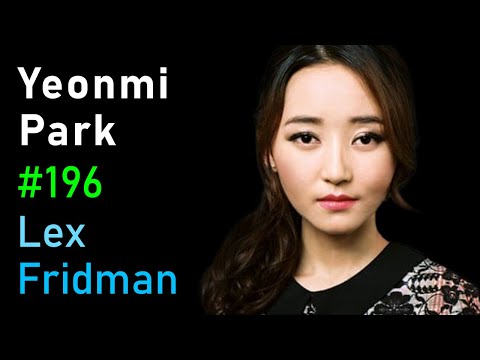
Yeonmi Park: North Korea | Lex Fridman Podcast #196
Lex Fridman (host), Yeonmi Park (guest)
In this episode of Lex Fridman Podcast, featuring Lex Fridman and Yeonmi Park, Yeonmi Park: North Korea | Lex Fridman Podcast #196 explores north Korean Defector Exposes Totalitarian Horror, Hope, and Human Resilience Lex Fridman interviews Yeonmi Park, a North Korean defector and human rights activist, about growing up under an absolute totalitarian regime, her escape through China, and the psychological scars that followed. Yeonmi explains how North Korea systematically erases concepts like love, freedom, justice, and even fashion or the internet to maintain control, using famine, surveillance, and propaganda as core tools. They discuss the ideological roots of the regime, China’s enabling role, the moral failures of the international community, and disturbing parallels Yeonmi sees between North Korean indoctrination and certain trends in Western academia. Throughout, she reflects on suffering, love, freedom, and responsibility, arguing that gratitude and fighting for something bigger than oneself give life meaning.
North Korean Defector Exposes Totalitarian Horror, Hope, and Human Resilience
Lex Fridman interviews Yeonmi Park, a North Korean defector and human rights activist, about growing up under an absolute totalitarian regime, her escape through China, and the psychological scars that followed. Yeonmi explains how North Korea systematically erases concepts like love, freedom, justice, and even fashion or the internet to maintain control, using famine, surveillance, and propaganda as core tools. They discuss the ideological roots of the regime, China’s enabling role, the moral failures of the international community, and disturbing parallels Yeonmi sees between North Korean indoctrination and certain trends in Western academia. Throughout, she reflects on suffering, love, freedom, and responsibility, arguing that gratitude and fighting for something bigger than oneself give life meaning.
Key Takeaways
Totalitarian control begins by erasing language and concepts.
In North Korea, words for freedom, human rights, romantic love, stress, or even 'fashion' simply do not exist, which prevents people from forming the very ideas that could challenge the regime; controlling vocabulary is controlling thought.
Get the full analysis with uListen AI
Famine and poverty are deliberately weaponized to crush dissent.
The 1990s famine and renewed 'Arduous March' policies are not accidents but tools: when people are starved and focused solely on survival, they cannot organize, question authority, or imagine alternatives.
Get the full analysis with uListen AI
China’s backing is critical to the survival of the North Korean dictatorship.
Yeonmi argues Kim Jong-un could not last a week without Chinese political, economic, and diplomatic support; confronting North Korean atrocities therefore requires squarely addressing the Chinese Communist Party’s enabling role.
Get the full analysis with uListen AI
Evil systems can turn ordinary people into participants by fear and ignorance.
Drawing on Animal Farm and her own experience, Yeonmi emphasizes that not only dictators but also fearful bystanders and those who 'don’t know any better' collectively allow dystopias to persist.
Get the full analysis with uListen AI
Freedom is deeply valuable but psychologically demanding.
After North Korea, Yeonmi found that freedom means constant responsibility, uncertainty, and self-censorship pressures even in the West; it doesn’t guarantee happiness, but it enables authentic thought, growth, and moral agency.
Get the full analysis with uListen AI
Western societies risk repeating patterns of ideological control.
Her experience at Columbia—mandatory pronoun rituals, politicized curricula, demonization of meritocracy, and pervasive self-censorship—reminded her of early-stage thought control, leading her to see dangerous echoes of North Korean propaganda techniques.
Get the full analysis with uListen AI
Gratitude, love, and fighting for something bigger give suffering meaning.
Yeonmi copes not by guilt but by gratitude for being alive and free, by loving her family and humanity, and by choosing to be a witness for those who cannot speak, accepting personal risk to pursue a purpose beyond herself.
Get the full analysis with uListen AI
Notable Quotes
“North Korea is not just another country. It’s a different planet.”
— Yeonmi Park
“They don’t even know they are oppressed. That’s the most unique thing about North Koreans.”
— Yeonmi Park
“We tell ourselves stories in order to live.”
— Yeonmi Park
“Freedom is not a gateway to happiness; in a way it can make life a lot more complex.”
— Yeonmi Park
“If the Holocaust is happening again, how are you okay doing nothing about it?”
— Yeonmi Park
Questions Answered in This Episode
How can individuals in free countries move beyond momentary outrage and actually sustain long-term action against regimes like North Korea’s?
Lex Fridman interviews Yeonmi Park, a North Korean defector and human rights activist, about growing up under an absolute totalitarian regime, her escape through China, and the psychological scars that followed. ...
Get the full analysis with uListen AI
What practical steps could the international community take to confront China’s enabling role without sliding into counterproductive demonization of the Chinese people?
Get the full analysis with uListen AI
Where is the line between healthy social norms (like respectful language) and the early stages of authoritarian-style thought control in Western institutions?
Get the full analysis with uListen AI
If language shapes thought, what concepts or words might we be losing in modern discourse that could make us more vulnerable to manipulation?
Get the full analysis with uListen AI
How should societies balance the risks of harmful speech with the even greater dangers of censorship and enforced ideological conformity?
Get the full analysis with uListen AI
Transcript Preview
The following is a conversation with Yeonmi Park, a North Korean defector, human rights activist, and author of the book In Order to Live. Quick mention of our sponsors: Belcampo, Gala Games, BetterHelp, and Eight Sleep. Check them out in the description to support this podcast. Let me say a few words about North Korea. From 1994 to '98, North Korea went through a famine, mass starvation caused primarily by Kim Jong Il, who at the time was the new leader of North Korea after his father's death in 1994. Somewhere between 600,000 and three million people died due to starvation. From all the stories of famine in history, including my own family history, I've come to understand that hunger tortures the human mind in a way that can break everything we stand for. In North Korea, during the '90s famine, many were driven to cannibalism. Imagine, more than 10 million people suffering starvation for months and years, always on the brink of death. We don't know the exact numbers of people who died because the suffering was done in silence, in darkness. Very little information in or out. Most people had to survive without electricity, without clean water, medical supplies, sanitation, and food. The North Korean propaganda machine called this The Arduous March or the March of Suffering, and words such as "famine" and "hunger" were banned because they implied government failure. And once again, now in 2021, Kim Jong-un, the current leader of North Korea, is calling for his country to prepare for another Arduous March or March of Suffering, another period of mass starvation as the country closes its borders. Looking at atrocities of the past decades and the encroaching atrocity there now, I think about the quiet suffering of millions of North Koreans. I think about the torture of the human spirit. I think about a North Korean child who could be a scientist, an artist, a writer, but who instead grows impossibly thin without food, their body slowly rotting away as their parents watch helplessly. I got emotional in this conversation with Yeonmi, in part because I remembered my grandmother who survived Holodomor, the famine in Ukraine intentionally created by Stalin where 4 to 10 million people died and many, many more suffered. Imagine knowing that if you don't engage in cannibalism, you will die before your children did, and then they will be eaten. Imagine because of this deciding to murder and eat your own children as many people did. Imagine the kind of desperation, torture that leads up to a decision like that. I'm not smart enough to know what evil is, know where to draw the line between good and evil, but Stalin, Kim Jong Il, Kim Jong Un are men who in the name of power are willing to make millions of people, of children suffer and die from starvation. I rarely have hate in my heart, but I hate these men. I hate that such men exist in this world. I hate that the beauty I love about this life exists amidst such unimaginable cruelty. I have been haunted by this conversation, by memories of my grandmother's pain, but I've also been warmed by memories of her love. Love gives me hope, hope for the perseverance of the human spirit even in the face of evil. This is the Lex Fridman Podcast, and here is my conversation with Yeonmi Park. Can you tell your story from North Korea to today as you describe in your 2015 book and with the extra perspective on life, love, and freedom you've gained since then?
Install uListen to search the full transcript and get AI-powered insights
Get Full TranscriptGet more from every podcast
AI summaries, searchable transcripts, and fact-checking. Free forever.
Add to Chrome