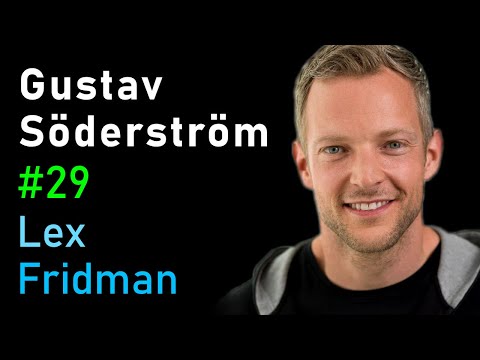
Gustav Soderstrom: Spotify | Lex Fridman Podcast #29
Lex Fridman (host), Gustav Soderstrom (guest)
In this episode of Lex Fridman Podcast, featuring Lex Fridman and Gustav Soderstrom, Gustav Soderstrom: Spotify | Lex Fridman Podcast #29 explores spotify’s Gustav Soderström on Music, AI, Creation, and the Future Gustav Soderström, Spotify’s Chief R&D Officer, discusses how Spotify evolved from fighting piracy in Sweden to reshaping how the world discovers and listens to music and podcasts.
Spotify’s Gustav Soderström on Music, AI, Creation, and the Future
Gustav Soderström, Spotify’s Chief R&D Officer, discusses how Spotify evolved from fighting piracy in Sweden to reshaping how the world discovers and listens to music and podcasts.
He explains the technical and product innovations behind instant streaming, personalization, and recommendation systems built from billions of user-generated playlists.
The conversation explores creator tools, feedback loops, and how AI can aid not just consumption but the creation and optimization of music and podcasts.
They also look ahead to the future of audio, voice interfaces, and the possibility of deeply personal relationships with AI agents accessed primarily through sound.
Key Takeaways
Access beats ownership in digital music consumption.
Spotify’s key innovation wasn’t just streaming technology but shifting users from hoarding files to having on-demand access to virtually all music, which changes listening behavior and massively lowers the cost of exploration.
Get the full analysis with uListen AI
Piracy revealed unmet product demand, not just price sensitivity.
Users pirated because it offered a superior experience—instant, broad access—despite poor interfaces; Spotify succeeded by matching piracy’s access model while improving UX and adding a viable business model that pays rights holders.
Get the full analysis with uListen AI
Billions of playlists form a powerful training set for recommendations.
User-created playlists are implicit, semantically meaningful groupings of tracks; treating them as labeled data allows Spotify to learn latent relationships and build strong taste embeddings without fully understanding audio content at first.
Get the full analysis with uListen AI
Human curation and algorithms work best in combination (“algotorial”).
Editors define concepts like “songs to sing in the car” and assemble candidate pools, while algorithms personalize which subset each user hears, marrying cultural judgment with scalable personalization.
Get the full analysis with uListen AI
Creator tools with feedback loops will transform music and podcast production.
Spotify is building DAWs, podcast platforms, and analytics so creators can collaborate, auto-assist with AI (e. ...
Get the full analysis with uListen AI
Expectation-setting is crucial in ML-powered products.
Features like Discover Weekly can be risky and exploratory because users expect discovery (and accept misses), while products like Daily Mix must be conservative; framing determines how users perceive recommendation quality.
Get the full analysis with uListen AI
Audio and voice interfaces will make computing more ambient and intimate.
Smart speakers and wearables turn audio into a primary interface, with music and podcasts as top use cases; over time assistants that ‘live in your ears’ may feel more personally engaging than screen-based agents, enabling new kinds of relationships with AI.
Get the full analysis with uListen AI
Notable Quotes
“One way to think about Spotify is it was just legal and fast piracy.”
— Gustav Soderström
“From a product development perspective, the test set is the new wireframe.”
— Gustav Soderström
“Instead of giving away your music, you got all the music.”
— Gustav Soderström
“Playlisting is like a programming language for music to soundtrack your life.”
— Gustav Soderström
“Podcasting gives me a lot of hope for humanity that people seem really interested in hearing deeper, more complicated conversations.”
— Gustav Soderström
Questions Answered in This Episode
How might AI-assisted creation tools change the artistic process without pushing creators to optimize purely for engagement metrics?
Gustav Soderström, Spotify’s Chief R&D Officer, discusses how Spotify evolved from fighting piracy in Sweden to reshaping how the world discovers and listens to music and podcasts.
Get the full analysis with uListen AI
What are the ethical boundaries for using listening data to nudge mood or behavior, given how powerful music is as a ‘brain hack’?
He explains the technical and product innovations behind instant streaming, personalization, and recommendation systems built from billions of user-generated playlists.
Get the full analysis with uListen AI
Could changes in the “format” of songs and podcasts (length, interactivity, adaptive content) ever become mainstream, or are cultural habits too entrenched?
The conversation explores creator tools, feedback loops, and how AI can aid not just consumption but the creation and optimization of music and podcasts.
Get the full analysis with uListen AI
How should revenue and ownership be structured if AI tools materially shape the composition or editing of music and podcasts?
They also look ahead to the future of audio, voice interfaces, and the possibility of deeply personal relationships with AI agents accessed primarily through sound.
Get the full analysis with uListen AI
What safeguards are needed if we move toward Her-like voice assistants that users may emotionally bond with or ‘fall in love’ with?
Get the full analysis with uListen AI
Transcript Preview
The following is a conversation with Gustav Soderström. He's the chief research and development officer at Spotify, leading their product, design, data, technology, and engineering teams. As I've said before in my research and in life in general, I love music, listening to it and creating it, and using technology, especially personalization through machine learning to enrich the music discovery and listening experience. That is what Spotify has been doing for years, continually innovating, defining how we experience music as a society in the digital age. That's what Gustav and I talk about among many other topics, including our shared appreciation of the movie True Romance, in my view, one of the great movies of all time. This is the Artificial Intelligence podcast. If you enjoy it, subscribe on YouTube, give it five stars on iTunes, support it on Patreon, or simply connect with me on Twitter @lexfridman, spelled F-R-I-D-M-A-N. And now here's my conversation with Gustav Soderström. Spotify has over 50 million songs in its catalog, so let me ask the all-important question, I feel like you're the right person to ask, what is the definitive greatest song of all time?
(laughs) It varies for me, personally.
So you can't speak definitively for everyone?
(laughs) I wouldn't believe very much in machine learning if I did, right?
Okay.
Because it meant everyone had the same taste.
So for you, what is... you have to pick, what is the song?
All right, so it's, it's pretty easy for me. There is this song called "You're So Cool" by Hans Zimmer, uh, soundtrack to True Romance.
Ah.
It was a movie that made a big impression on me and it's kind of been following me through my life. Actually had it play at my wedding. I sat with the organist and helped him play it on an organ, which was a pretty, pretty interesting experience. It's, uh...
That is probably my, uh, I would say top three movie of all time. Yeah, it's just an incredible movie.
Yeah, and, and it came out during my formative years and, uh, as I've discovered in music, you, you shape your music taste during those years, so it definitely affected me quite a bit.
Did it affect you in any other kind of way?
Well, the movie itself affected me back then, it was a big part of culture. I didn't really adopt any characters from the movie-
(laughs)
... but it was a, it was a great story of love, some fantastic actors and, and, you know, really I didn't even know who Hans Zimmer was at the time, but fantastic music. And so, um, that song has followed me, and the movie actually has followed me throughout my life.
That was Quentin Tarantino actually, I think, uh, director, directed or produced that, or... So it's not Stairway to Heaven or Bohemian Rhapsody, it's, uh...
Tho- those are, those are great. They're not my personal favorites, but, uh-
Install uListen to search the full transcript and get AI-powered insights
Get Full TranscriptGet more from every podcast
AI summaries, searchable transcripts, and fact-checking. Free forever.
Add to Chrome