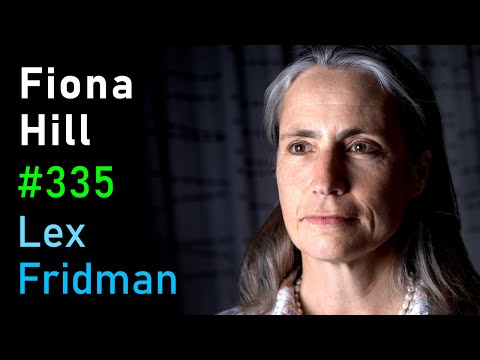
Fiona Hill: Vladimir Putin and Donald Trump | Lex Fridman Podcast #335
Fiona Hill (guest), Lex Fridman (host), Narrator, Narrator
In this episode of Lex Fridman Podcast, featuring Fiona Hill and Lex Fridman, Fiona Hill: Vladimir Putin and Donald Trump | Lex Fridman Podcast #335 explores fiona Hill Dissects Putin, Trump, Ukraine, And America’s Fractured Politics Fiona Hill traces her journey from a coal-mining town in Northern England to the White House, using her life story to frame how class, education, and industrial decline shape political worldviews. She analyzes Vladimir Putin’s evolution from a pragmatic stabilizer of post-Soviet Russia to an increasingly isolated, historically obsessed, and risk‑acceptant autocrat who launched the war in Ukraine. Hill connects U.S. domestic dysfunction—Trump’s first impeachment, partisan warfare, and erosion of institutional integrity—to how Putin misread American resolve and Ukrainian agency. Throughout, she argues for “strategic empathy” toward adversaries, deep reform of U.S. governance, and a clear-eyed, non-partisan approach to ending the war in Ukraine while deterring nuclear escalation and future proliferation.
Fiona Hill Dissects Putin, Trump, Ukraine, And America’s Fractured Politics
Fiona Hill traces her journey from a coal-mining town in Northern England to the White House, using her life story to frame how class, education, and industrial decline shape political worldviews. She analyzes Vladimir Putin’s evolution from a pragmatic stabilizer of post-Soviet Russia to an increasingly isolated, historically obsessed, and risk‑acceptant autocrat who launched the war in Ukraine. Hill connects U.S. domestic dysfunction—Trump’s first impeachment, partisan warfare, and erosion of institutional integrity—to how Putin misread American resolve and Ukrainian agency. Throughout, she argues for “strategic empathy” toward adversaries, deep reform of U.S. governance, and a clear-eyed, non-partisan approach to ending the war in Ukraine while deterring nuclear escalation and future proliferation.
Key Takeaways
Strategic empathy is essential for dealing with adversaries like Putin.
Hill argues you must understand Putin’s historical lens, security fears, status aspirations, and rationality in his own frame—not to excuse him, but to anticipate how he interprets moves by the U. ...
Get the full analysis with uListen AI
Putin’s trajectory shifted from pragmatic stabilizer to imperial restorer obsessed with history.
In his first two terms, he prioritized economic stabilization, debt repayment, and technocratic governance, but from roughly 2011–2014 he became fixated on reconstituting a ‘Russian world,’ revising Lenin’s legacy, and reclaiming Ukraine—culminating in Crimea’s annexation and the current full-scale invasion.
Get the full analysis with uListen AI
U.S. domestic dysfunction directly influenced Kremlin perceptions and risk-taking on Ukraine.
The politicization of Ukraine in Trump’s first impeachment, conspiracy theories about 2016, and visible U. ...
Get the full analysis with uListen AI
Trump mixed valid questions with destructive methods, eroding alliances and institutions.
Hill credits him for challenging European dependence on Russian energy and complacency in NATO, but says his personal attacks, incitement, and transactional view of Ukraine (seeking “a favor” from Zelensky) weakened U. ...
Get the full analysis with uListen AI
The Ukraine war is both about territory and Russia’s claim to great-power veto rights.
Beyond land grabs, Putin seeks a return to a 19th–20th century ‘concert’ where big powers—now the U. ...
Get the full analysis with uListen AI
Nuclear saber-rattling is already changing the global proliferation landscape.
By brandishing nuclear threats and attacking around civilian reactors, Putin incentivizes states like South Korea, Japan, Saudi Arabia, and Turkey to reconsider acquiring nuclear capabilities, undermining decades of nonproliferation efforts and making future crises more dangerous.
Get the full analysis with uListen AI
Revitalizing U.S. governance requires de-partisanizing expertise and widening the decision circle.
Hill criticizes narrow, personality-driven presidencies (Bush, Obama, Trump) and a bloated political appointment system, arguing for more non-partisan professional roles, structured mechanisms for diverse expert input, and a cultural reset that values public service and internal dissent over tribal loyalty.
Get the full analysis with uListen AI
Notable Quotes
“We’ve got to have strategic empathy about Putin as well. We’ve got to understand how the guy thinks and why he thinks like he does.”
— Fiona Hill
“He is a rational actor in his own context.”
— Fiona Hill
“Look, I was a starry-eyed immigrant… I really saw that the United States was the gold standard for some of its institutions. And then suddenly I found myself in this totally crazy looking glass version of American politics.”
— Fiona Hill
“Putin has declared war on us. He did that on September 30th… We’ve got a wartime economy situation. That’s where we are.”
— Fiona Hill
“We all have a voice, right? We all have agency. We all actually have the ability to do something… It always works better when we work together with other people.”
— Fiona Hill
Questions Answered in This Episode
If you were advising the U.S. president today, what concrete steps would you recommend to reduce the nuclear risk in Ukraine without rewarding Russian aggression?
Fiona Hill traces her journey from a coal-mining town in Northern England to the White House, using her life story to frame how class, education, and industrial decline shape political worldviews. ...
Get the full analysis with uListen AI
How can Western governments meaningfully support Ukraine’s long-term reconstruction and political independence without triggering the very ‘sphere of influence’ logic Putin seeks?
Get the full analysis with uListen AI
What reforms to the U.S. political and bureaucratic system would most effectively restore non-partisan expertise and prevent future foreign-policy failures like Iraq and the Ukraine signaling failures?
Get the full analysis with uListen AI
Under what conditions, if any, do you think a sustainable political settlement between Ukraine and Russia becomes possible, and what would it likely look like on borders and security guarantees?
Get the full analysis with uListen AI
How should the global nonproliferation regime adapt to a world where nuclear blackmail, civilian reactor coercion, and regional nuclear ambitions are all on the rise?
Get the full analysis with uListen AI
Transcript Preview
We've got to have strategic empathy about Putin as well. We've got to understand how the guy thinks and why he thinks like he does. You know, he, he has got his own context and his own frame and his own rationale. And he is rational. He is a rational actor in his own context. We've got to understand that. We've got to understand that he would take offense at something and he would take action over something. It doesn't mean to say that, you know, we are necessarily to blame by taking actions. But we are to blame when we don't understand the consequences of things that we do and act accordingly, or, you know, take preventative action or recognize that something might happen as a result of something.
What is the probability that Russia attacks Ukraine with a tactical nuclear weapon? The following is a conversation with Fiona Hill, a presidential advisor and foreign policy expert specializing in Russia. She has served the Bush, Obama, and Trump administrations, including being a top advisor on Russia to Donald Trump. She has made it to the White House from humble beginnings in the north of England, a story she tells in her book, There Is Nothing For You Here. This is the Lex Fridman Podcast. To support it, please check out our sponsors in the description and now, dear friends, here's Fiona Hill. You came from humble beginning in a coal mining town in Northeast England. So what were some formative moments in your young life that made you the woman you are today?
I was born in 1965. And it was the period where the whole coal sector in Britain was in decline already and, you know, basically my father, by the time I came along, had lost his job multiple times. Every coal mine he worked in was closing down. He was looking constantly for other work and he had no qualifications because at age 14 he'd gone down the mines. His father had gone down the mines at 13. His great-grandfather, you know, around the same kind of age. I mean, you had a lot of people, you know, at different points going down coal mines at 12, 13, you know, 14. They didn't get educated beyond that period because the expectation was, "Hey, you're gonna go down the mine like everybody else in your family." And then he didn't really have any other qualifications to, you know, basically find another job beyond something in manual labor. So he worked in a steelworks, that didn't work out. A brick works, that closed down. And then he went to work in the local hospital, part of the National Health Service in the United Kingdom as a porter, an orderly. So basically somebody's just pushing people around. There was no opportunity to retrain. So the big issue in my family was education. You've got to have one. You know, you've got to have some qualifications. The world is changing. It's changing really quickly and for you to kind of keep up with it, you're gonna have to get educated and find a way out of this. And very early on my father had basically said to me, "There's nothing for you here. You're gonna have to, if you want to get ahead..." And he didn't have any kind of idea that as a girl I wouldn't. I mean, actually, in many respects I think I benefited from being a girl-
Install uListen to search the full transcript and get AI-powered insights
Get Full TranscriptGet more from every podcast
AI summaries, searchable transcripts, and fact-checking. Free forever.
Add to Chrome