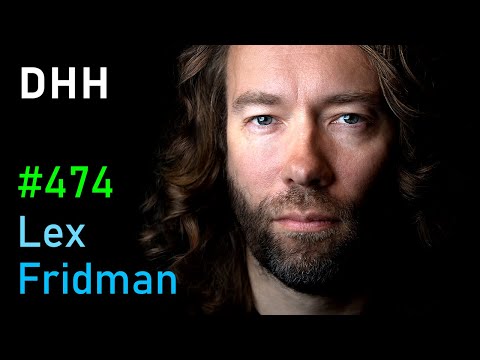
DHH: Future of Programming, AI, Ruby on Rails, Productivity & Parenting | Lex Fridman Podcast #474
David Heinemeier Hansson (guest), Lex Fridman (host), Lex Fridman (host), Lex Fridman (host), Lex Fridman (host), Lex Fridman (host), Lex Fridman (host), Lex Fridman (host)
In this episode of Lex Fridman Podcast, featuring David Heinemeier Hansson and Lex Fridman, DHH: Future of Programming, AI, Ruby on Rails, Productivity & Parenting | Lex Fridman Podcast #474 explores dHH on joyful coding, AI’s limits, small teams, and fatherhood David Heinemeier Hansson (DHH) recounts his late, rocky path into programming, his love affair with Ruby and Rails, and his mission to keep web development simple and joyful. He criticizes the rise of unnecessary complexity in JavaScript tooling, cloud infrastructure, and corporate tech, arguing for monoliths, small teams, and owning your hardware. The conversation ranges from the philosophy of open source and the dangers of platform monopolies to AI-assisted coding, where DHH insists on preserving human competence and craftsmanship. Alongside deep technical and business opinions, he reflects on racing at Le Mans, the discipline of flow, and how marriage and fatherhood reshaped his priorities and sense of meaning.
DHH on joyful coding, AI’s limits, small teams, and fatherhood
David Heinemeier Hansson (DHH) recounts his late, rocky path into programming, his love affair with Ruby and Rails, and his mission to keep web development simple and joyful. He criticizes the rise of unnecessary complexity in JavaScript tooling, cloud infrastructure, and corporate tech, arguing for monoliths, small teams, and owning your hardware. The conversation ranges from the philosophy of open source and the dangers of platform monopolies to AI-assisted coding, where DHH insists on preserving human competence and craftsmanship. Alongside deep technical and business opinions, he reflects on racing at Le Mans, the discipline of flow, and how marriage and fatherhood reshaped his priorities and sense of meaning.
Key Takeaways
Optimize for programmer happiness and aesthetics, not just correctness.
Ruby and Rails are deliberately designed to make code read like prose and feel good to write, even at the cost of parser complexity or a bit of performance. ...
Get the full analysis with uListen AI
Convention over configuration and integrated systems still beat DIY complexity.
Rails’ success comes from strong defaults (“the menu is omakase”), an opinionated monolith, and tools that solve the whole web stack. ...
Get the full analysis with uListen AI
Dynamic typing and metaprogramming enable expressive, powerful domain languages.
DHH defends Ruby’s duck typing and metaprogramming (e. ...
Get the full analysis with uListen AI
The cloud is often an expensive convenience; owning hardware can be a win.
After moving Basecamp/HEY off AWS, 37signals cut infrastructure costs by roughly half to two-thirds without adding staff. ...
Get the full analysis with uListen AI
Open source is a gift economy, not a customer-service contract.
DHH insists users of open source are receiving gifts, not buying support, and creators cannot retroactively demand rent from successful adopters. ...
Get the full analysis with uListen AI
AI coding tools are powerful, but over-reliance erodes real competence.
He loves AI as a pair-programmer, explainer, and research assistant but refuses to let it fully drive his editor. ...
Get the full analysis with uListen AI
Small, manager-free teams with long uninterrupted time outperform bloated orgs.
Basecamp runs with tiny, two-person teams (designer + programmer), almost no standing meetings, and minimal management. ...
Get the full analysis with uListen AI
Career and money are secondary to family, flow, and meaningful responsibility.
Despite significant success, DHH frames marriage and having three kids as the most important choice he’s made, one he nearly missed without his wife’s push. ...
Get the full analysis with uListen AI
Notable Quotes
“Webpages aren’t that different from what they were in the late ’90s. They’re still just forms that write to databases. People are uncomfortable being CRUD monkeys, so they overcomplicate things.”
— DHH
“Ruby was made for my brain like a perfect tailored glove by someone I’d never met.”
— DHH
“If you can just vibe-code it, you’re not a programmer. Then anyone could do it.”
— DHH
“The cookie banner is a monument to good intentions leading straight to hell.”
— DHH
“Mojito Island is a mirage. There is no retirement for ambitious people.”
— DHH
Questions Answered in This Episode
How much dynamic typing and metaprogramming is “too much” before maintainability or onboarding new developers becomes a real problem?
David Heinemeier Hansson (DHH) recounts his late, rocky path into programming, his love affair with Ruby and Rails, and his mission to keep web development simple and joyful. ...
Get the full analysis with uListen AI
In what concrete situations does DHH think cloud infrastructure is still clearly superior to owning servers, and how should a startup decide when to repatriate?
Get the full analysis with uListen AI
How can a young developer today balance learning to code from scratch with becoming an expert “vibe coder” who effectively leverages AI?
Get the full analysis with uListen AI
What are the failure modes of small, manager-free teams, and how would DHH detect and correct when a team truly does need management structure?
Get the full analysis with uListen AI
Given his critique of Apple, Chrome antitrust, and the WordPress dispute, what governance model does DHH consider ideal for large, widely used open source projects?
Get the full analysis with uListen AI
Transcript Preview
No one anywhere who's serious believes that cookie banners does anything good for anyone. Yet, we've been unable to get rid of it. This is the thing that really gets me about cookie banners too. It's not just the EU, it's the entire world. You can't hide from cookie banners anywhere on this planet. If you go to goddamn Mars on one of Elon's rockets and you try to access a webpage, you will still see a cookie banner. No one in the universe is safe from this nonsense. It sometimes feels like we're barely better off. Like, webpages aren't that different from what they were in the late '90s, early 2000s. They're still just forms. They still just write to databases. A lot of people, I think, are very uncomfortable with the fact that they are essentially crud monkeys.
Mm-hmm.
They just make systems that create, read, update or delete rows in the database, and they have to compensate for that existential dread by over-complicating things. That's a huge part of the satisfaction of driving a race car, is driving it at the edge of adhesion, as we call it, where you're essentially just a tiny movement away from spinning out. Doesn't take much, then the car starts rotating. Once it starts rotating, you lose grip and you're going for the wall. That balance of danger and skill is what's so intoxicating.
The following is a conversation with David Heinemeier Hansson, also known as DHH. He is a legend in the programming and tech world, brilliant and insightful, sometimes controversial, and always fun to talk to. He's the creator of Ruby on Rails, which is an influential web development framework behind many websites used by millions of people, including Shopify, GitHub, and Airbnb. He is the co-owner and CTO of 37signals that created Basecamp, HEY, and Once. He is a New York Times bestselling author, together with his co-author Jason Fried, of four books, Rework, Remote, Getting Real, and It Doesn't Have to Be Crazy at Work. And on top of that, he's also a race car driver, including being a class winner at the legendary 24-hour Le Mans race. This is a Lex Fridman podcast. To support it, please check out our sponsors in the description and consider subscribing to this channel. And now, dear friends, here's DHH. For someone who became a legendary programmer, you officially got into programming late in life, and I guess that's because, uh, you tried to learn how to program a few times and you failed. So, can you tell me the, uh, the full story, the saga of your failures to learn programming? Was Commodore 64 involved?
Commodore 64 was the inspiration. I really wanted a Commodore 64. That was the first computer I ever sat down in front. And the way I sat down in front of it was I was five years old and there was this one kid on my street who had a Commodore 64. No one else had a computer, so we were all the kids just getting over there and we were all playing Yie Ar Kung-Fu. I don't know if you've ever seen that game. It was one of the original fighting games. It's really a great game and I was playing that for the first time at five years old. And we were, like, seven kids sitting up in this one kid's bedroom all taking our turn to play the game. And I just found that unbelievably interesting. And I begged and I begged and I begged my dad, "Could I get a computer?"
Install uListen to search the full transcript and get AI-powered insights
Get Full TranscriptGet more from every podcast
AI summaries, searchable transcripts, and fact-checking. Free forever.
Add to Chrome