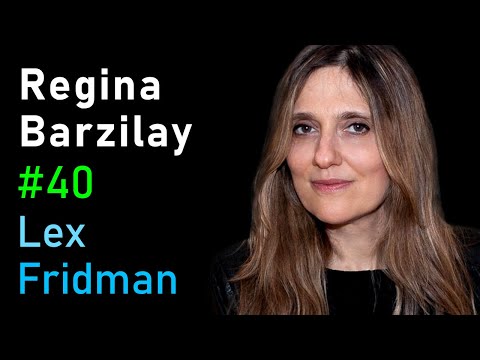
Regina Barzilay: Deep Learning for Cancer Diagnosis and Treatment | Lex Fridman Podcast #40
Lex Fridman (host), Regina Barzilay (guest)
In this episode of Lex Fridman Podcast, featuring Lex Fridman and Regina Barzilay, Regina Barzilay: Deep Learning for Cancer Diagnosis and Treatment | Lex Fridman Podcast #40 explores mIT’s Regina Barzilay on Deep Learning, Cancer, and Life’s Purpose Regina Barzilay, an MIT professor and leading NLP researcher, discusses how deep learning is transforming cancer diagnosis, prevention, and drug discovery, while also reflecting on her own experience as a breast cancer patient. She contrasts data-driven, probabilistic approaches in computer science with mechanistic understanding in biology, arguing that prediction and pattern recognition can save lives even without full explanatory models. Barzilay highlights the massive obstacles to progress in medicine—data access, regulation, incentives, and adoption—often more than algorithmic limitations. Throughout, she weaves in themes of personal meaning, the role of personality in science, and the need for researchers to align their work with what truly matters to them and to society.
MIT’s Regina Barzilay on Deep Learning, Cancer, and Life’s Purpose
Regina Barzilay, an MIT professor and leading NLP researcher, discusses how deep learning is transforming cancer diagnosis, prevention, and drug discovery, while also reflecting on her own experience as a breast cancer patient. She contrasts data-driven, probabilistic approaches in computer science with mechanistic understanding in biology, arguing that prediction and pattern recognition can save lives even without full explanatory models. Barzilay highlights the massive obstacles to progress in medicine—data access, regulation, incentives, and adoption—often more than algorithmic limitations. Throughout, she weaves in themes of personal meaning, the role of personality in science, and the need for researchers to align their work with what truly matters to them and to society.
Key Takeaways
Personality and persistence often determine which scientific ideas succeed.
Barzilay notes that historically, influential figures have slowed or accelerated whole fields—such as delaying statistical NLP—showing that devotion and advocacy can matter as much as raw technical merit in shaping research directions.
Get the full analysis with uListen AI
Early cancer detection is a high‑impact, tractable target for machine learning.
Using imaging and other clinical data, ML models can predict cancer risk years in advance (e. ...
Get the full analysis with uListen AI
Lack of accessible medical datasets is a central bottleneck, not algorithms.
It took Barzilay about two years to get significant mammography data; there is no modern ‘ImageNet for medicine,’ and hospitals face legal risk but limited upside in sharing, severely slowing progress in medical AI.
Get the full analysis with uListen AI
Patient-controlled, consent-based data sharing could unlock medical AI progress.
Barzilay advocates mechanisms akin to organ-donor consent, where patients explicitly donate de‑identified or encrypted data for research, balancing privacy with the collective need for better evidence and decision-making tools.
Get the full analysis with uListen AI
Machine learning is poised to transform drug discovery through graph-based models.
Current drugs are designed via expert chemists plus high-throughput lab screening; Barzilay argues ML can learn from millions of molecules to predict properties and generate improved candidates, exploring chemical space far beyond human intuition.
Get the full analysis with uListen AI
NLP’s biggest gaps now involve generalization, few-shot learning, and robustness.
While translation and other tasks have improved dramatically, models remain brittle under domain shift (e. ...
Get the full analysis with uListen AI
Serious illness can radically reorder what research feels meaningful.
After her own breast cancer, Barzilay found much of mainstream academic work trivial, shifted toward projects that alleviate suffering (like oncology and drug design), and urges scientists to align their careers with what genuinely matters to them.
Get the full analysis with uListen AI
Notable Quotes
“Ideas on their own are not sufficient; it’s the personalities and their devotion that locally change the scientific landscape.”
— Regina Barzilay
“I walked out of MIT, where people really care what happened to your ICLR paper, into a world of real suffering—and it was the first time I saw real life.”
— Regina Barzilay
“Detection is crucial. For many cancers, by the time we find them, they’re essentially a sentence.”
— Regina Barzilay
“The barrier is not the algorithm. The barrier is this other piece—how you change standards of care and drive adoption in a very complex system.”
— Regina Barzilay
“Since we have limited time on Earth, it’s important to prioritize things that really matter to you, which may not be what matters to the rest of your scientific community.”
— Regina Barzilay
Questions Answered in This Episode
What concrete steps could governments and hospitals take to safely open large, standardized medical datasets for AI research while preserving patient trust and privacy?
Regina Barzilay, an MIT professor and leading NLP researcher, discusses how deep learning is transforming cancer diagnosis, prevention, and drug discovery, while also reflecting on her own experience as a breast cancer patient. ...
Get the full analysis with uListen AI
How should we evaluate and regulate AI systems that are clearly more accurate than existing clinical heuristics (like breast density) but face entrenched standards and legal inertia?
Get the full analysis with uListen AI
In drug discovery, what would it take for the first widely-used therapy to be credibly described as ‘machine-learning–designed,’ and how might that change pharmaceutical R&D?
Get the full analysis with uListen AI
How can young researchers practically balance career incentives (papers, prestige) with the desire to work on problems that meaningfully reduce human suffering?
Get the full analysis with uListen AI
Given the brittleness and data hunger of current deep learning systems, what new paradigms or learning principles might be needed to approach human-like generalization in language and medicine?
Get the full analysis with uListen AI
Transcript Preview
The following is a conversation with Regina Barzilay. She's a professor at MIT and a world-class researcher in natural language processing and applications of deep learning to chemistry and oncology or the use of deep learning for early diagnosis, prevention, and treatment of cancer. She's also been recognized for teaching of several successful AI-related courses at MIT including the popular Introduction to Machine Learning course. This is the Artificial Intelligence podcast. If you enjoy it, subscribe on YouTube, give it five stars on iTunes, support it on Patreon or simply connect with me on Twitter @lexfridman, spelled F-R-I-D-M-A-N. And now here's my conversation with Regina Barzilay. In an interview you've mentioned that if there's one course you would take, it would be a literature course with a friend of yours, uh, that a friend of yours teaches. Just out of curiosity, 'cause I couldn't find anything on it, are there books or ideas that had profound impact on your life journey, books and ideas perhaps outside of computer science and the technical fields?
I think because I'm spending a lot of my time at MIT and previously in other institutions where I was a student, I have limited ability to interact with people so a lot of what I know about the world actually comes from books, uh, and there were quite a number of books that had profound impact on me and how I view the world. Let me just give you, mm, one example of such a book. I've, um, maybe a year ago read a book called The Emperor of All Maladies. It's a book about, um, it's kind of a history of science book on how the treatments and drugs for cancer were developed, and that book, despite the fact that I am in the business of science, really opened my eyes on how imprecise and imperfect the discovery process is, a- and how imperfect our current solutions, uh, and what makes science succeed and be implemented and sometimes it's actually not the strengths of the idea but devotion of the person who wants to see it implemented. So, this is one of the books that, you know, at least for the last year quite changed the way I'm thinking about scientific process just from the historical perspective and what do I need to do to make my ideas really implemented. Let me give you an example of a book which is not a kind of, uh, which is a fiction book, is a book called Americanah and this is a book about a young female student who comes from Africa to study in the United States and it describes her past, uh, you know, within her studies and, uh, her life transformation that, you know, i- in a new country and kind of adaptation to a new culture.
Mm-hmm.
And when I read this book, I saw myself in many different points of it, uh, but- but it also (laughs) kind of gave me the- the lens on different events and some events that I never actually paid attention. One of the funny stories in this book is how she, uh, arrives, uh, to- to her c- new college and she starts speaking in English and she had this beautiful British a- accent because that's how she was educated-
Install uListen to search the full transcript and get AI-powered insights
Get Full TranscriptGet more from every podcast
AI summaries, searchable transcripts, and fact-checking. Free forever.
Add to Chrome