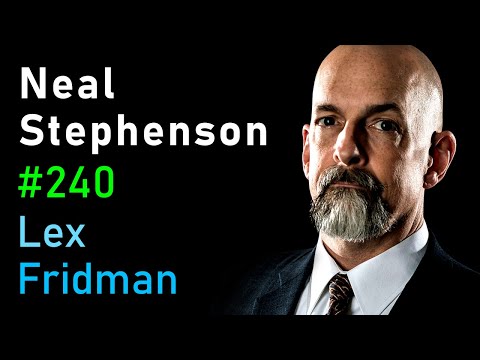
Neal Stephenson: Sci-Fi, Space, Aliens, AI, VR & the Future of Humanity | Lex Fridman Podcast #240
Lex Fridman (host), Neal Stephenson (guest)
In this episode of Lex Fridman Podcast, featuring Lex Fridman and Neal Stephenson, Neal Stephenson: Sci-Fi, Space, Aliens, AI, VR & the Future of Humanity | Lex Fridman Podcast #240 explores neal Stephenson on tech, truth, and the fragile future of humanity Lex Fridman and Neal Stephenson range across history, space exploration, AI, virtual and augmented reality, climate change, and cryptocurrencies, constantly looping back to human nature and our capacity for good and evil.
Neal Stephenson on tech, truth, and the fragile future of humanity
Lex Fridman and Neal Stephenson range across history, space exploration, AI, virtual and augmented reality, climate change, and cryptocurrencies, constantly looping back to human nature and our capacity for good and evil.
Stephenson argues that technology reveals rather than fixes human nature, and that many of our biggest trajectories—interstellar travel, Mars colonization, geoengineering, and social media—are constrained less by physics than by economics, politics, and psychology.
They discuss how narratives, from World War II to science fiction and internet memes, shape our collective behavior and aspirations, including projects like Blue Origin, SpaceX, and decentralized technologies such as Bitcoin.
Underlying the conversation is the idea that explanatory knowledge and bold experimentation—whether in science, engineering, or storytelling—may be the only real way forward for a species that is both dangerous and uniquely capable of understanding the universe.
Key Takeaways
Technology amplifies human nature more than it reforms it.
Stephenson notes that despite dramatic gains in health and living standards, people still seek reasons to be angry and divisive; tools like social media expose and scale existing psychological tendencies rather than curing them.
Get the full analysis with uListen AI
Interstellar travel is technically possible but economically irrational with current paradigms.
He argues that the energy, life-support, and risk requirements for meaningful interstellar journeys are so immense that only religious or deeply non-economic motives would justify them, making large-scale habitats in our own solar system far more sensible.
Get the full analysis with uListen AI
Solar geoengineering is technically easy, politically explosive, and likely to be unilateral.
Drawing from ‘Termination Shock’ and actual climate science, he explains that injecting sulfur into the stratosphere to cool the planet is cheap and reversible in physical terms, but almost impossible to coordinate democratically, so it may be attempted by a single state or actor once climate impacts become severe enough.
Get the full analysis with uListen AI
VR/AR’s bottleneck is less imagination than hard engineering and a killer use case.
From his time at Magic Leap, Stephenson emphasizes that technologies like real-time SLAM, low-latency rendering, and eye tracking are nontrivial prerequisites; only once those are solid can compelling consumer or industrial applications meaningfully emerge.
Get the full analysis with uListen AI
Decentralized tech’s most transformative potential may lie beyond “money” itself.
He suggests that while cryptocurrencies matter, cryptographically enforced contracts and new forms of organizations—and possibly markets in truth claims—could have deeper structural effects on power, governance, and how we settle disputes.
Get the full analysis with uListen AI
Rigorous detail in fiction makes stories more immersive and believable.
Stephenson uses real math, physics, and engineering constraints to discover unexpected plot details; this realism helps readers suspend disbelief and gives his speculative worlds the complexity and surprise of actual reality.
Get the full analysis with uListen AI
Finding work you can lose yourself in is more important than abstract ideals.
As advice to young people, he stresses discovering activities you naturally spend hours on—then pushing through the initial phase of incompetence—because real impact comes from where deep interest and sustained attention align.
Get the full analysis with uListen AI
Notable Quotes
“We were never allowed to have illusions anymore about human nature… even in a supposedly enlightened, civilized society, people can become monsters quite easily.”
— Neal Stephenson
“The amount of energy needed to get to another star system in a few lifetimes is just staggering… economically, it makes more sense to build rotating cylindrical space habitats and make them perfect.”
— Neal Stephenson
“Solar geoengineering would be comparatively so cheap and easy to implement that someone is probably going to do it once things get bad enough.”
— Neal Stephenson
“If you’ve got a good yarn going that people will enjoy reading, then you’re free to do whatever you want inside that frame. If you don’t have that, then you’ve got nothing.”
— Neal Stephenson
“As far as I know we’re unique in the universe… there’s no evidence that there’s anything else as complicated as what’s between our ears.”
— Neal Stephenson
Questions Answered in This Episode
If technology mostly reveals rather than improves human nature, what governance or cultural mechanisms could counterbalance its amplifying effects on anger and division?
Lex Fridman and Neal Stephenson range across history, space exploration, AI, virtual and augmented reality, climate change, and cryptocurrencies, constantly looping back to human nature and our capacity for good and evil.
Get the full analysis with uListen AI
Under what circumstances, if any, should a single nation or actor be morally justified in undertaking unilateral solar geoengineering?
Stephenson argues that technology reveals rather than fixes human nature, and that many of our biggest trajectories—interstellar travel, Mars colonization, geoengineering, and social media—are constrained less by physics than by economics, politics, and psychology.
Get the full analysis with uListen AI
How might long-lived, economically irrational projects—like interstellar generation ships—reshape our concepts of value, success, and purpose?
They discuss how narratives, from World War II to science fiction and internet memes, shape our collective behavior and aspirations, including projects like Blue Origin, SpaceX, and decentralized technologies such as Bitcoin.
Get the full analysis with uListen AI
What forms of decentralized organizations or smart contracts could genuinely shift political or economic power away from entrenched institutions rather than simply recreating them on-chain?
Underlying the conversation is the idea that explanatory knowledge and bold experimentation—whether in science, engineering, or storytelling—may be the only real way forward for a species that is both dangerous and uniquely capable of understanding the universe.
Get the full analysis with uListen AI
As VR and AR mature, how do we prevent the most engaging virtual experiences from displacing engagement with physical reality in ways that harm individual or societal well-being?
Get the full analysis with uListen AI
Transcript Preview
The following is a conversation with Neal Stephenson, a legendary science fiction writer exploring ideas in mathematics, science, cryptography, money, linguistics, philosophy, and virtual reality, from his early book, Snow Crash, to his new one called Termination Shock. He doesn't just write novels. He worked at the space company Blue Origin for many years, including, technically, being Blue Origin's first employee. He also was the chief futurist at the virtual reality company Magic Leap. This is the Lex Fridman Podcast. To support it, please check out our sponsors in the description. And now, here's my conversation with Neal Stephenson. You write both historical fiction, like World War II in Cryptonomicon, and science fiction-
Mm-hmm.
... looking both into the past and the future. So let me ask, does history repeat itself? In which way does it repeat itself? In which way does it not?
I'm afraid it repeats itself a lot. Um, so I, I think human nature kind of is what it is, and so we tend to see similar behavior patterns emerging again and again. And so, uh, it's, it's kind of the, uh, exception rather than the rule when something new happens.
What role does technology play in the suppression or in revealing human nature?
Well, the standards of living, uh, life expectancy, all that, have gotten incredibly better within the last, particularly the last 100 years. I mean, just antibiotics, um, modern vaccines, electrification, uh, the internet, um, these are all, uh, improvements in most peoples' standard of living and health and longevity that, um, that exceed anything that was seen before in, in human history. Um, so, um, so people are living longer, they're generally healthier, and so on. Uh, but again, um, we still see a lot of the same behavior patterns, some of which are, uh, not very attractive.
So some of it has to do with the constraints on resources. Presumably, with technology, you have less and less constraints on resources, so we get to maybe emphasize the better angels of our nature? And in, in so doing, does that not potentially fundamentally alter the sort of th- the experience that we have of life on Earth?
Y- you know, until the last 10 or so years, I would've, uh, taken that view, I think, but, um, you know, uh, uh, people w- w- will find ways to be, um, to be divisive and angry, um, if it scratches a kind of psychological itch that they have got. And, um, we used to look at the Weimar Republic, um, what happened in the economic collapse of Germany prior to, um, the, the rise of Hitler, um, World War II, uh, and kind of, uh, explain Hitler, at least partially, by, um, just the, the misery that people were living in at that time. Um-
The economic collapse.
Yeah. The hyperinflation and unemployment and, um, the, the decline in standard of, of living. And that sounds like a, a plausible, uh, explanation, but there are economic troubles now for sure. We had the bank collapse in 2008, um, and there's stagnation in some peoples' standards of living. But it's hard to explain what we've seen in this country in the last few years just strictly on the basis of, uh, people are poor and angry and sad. I think they wanna be angry.
Install uListen to search the full transcript and get AI-powered insights
Get Full TranscriptGet more from every podcast
AI summaries, searchable transcripts, and fact-checking. Free forever.
Add to Chrome