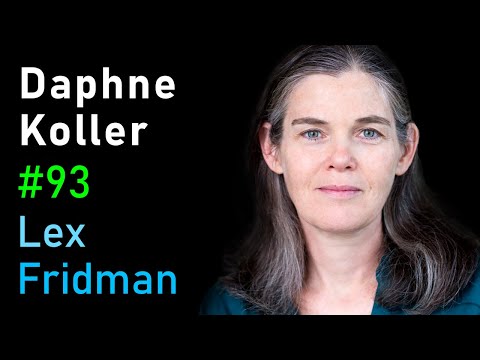
Daphne Koller: Biomedicine and Machine Learning | Lex Fridman Podcast #93
Lex Fridman (host), Daphne Koller (guest)
In this episode of Lex Fridman Podcast, featuring Lex Fridman and Daphne Koller, Daphne Koller: Biomedicine and Machine Learning | Lex Fridman Podcast #93 explores daphne Koller on using machine learning to reinvent drug discovery Daphne Koller discusses how modern machine learning, coupled with new biological tools, can transform our understanding of disease and the drug discovery process. She explains the limits of current medical knowledge, especially for complex, heterogeneous diseases like Alzheimer’s and schizophrenia, and why traditional animal models often fail. Koller describes insitro’s strategy of building large, high-quality “disease-in-a-dish” datasets using stem cells, CRISPR, and advanced cellular measurements, then learning predictive models to find effective interventions. The conversation also touches on MOOCs and global education, AI safety and uncertainty, and her broader philosophy about impact, ethics, and the meaning of a good life.
Daphne Koller on using machine learning to reinvent drug discovery
Daphne Koller discusses how modern machine learning, coupled with new biological tools, can transform our understanding of disease and the drug discovery process. She explains the limits of current medical knowledge, especially for complex, heterogeneous diseases like Alzheimer’s and schizophrenia, and why traditional animal models often fail. Koller describes insitro’s strategy of building large, high-quality “disease-in-a-dish” datasets using stem cells, CRISPR, and advanced cellular measurements, then learning predictive models to find effective interventions. The conversation also touches on MOOCs and global education, AI safety and uncertainty, and her broader philosophy about impact, ethics, and the meaning of a good life.
Key Takeaways
We understand only a small fraction of major diseases, and many are actually heterogeneous syndromes.
For conditions like Alzheimer’s and schizophrenia, Koller argues we are “closer to 0 than 80” in understanding mechanisms, and they likely comprise multiple distinct biological subtypes that only look similar clinically.
Get the full analysis with uListen AI
Animal models often fail because they mimic symptoms, not human mechanisms.
Mice rarely develop human diseases naturally; researchers engineer rough phenotypic copies that frequently don’t share causal pathways with human illness, so drugs that ‘work’ in mice fail in people.
Get the full analysis with uListen AI
Disease-in-a-dish models enable more human-relevant, data-rich experimentation.
By reprogramming human cells into induced pluripotent stem cells (iPSCs) and differentiating them into relevant cell types, then perturbing them (e. ...
Get the full analysis with uListen AI
The real innovation is designing biology and experiments around machine learning needs.
Instead of treating ML as an afterthought on existing small datasets, insitro explicitly engineers large-scale, high-quality cellular and molecular data so powerful models can learn predictive representations useful for target discovery and intervention design.
Get the full analysis with uListen AI
New measurement technologies are turning ‘squishy’ biology into digital data.
Techniques like single-cell RNA sequencing and high-resolution microscopy generate quantitative, high-dimensional snapshots of cells and subcellular structure, providing rich inputs for ML to detect patterns, subtypes, and candidate interventions.
Get the full analysis with uListen AI
Short, modular, interactive content dramatically improves online learning outcomes.
From Coursera experience, Koller notes that 5–7 minute videos, compressed content, embedded micro-quizzes, and shorter, stackable courses align better with adult learners’ lives and attention, and support flipped-classroom use on campus.
Get the full analysis with uListen AI
AI systems must learn to represent and communicate uncertainty, especially in safety-critical domains.
Current deep nets are often overconfident and poorly calibrated, especially off-distribution; Koller highlights Bayesian techniques, ensembles, and explicit “I don’t know” behavior as essential for medicine, autonomous driving, and other high-stakes uses.
Get the full analysis with uListen AI
Notable Quotes
““We’ve been able to provide treatment for an increasingly large number [of diseases], but the number of things that you could actually define to be cures is actually not that large.””
— Daphne Koller
““Mice don’t get Alzheimer’s, they don’t get diabetes, they don’t get atherosclerosis, they don’t get autism or schizophrenia… and those cures don’t translate over to what happens in the human.””
— Daphne Koller
““What we are doing at insitro is actually flipping that around… putting [biological methods] together in brand new ways with the goal of creating datasets that machine learning can really be applied on productively.””
— Daphne Koller
““Machine learning algorithms today are really exquisitely good pattern recognizers in very specific problem domains… We’re nowhere close to the versatility and flexibility of even a human toddler.””
— Daphne Koller
““Our goal in life should be to make a dent in the universe… that I have left the world a better place than it was when I entered it.””
— Daphne Koller
Questions Answered in This Episode
How can we rigorously validate that disease-in-a-dish cellular improvements will translate into meaningful clinical benefits for patients?
Daphne Koller discusses how modern machine learning, coupled with new biological tools, can transform our understanding of disease and the drug discovery process. ...
Get the full analysis with uListen AI
What kinds of diseases or biological systems are still fundamentally out of reach for current iPSC and organoid-based modeling?
Get the full analysis with uListen AI
How should regulators adapt drug-approval pathways when AI-driven models, rather than traditional animal studies, generate much of the mechanistic evidence?
Get the full analysis with uListen AI
In education, how might universities need to change incentives and structures so faculty can invest the extra time required for truly high-quality online and flipped teaching?
Get the full analysis with uListen AI
What concrete standards or testing frameworks would Koller like to see adopted to ensure AI systems are robust and uncertainty-aware before they’re deployed in medicine and other safety-critical domains?
Get the full analysis with uListen AI
Transcript Preview
The following is a conversation with Daphne Koller, a professor of computer science at Stanford University, a co-founder of Coursera with Andrew Ng, and founder and CEO of insitro, a company at the intersection of machine learning and biomedicine. We're now in the exciting early days of using the data-driven methods of machine learning to help discover and develop new drugs and treatments at scale. Daphne and insitro are leading the way on this with breakthroughs that may ripple through all fields of medicine, including ones most critical for helping with the current coronavirus pandemic. This conversation was recorded before the COVID-19 outbreak. For everyone feeling the medical, psychological, and financial burden of this crisis, I'm sending love your way. Stay strong. We're in this together. We'll beat this thing. This is the Artificial Intelligence podcast. If you enjoy it, subscribe on YouTube, review it with five stars on Apple podcasts, support it on Patreon, or simply connect with me on Twitter, @lexfridman, spelled F-R-I-D-M-A-N. As usual, I'll do a few minutes of ads now, and never any ads in the middle that can break the flow of this conversation. I hope that works for you and doesn't hurt the listening experience. This show is presented by Cash App, the number one finance app in the App Store. When you get it, use code LEXPODCAST. Cash App lets you send money to friends, buy Bitcoin, and invest in the stock market with as little as $1. Since Cash App allows you to send and receive money digitally peer-to-peer, and security in all digital transactions is very important, let me mention that PCI data security standard that Cash App is compliant with. I'm a big fan of standards for safety and security. PCI DSS is a good example of that, where a bunch of competitors got together and agreed that there needs to be a global standard around the security of transactions. Now we just need to do the same for autonomous vehicles and AI systems in general. So again, if you get Cash App from the App Store or Google Play, and use the code LEXPODCAST, you get $10 and Cash App will also donate $10 to FIRST, an organization that is helping to advance robotics and STEM education for young people around the world. And now, here's my conversation with Daphne Koller. So you co-founded Coursera and made a huge impact in the global education of AI, and after five years, in August 2016, wrote a blog post saying that you're stepping away and wrote, quote, "It is time for me to turn to another critical challenge, the development of machine learning and its applications to improving human health." So let me ask two far out philosophical questions. One, do you think we will one day find cures for all major diseases known today? And two, do you think we will one day figure out a way to extend the human lifespan, perhaps to the point of immortality?
Install uListen to search the full transcript and get AI-powered insights
Get Full TranscriptGet more from every podcast
AI summaries, searchable transcripts, and fact-checking. Free forever.
Add to Chrome