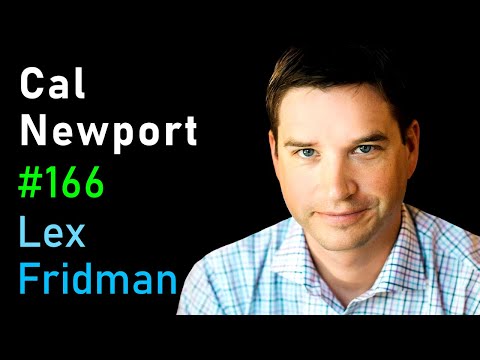
Cal Newport: Deep Work, Focus, Productivity, Email, and Social Media | Lex Fridman Podcast #166
Lex Fridman (host), Cal Newport (guest), Narrator, Narrator, Narrator, Narrator
In this episode of Lex Fridman Podcast, featuring Lex Fridman and Cal Newport, Cal Newport: Deep Work, Focus, Productivity, Email, and Social Media | Lex Fridman Podcast #166 explores cal Newport Explains Deep Work, Email Overload, And Digital Minimalism Cal Newport and Lex Fridman explore the concept of deep work—long, undistracted focus on cognitively demanding tasks—as the core driver of meaningful productivity, learning, and life satisfaction.
Cal Newport Explains Deep Work, Email Overload, And Digital Minimalism
Cal Newport and Lex Fridman explore the concept of deep work—long, undistracted focus on cognitively demanding tasks—as the core driver of meaningful productivity, learning, and life satisfaction.
They argue that constant context switching, driven largely by email, social media, and chat tools, is cognitively poisonous and a root cause of burnout, shallow work, and the feeling of chaos in modern knowledge work.
Newport outlines practical frameworks like time blocking, multi-scale planning (quarterly/weekly/daily), and process engineering to reduce dependence on ad-hoc email and Slack communication, especially within organizations.
They also discuss digital minimalism, boredom as a fundamental human drive toward meaningful action, the potential of emerging platforms like Clubhouse, and how relationships, seasonality, and a personal "code" fit into a well-lived, productive life.
Key Takeaways
Deep work is the primary driver of high-value knowledge work.
Newport defines deep work as focused, distraction-free concentration on demanding tasks and argues it is the "tier one" skill for complex problem-solving, skill acquisition, and truly impactful output, yet modern workplaces and tools are structured to almost eliminate it.
Get the full analysis with uListen AI
Context switching severely degrades thinking and fuels exhaustion.
Even brief shifts—like checking email or Twitter for a few seconds—trigger neurological cascades that suppress and re-activate different neural networks, leaving residue that can take up to 20 minutes to clear, sharply reducing clarity and increasing fatigue over the day.
Get the full analysis with uListen AI
Time blocking and multi-scale planning create intentional days.
By planning quarterly goals, weekly priorities, and then blocking each day into specific tasks (especially 60–90 minute deep work blocks), you avoid being driven by inboxes and to-do lists, dramatically increasing meaningful output without necessarily working more hours.
Get the full analysis with uListen AI
Email itself isn’t the enemy; the ‘hyperactive hive mind’ is.
The real problem is using email/Slack for all collaboration via constant unscheduled, back-and-forth messaging, which forces people to check inboxes every few minutes; replacing this workflow with clearer processes and tools can unlock huge productivity gains.
Get the full analysis with uListen AI
Design explicit processes to reduce back-and-forth communication.
Instead of improvising everything over email, define repeatable workflows (for scheduling, client questions, content production, etc. ...
Get the full analysis with uListen AI
Intentional digital minimalism works better than sheer abstinence.
Newport’s 30-day ‘digital declutter’ encourages people to step away from optional digital tools, listen to their boredom, rediscover offline activities and values, then reintroduce only the technologies that clearly support those values, with strict rules on how they’re used.
Get the full analysis with uListen AI
Seasonality, multiple “waves,” and strong relationships prevent burnout.
Running a few major pursuits out of phase (e. ...
Get the full analysis with uListen AI
Notable Quotes
“Context shifting kills the human capacity to think.”
— Cal Newport
“We’ve accidentally created circumstances where we just don’t do a lot of focus.”
— Cal Newport
“The real title [of A World Without Email] should be A World Without the Hyperactive Hive Mind Workflow.”
— Cal Newport
“The days on which I’m able to accomplish several hours of that kind of work, I’m happy.”
— Lex Fridman
“Clarity about what matters provides clarity about what does not.”
— Cal Newport
Questions Answered in This Episode
How could I redesign my own work processes this month to reduce unscheduled back-and-forth messaging and free up more time for deep work?
Cal Newport and Lex Fridman explore the concept of deep work—long, undistracted focus on cognitively demanding tasks—as the core driver of meaningful productivity, learning, and life satisfaction.
Get the full analysis with uListen AI
What would a 30-day ‘digital declutter’ look like in my life, and what might boredom reveal about the activities and technologies that genuinely matter to me?
They argue that constant context switching, driven largely by email, social media, and chat tools, is cognitively poisonous and a root cause of burnout, shallow work, and the feeling of chaos in modern knowledge work.
Get the full analysis with uListen AI
Where in my day do micro context switches (email, chat, phone checks) most often occur, and how could I experiment with 60–90 minute truly uninterrupted blocks?
Newport outlines practical frameworks like time blocking, multi-scale planning (quarterly/weekly/daily), and process engineering to reduce dependence on ad-hoc email and Slack communication, especially within organizations.
Get the full analysis with uListen AI
If I mapped my main responsibilities into explicit processes, which ones are most obviously trapped in the hyperactive hive mind, and what simple tools could replace that?
They also discuss digital minimalism, boredom as a fundamental human drive toward meaningful action, the potential of emerging platforms like Clubhouse, and how relationships, seasonality, and a personal "code" fit into a well-lived, productive life.
Get the full analysis with uListen AI
Beyond productivity, what relationships and non-work commitments would I need to prioritize or repair so that I feel resilient and proud looking back on my life?
Get the full analysis with uListen AI
Transcript Preview
The following is a conversation with Cal Newport. He's a friend and someone whose writing, like his book Deep Work, for example, has guided how I strive to approach productivity and life in general. He doesn't use social media, and in his book, Digital Minimalism, he encourages people to find the right amount of social media usage that provides value and joy. He has a new book out called A World Without Email, where he argues brilliantly, I would say, that email is destroying productivity in companies and in our lives. And, very importantly, he offers solutions. He is a computer scientist at Georgetown University who practices what he preaches. To do theoretical computer science at the level that he does it, you really have to live a focused life that minimizes distractions and maximizes hours of deep work. Lastly, he's a host of an amazing podcast called Deep Questions that I highly recommend for anyone who wants to improve their productive life. Quick mention of our sponsors: ExpressVPN, Linode Linux Virtual Machines, Sun Basket meal delivery service, and SimpliSafe home security. Click the sponsor links to get a discount and to support this podcast. As a side note, let me say that deep work or long periods of deep focused thinking have been something I've been chasing more and more over the past few years. Deep work is hard, but it's ultimately the thing that makes life so damn amazing. The ability to create things you're passionate about in a flow state where the distractions of the world just fade away. Social media, yes, reading the comments, yes, I still read the comments, is a source of joy for me in strict moderation. Too much takes away the focused mind, and too little, at least I think, takes away all of the fun. We need both, the focus and the fun. If you enjoy this thing, subscribe on YouTube, review it on Apple Podcast, follow on Spotify, support on Patreon, or connect with me on Twitter @lexfridman, if you can only figure out how to spell that. And now, here's my conversation with Cal Newport. What is deep work? Let's start with the big question.
So, I mean, it's, it's my term for when you're focusing without distraction on a cognitively demanding task, which is something we've all done, but we had never really given it a name necessarily that was separate from other type of work. And so I gave it a name and said, "Let's compare that to other types of efforts you might do while you're working and see that the deep work efforts actually have a huge benefit that we might be underestimating."
What does it mean to, to work deeply on something?
I, you know, I had been calling it hard focus in my writing, uh, before that. Well, so the context you would understand, I was in the Theory Group in CSAIL at MIT, right? So I was surrounded, at the time when I was coming up with these ideas, by these professional theoreticians. And that's like a murderer's row of thinkers there, right? I mean, it's like Turing Award, Turing Award, MacArthur, Turing Award. I mean, y-y-you know the crew, right?
Install uListen to search the full transcript and get AI-powered insights
Get Full TranscriptGet more from every podcast
AI summaries, searchable transcripts, and fact-checking. Free forever.
Add to Chrome