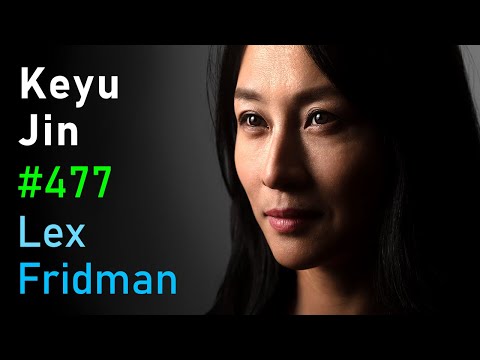
Keyu Jin: China's Economy, Tariffs, Trade, Trump, Communism & Capitalism | Lex Fridman Podcast #477
Lex Fridman (host), Keyu Jin (guest)
In this episode of Lex Fridman Podcast, featuring Lex Fridman and Keyu Jin, Keyu Jin: China's Economy, Tariffs, Trade, Trump, Communism & Capitalism | Lex Fridman Podcast #477 explores china’s Hybrid Model: Fierce Capitalism, Socialist Fabric, and Misunderstood Power Lex Fridman and economist Keyu Jin explore how China’s economy actually works, challenging Western misconceptions that it is centrally run, anti-entrepreneurial, and purely communist. Jin explains China’s unique mix of political centralization and economic decentralization, highlighting the “mayor economy,” intense local competition, and a deeply capitalist private sector embedded in a socialist social fabric.
China’s Hybrid Model: Fierce Capitalism, Socialist Fabric, and Misunderstood Power
Lex Fridman and economist Keyu Jin explore how China’s economy actually works, challenging Western misconceptions that it is centrally run, anti-entrepreneurial, and purely communist. Jin explains China’s unique mix of political centralization and economic decentralization, highlighting the “mayor economy,” intense local competition, and a deeply capitalist private sector embedded in a socialist social fabric.
They discuss Confucian roots of meritocracy and harmony, the impacts of the one‑child policy, real estate and demographic challenges, and how industrial policy and crisis-driven innovation (e.g., EVs, solar, DeepSeek) propel China’s technological rise. The conversation contrasts U.S. and Chinese models on innovation, regulation, immigration, tariffs, and finance, arguing that both have benefited from the U.S.-led liberal order.
Jin criticizes U.S. tariffs and tech sanctions as counterproductive, accelerating China’s domestic capabilities, and stresses that tariffs don’t fix underlying macro imbalances. She also examines sensitive issues like Jack Ma, the limits placed on Chinese entrepreneurs, Taiwan as both political symbol and semiconductor hub, and the deep mutual misunderstandings between China and the West.
Throughout, she emphasizes that China is neither collapsing nor destined to dominate everything; instead it is a complex, evolving system wrestling with trade‑offs between growth, social harmony, technological ambition, and political control.
Key Takeaways
China’s economy is highly decentralized and ferociously competitive despite centralized politics.
Local mayors and provincial leaders drive growth, investment, and sector pushes, competing against each other on GDP, innovation, and now environment, creating a bottom-up dynamism that contradicts the Western image of a monolithic, centrally managed economy.
Get the full analysis with uListen AI
China runs on capitalist incentives within a socialist social fabric.
State-owned enterprises and banks dominate key sectors and social programs emphasize communal life and equality, yet private firms are ruthless, profit-driven, and innovative, and individuals are intensely focused on wealth, education, and status.
Get the full analysis with uListen AI
Confucian meritocracy and extreme educational competition both powered growth and now constrain creativity.
Standardized exams historically enabled social mobility and produced a capable bureaucracy and entrepreneurial class, but the system also molds conformist, box-maximizing thinkers, making truly original, zero‑to‑one breakthroughs harder than pragmatic, solution-focused innovation.
Get the full analysis with uListen AI
China’s industrial policy and ‘mayor economy’ excel at starting and scaling new sectors but waste capital.
Aggressive state-backed pushes (e. ...
Get the full analysis with uListen AI
U.S. tariffs and tech sanctions often backfire by accelerating China’s domestic capabilities.
Measures like Trump’s tariffs and Biden’s export controls spurred a whole‑of‑nation ‘crisis innovation’ response, pushing China to localize semiconductors and AI (e. ...
Get the full analysis with uListen AI
China’s biggest structural challenge is boosting consumption, not production.
The existing political and fiscal model brilliantly scaled supply—via infrastructure, real estate, and exports—but underdeveloped social safety nets, demographic pressures, and the real estate downturn keep households cautious, suggesting local official incentives must be realigned toward jobs, services, and consumption.
Get the full analysis with uListen AI
Demographics, real estate stress, and political caution will slow China, but collapse is unlikely.
Despite an aging society, a property bust, and eroding meritocracy, China retains strong human capital, infrastructure, macro stability, and entrepreneurial energy; historical fears of imminent collapse have repeatedly been wrong, though sustained high growth now depends more on political choices than on economic capacity.
Get the full analysis with uListen AI
Notable Quotes
“The biggest misunderstanding is somehow that a group of people, or even just one person, runs the entire Chinese economy.”
— Keyu Jin
“I’ve rarely seen a more capitalist society than China, from the pure economic side.”
— Keyu Jin
“You can have dynamic entrepreneurialism and socialist characteristics at the same time; it’s not black and white.”
— Keyu Jin
“Tariffs don’t make sense to economists either, and economists are not all dumb.”
— Keyu Jin
“China’s political model was brilliant at scaling up supply, but extremely weak at raising personal consumption.”
— Keyu Jin
Questions Answered in This Episode
How should Western policymakers and media change their framework for analyzing China if they took the ‘mayor economy’ and true decentralization seriously?
Lex Fridman and economist Keyu Jin explore how China’s economy actually works, challenging Western misconceptions that it is centrally run, anti-entrepreneurial, and purely communist. ...
Get the full analysis with uListen AI
What concrete reforms could China implement to restore meritocracy in hiring and reduce the growing role of connections in job allocation?
They discuss Confucian roots of meritocracy and harmony, the impacts of the one‑child policy, real estate and demographic challenges, and how industrial policy and crisis-driven innovation (e. ...
Get the full analysis with uListen AI
If copying and rapid diffusion have been strengths so far, how might China’s legal and cultural attitudes toward IP need to evolve to support world-leading original innovation?
Jin criticizes U. ...
Get the full analysis with uListen AI
Given that tariffs are economically inefficient but politically popular, what alternative tools could democracies use to both protect workers and remain deeply integrated in global trade?
Throughout, she emphasizes that China is neither collapsing nor destined to dominate everything; instead it is a complex, evolving system wrestling with trade‑offs between growth, social harmony, technological ambition, and political control.
Get the full analysis with uListen AI
How might the tension between China’s desire for technological supremacy and its fear of highly powerful private capital be resolved without stalling innovation?
Get the full analysis with uListen AI
Transcript Preview
The following is a conversation with Keyu Jin, an economist at the London School of Economics specializing in China's economy, international macroeconomics, global trade imbalances, and financial policy. She wrote the highly lauded book on China titled The New China Playbook: Beyond Socialism and Capitalism that details China's economic transformation since 1978 to today, and it dispels a lot of misconceptions about China's economy that people in the West have. This is the Lex Fridman podcast. To support it, please check out our sponsors in the description and consider subscribing to this channel. And now, dear friends, here's Keyu Jin. What is the single biggest misconception the West has about China's economy today?
The biggest misunderstanding is somehow that a group of people, or even just one person, runs the entire Chinese economy. It is far from the v- reality. It is a very complex, large economy and even if there is an extreme form of political centralization, the economy is totally decentralized. The role that the local mayors, I call this the mayor economy, plays in reforms but also driving the technological innovation that we're seeing right now, it is actually not run by just a handful of people. It's more decentralized than the US is. And I think more broadly, a big misunderstanding is really the r- relationship between Chinese people and authority.
Can you elaborate on that?
Well, you know, people think that somehow there's almost blind submission to authority in China. We have a very nuanced relationship, uh, with authority, whether it is, you know, between kids and parents or, um, students and their teachers or with your bosses and the Chinese government. It's kind of the same thing. There's paternalism, uh, they think that they're responsible for you, um, but, uh, deference, a certain amount of deference to authority is not blind submission. It's been written implicitly in our contract, uh, for thousands of years that in exchange for some deference, uh, we are given stability, security, and peace, and hopefully prosperity.
So there is some element that we have in the West of freedom of the individual, so that a little bit of the rebel is allowed, uh, in balance with the deference to authority?
Yeah, absolutely. Without that, how can you have this radical, dynamic entrepreneurialism you see in China? If you don't have a sense of self, a sense of, uh, the fact that you can find opportunities, you look for opportunities, you, you, you drive opportunities, um, it's all self-motivated.
Is there still a young kid in China that's able to dream to be sort of the, the stereotypical Steve Jobs in the garage, start a business, and change the world by doing so?
There are millions of young kids like that in China. They might not be thinking about changing the world, and this is where the Chinese approach to innovation is very different from the Silicon Valley one, I'd say, um, but they see opportunity. They see a country with a billion consumers, they see scale, they see speed, they see that with their dreams and the team that you have in China with engineers and the digital transformation, you can do so many things and this generation of young people think about transforming their local economy. I, I think we're gonna get into this, but it's no longer gonna just be manufacturing. The young kids are entrepreneurs.
Install uListen to search the full transcript and get AI-powered insights
Get Full TranscriptGet more from every podcast
AI summaries, searchable transcripts, and fact-checking. Free forever.
Add to Chrome