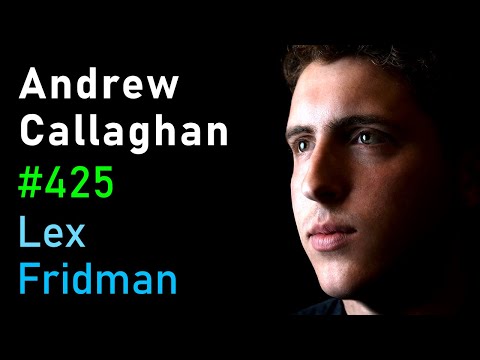
Andrew Callaghan: Channel 5, Gonzo, QAnon, O-Block, Politics & Alex Jones | Lex Fridman Podcast #425
Andrew Callaghan (guest), Lex Fridman (host), Narrator, Narrator, Narrator
In this episode of Lex Fridman Podcast, featuring Andrew Callaghan and Lex Fridman, Andrew Callaghan: Channel 5, Gonzo, QAnon, O-Block, Politics & Alex Jones | Lex Fridman Podcast #425 explores gonzo journalist Andrew Callaghan on fame, chaos, QAnon and redemption Lex Fridman interviews gonzo reporter Andrew Callaghan about his unconventional path into journalism, from hitchhiking America and Bourbon Street ‘confessions’ to All Gas No Brakes, Channel 5, and his HBO documentary This Place Rules.
Gonzo journalist Andrew Callaghan on fame, chaos, QAnon and redemption
Lex Fridman interviews gonzo reporter Andrew Callaghan about his unconventional path into journalism, from hitchhiking America and Bourbon Street ‘confessions’ to All Gas No Brakes, Channel 5, and his HBO documentary This Place Rules.
They dig into his mental health struggles, including HPPD, depersonalization, addiction, and how journalism became both therapy and purpose amid extremism, riots, and fringe subcultures.
Callaghan details the business and legal battles behind losing All Gas No Brakes, building Channel 5, fighting media copyright abuse, and navigating the backlash around his work with Alex Jones and QAnon.
He also openly reflects on consent, being ‘canceled,’ suicidal ideation, entering recovery, and what it means for men with power or platforms to act responsibly in relationships.
Key Takeaways
Leaning into curiosity can turn personal turmoil into meaningful work.
Callaghan’s HPPD, depersonalization, and teenage psychedelic damage pushed him toward journalism as a way to feel ‘real’—immersing himself in extreme events and fringe communities became both therapy and career.
Get the full analysis with uListen AI
Ambush comedy has ethical limits when people can’t foresee future consequences.
His Bourbon Street ‘Quarter Confessions’ went viral but left participants regretting deeply personal on-camera admissions years later, leading him to shift from pure satire toward more respectful, context-rich reporting.
Get the full analysis with uListen AI
Creative control and contracts matter more than early money and hype.
Signing a 360 deal for All Gas No Brakes left him unable to earn outside income and ultimately cost him his own show; he now uses Channel 5—an owned brand—as a cautionary example of reading the fine print and retaining rights.
Get the full analysis with uListen AI
Platforming extremists can reveal more truth than silencing them—if done critically.
This Place Rules uses access to Proud Boys, QAnon families, and Alex Jones to show how media ecosystems inflame people; the backlash he faced from CNN/NPR illustrates the tension between exposure and fears of ‘amplification.’
Get the full analysis with uListen AI
Homelessness and addiction aren’t solved by quick technical fixes alone.
His Vegas tunnels and street reporting show that IDs, shelters, and tiny homes help, but deeper trauma, shame, and lack of self-belief often block change; long-term, trauma-informed engagement is essential.
Get the full analysis with uListen AI
Men with status have a special responsibility around consent and power dynamics.
Reflecting on accusations and his own behavior, Callaghan stresses that fame creates invisible pressure on partners; he advocates trauma-informed conversations, avoiding one-night stands with fans, and recognizing implicit power imbalances.
Get the full analysis with uListen AI
Most people think they’re doing good—but are easily captured by narratives and incentives.
From QAnon believers to cable news hosts and drill rappers, he sees individuals convinced they’re on the right side while being driven by attention, money, or groupthink; he argues that deep listening is the only real antidote to polarization.
Get the full analysis with uListen AI
Notable Quotes
“Being a journalist gives you a ticket to everywhere you wanna go in life.”
— Andrew Callaghan
“I used journalism as a therapeutic mechanism to deal with depersonalization.”
— Andrew Callaghan
“One of the hardest parts about addiction is your brain convinces you the drugs are the source of your creativity.”
— Andrew Callaghan
“It’s scary how easy it is for high‑up political people to mobilize the hate of just the average working person.”
— Andrew Callaghan
“Most people are good, but I’m not sure they’re courageous. Listening is the only option we have.”
— Andrew Callaghan
Questions Answered in This Episode
How should journalists and creators balance giving a platform to extreme views with the risk of amplifying them?
Lex Fridman interviews gonzo reporter Andrew Callaghan about his unconventional path into journalism, from hitchhiking America and Bourbon Street ‘confessions’ to All Gas No Brakes, Channel 5, and his HBO documentary This Place Rules.
Get the full analysis with uListen AI
What contractual or business safeguards should young creators insist on so they don’t lose control of their own work?
They dig into his mental health struggles, including HPPD, depersonalization, addiction, and how journalism became both therapy and purpose amid extremism, riots, and fringe subcultures.
Get the full analysis with uListen AI
How can men with any level of status or influence practically account for power imbalances when it comes to dating and consent?
Callaghan details the business and legal battles behind losing All Gas No Brakes, building Channel 5, fighting media copyright abuse, and navigating the backlash around his work with Alex Jones and QAnon.
Get the full analysis with uListen AI
In what ways do you think mainstream media and alternative media each contribute to political radicalization and distrust?
He also openly reflects on consent, being ‘canceled,’ suicidal ideation, entering recovery, and what it means for men with power or platforms to act responsibly in relationships.
Get the full analysis with uListen AI
What would a genuinely solution-focused approach to homelessness and addiction look like, based on what you’ve seen on the streets?
Get the full analysis with uListen AI
Transcript Preview
There's two people in the back, two of her homegirls wearing, like, sheisty masks. I'm like, "What are we doing? What, where are we going?"
(laughs)
And she goes, "We're gonna go film the riot. We're going to Lake Street." And so, uh, we drive down there. Kmart is burning. Target is burning. Everything is on fire. She has the Sony A7. She gives me a microphone and she's like, "Go talk to that guy." And there was a guy with a Molotov cocktail in his hand who had just burned Kmart down. And so I go, "What should I ask him?" She goes, "What's on your mind?" So I walk up to him and I'm like, "What's on your mind?"
The following is a conversation with Andrew Callaghan, host of Channel 5 on YouTube, where he does Gonzo-style interviews with fascinating humans at the edges of society, the so-called vagrants, vagabonds, runaways, outlaws, from QAnon adherence to Fish Heads to O Block residents, and much more. He created the documentary that I highly recommend called This Place Rules on the undercurrents that led to the January 6th Capitol riots. This is the Lex Fridman Podcast. To support it, please check out our sponsors in the description. And now, dear friends, here's Andrew Callaghan.
I tried to color match you, though. Got the black and white going. It's when, I went to Walmart before this and got the Wrangler shirt with the, uh, Texas Longhorns tee under it.
Is that where you shop, Walmart?
Generally, yeah.
I'm a Target man myself.
There's no way you get those suits from Target.
So you're saying it's a ni- it's a nice way to compliment a suit.
I think you go Men's Warehouse, if not further.
I think you would be wrong.
You go further?
No, the other direction.
You got that from Target?
Not Target. I was joking about Target. I like Walmart better. It just felt like a funny thing to say.
(laughs) No, it was funny.
The most expensive thing I own is this watch, and it was given- given to me as a gift.
Yeah. When I was on tour, I had these $2,700 Cartier glasses that I got for a lot of money, $2,700.
Uh, like sunglasses?
Yeah, but they're really embarrassing.
Mm-hmm.
But I was on tour, so I just felt like I could do anything as far as fashion choices, but looking-
Oh, yeah.
... looking back at pictures from myself in that era, I'm like, "God, what was I-"
So that was the symbol of, of the fame got to your head, and you just- (laughs)
I think so, yeah. I think fame getting to your head, if you s- spend more than a hundred bucks on sunglasses, you've officially gone off the deep end.
You've crossed the line.
Install uListen to search the full transcript and get AI-powered insights
Get Full TranscriptGet more from every podcast
AI summaries, searchable transcripts, and fact-checking. Free forever.
Add to Chrome