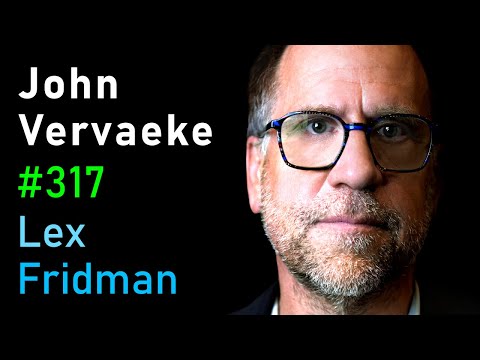
John Vervaeke: Meaning Crisis, Atheism, Religion & the Search for Wisdom | Lex Fridman Podcast #317
John Vervaeke (guest), Lex Fridman (host)
In this episode of Lex Fridman Podcast, featuring John Vervaeke and Lex Fridman, John Vervaeke: Meaning Crisis, Atheism, Religion & the Search for Wisdom | Lex Fridman Podcast #317 explores john Vervaeke Dissects Meaning, Mortality, Wisdom, and Modern Nihilism Lex Fridman and cognitive scientist John Vervaeke explore the contemporary 'meaning crisis': rising depression, loneliness, cynicism, and bullshit in a world stripped of traditional wisdom frameworks. Vervaeke distinguishes 'meaning in life' (felt connectedness and mattering) from 'meaning of life' (a metaphysical question he sees as misguided), and roots meaning in dynamic relationships between self, others, and reality rather than in fixed beliefs.
John Vervaeke Dissects Meaning, Mortality, Wisdom, and Modern Nihilism
Lex Fridman and cognitive scientist John Vervaeke explore the contemporary 'meaning crisis': rising depression, loneliness, cynicism, and bullshit in a world stripped of traditional wisdom frameworks. Vervaeke distinguishes 'meaning in life' (felt connectedness and mattering) from 'meaning of life' (a metaphysical question he sees as misguided), and roots meaning in dynamic relationships between self, others, and reality rather than in fixed beliefs.
They unpack Vervaeke’s cognitive-scientific model—relevance realization, salience landscapes, multiple kinds of knowing, and wisdom as the coordination of rationalities—to explain intelligence, self-deception, and why humans are vulnerable to despair. The conversation ranges through mortality, consciousness, distributed cognition, psychedelics, religion, myth, and higher states of consciousness, always circling back to how we can cultivate wisdom and reduce self-deception.
Vervaeke argues for a 'religion that is not a religion': ecologies of practices (meditation, contemplation, movement, dialog) rooted in science but serving the ancient functions of religion—cultivating wisdom, sacredness, community, and deep connectedness. He positions himself as a non-theist, critical of both modern theism and atheism, and sees love—understood as escaping egocentrism—as central to reason, meaning, and a life well-lived.
Key Takeaways
Meaning in life is about connectedness and mattering, not cosmic purpose.
Vervaeke defines 'meaning in life' as a felt sense of connectedness to self, others, and the world—especially to things that have value and endurance beyond one’s ego. ...
Get the full analysis with uListen AI
Our core cognitive strength—relevance realization—also makes us vulnerable to self-deception.
To survive combinatorial explosion, the mind constantly filters what’s relevant, shaping a 'salience landscape. ...
Get the full analysis with uListen AI
Wisdom is rational, self-correcting coordination of multiple ways of knowing.
Beyond propositional 'knowing that,' Vervaeke highlights procedural (knowing how), perspectival (knowing what it’s like here-and-now), and participatory (agent–arena, belonging) knowing. ...
Get the full analysis with uListen AI
Modern culture has a 'wisdom famine' despite an abundance of information and knowledge.
People know where to get information (phones) and knowledge (science, universities) but have no obvious, culturally legitimated homes for developing wisdom. ...
Get the full analysis with uListen AI
Flow, mindfulness, and psychedelics can be powerful but must be integrated wisely.
Flow optimizes non-propositional connectedness and can enhance meaning and performance, but can also be hijacked (e. ...
Get the full analysis with uListen AI
Religion’s deepest functions are non-propositional and can be re-created without dogma.
Vervaeke argues that religious traditions work largely at the procedural, perspectival, and participatory levels (rituals, narratives, identities, shared practices), not just belief. ...
Get the full analysis with uListen AI
Meaningful engagement with mortality shifts from fearing an event to seeing a condition.
Mortality isn’t just a future endpoint but an ever-present vulnerability: the universe’s indifference to our personal narratives. ...
Get the full analysis with uListen AI
Notable Quotes
“Your mortality is not an event in the future. It's a state you're in right now.”
— John Vervaeke
“Meaning isn't in me, and it isn't in the universe. It is a proper relationship. I've coined the phrase 'transjective'—the binding relationship between the subjective and the objective.”
— John Vervaeke
“What makes you intelligent is your ability to ignore so much information and do it in such a way that is somewhere between arbitrary guessing and algorithmic search.”
— John Vervaeke
“Wisdom isn't optional. It's perennial and cross-cultural because there are perennial problems. But we do not have homes for ecologies of practices that fit into our scientific-technological worldview.”
— John Vervaeke
“Love is when you painfully realize that something other than yourself is real.”
— John Vervaeke (quoting Iris Murdoch)
Questions Answered in This Episode
If meaning in life is about connectedness and mattering, what concrete practices can individuals adopt to systematically deepen those connections without relying on traditional religion?
Lex Fridman and cognitive scientist John Vervaeke explore the contemporary 'meaning crisis': rising depression, loneliness, cynicism, and bullshit in a world stripped of traditional wisdom frameworks. ...
Get the full analysis with uListen AI
How can we tell the difference, in real time, between a powerful new 'frame' that’s wise and insight-generating versus one that’s just sophisticated self-deception?
They unpack Vervaeke’s cognitive-scientific model—relevance realization, salience landscapes, multiple kinds of knowing, and wisdom as the coordination of rationalities—to explain intelligence, self-deception, and why humans are vulnerable to despair. ...
Get the full analysis with uListen AI
What would a mature 'religion that is not a religion' look like institutionally—how would it avoid guru-fication, dogma, and cult dynamics while still offering depth and commitment?
Vervaeke argues for a 'religion that is not a religion': ecologies of practices (meditation, contemplation, movement, dialog) rooted in science but serving the ancient functions of religion—cultivating wisdom, sacredness, community, and deep connectedness. ...
Get the full analysis with uListen AI
How should designers of AI and AGI systems think about relevance realization and salience to avoid building machines that replicate or amplify human self-deception and bullshit?
Get the full analysis with uListen AI
In an age dominated by social media and online discourse, how can we reintroduce genuine dialogos and collective flow states that serve wisdom rather than polarization and manipulation?
Get the full analysis with uListen AI
Transcript Preview
The universe doesn't care about your personal narrative. You can just have met the person that is going to be the love of your life. It's the culmination of your whole project for happiness, and you step into the street and a truck hits you, and you die. That's mortality. Mortality isn't just some far-flung event. It's that every moment, we are subject to fate in that way. So you can think of, uh, lots of little deaths you experience whenever all the projects and the plans you make come up against the fact that the universe can just roll over them.
The following is a conversation with John Vervaeke, a psychologist and cognitive scientist at University of Toronto. I highly recommend his lecture series called Awakening from the Meaning Crisis, which covers the history and future of humanity's search for meaning. This is the Lex Fridman podcast. To support it, please check out our sponsors in the description, and now, dear friends, here's John Vervaeke. You have an excellent 50-part lecture series online on the meaning crisis, and I think you describe in the modern times an increase in depression, loneliness, cynicism, and wait for it, bullshit.
(laughs)
The term used technically by Harry Frankfurt and adopted by you. So let me ask, what is meaning? What are we looking for when we, uh, engage in the search for meaning?
So when I'm talking about meaning, I'm talking about what's called meaning in life, not the meaning of life. That's some sort of metaphysical claim. Meaning in life are those factors that make people rate their lives as more meaningful, worth living, worth the suffering that they have to endure. And when you study that, what you see is it's a sense of connectedness. Uh, connectedness to yourself, to other people, to the world, and a particular kind of connectedness. You want to be connected to things that have a value and an existence independent of your egocentric sort of preferences and concerns. This is why, for example, having a child is considered very meaningful, because you're connecting to something that's gonna have a life and a value independent of you. Now, the question that comes up for me... Well, there's two questions. One is, why is that at risk right now? And then secondly, and I think you have to answer the second question first, which is, well, yeah, but why is meaning so important? Why is this sense of connectedness so important to human beings? Why, when it is lacking, do they typically fall into depression, potentially mental illness, addiction, self-destructive behavior? And so the first answer I give you is, well, it's that sense of connectedness. And people often express it metaphorically. They want to be connected to something larger than themselves. They want to matter. They don't mean it literally. I mean, if I chained you to a mountain, you wouldn't th- thereby say, "Oh, now my life is so fulfilling." Right? So what they're trying to convey, they're using this metaphor to try and say they want to be connected, they want to be connected to something real, they want to m- make a difference and matter to it. And one way of asking them, well, you know, what's meaningful is, "Tell me what you would like to continue to exist even if you weren't around anymore, and how are you connected to it and how do you matter to it?"
Install uListen to search the full transcript and get AI-powered insights
Get Full TranscriptGet more from every podcast
AI summaries, searchable transcripts, and fact-checking. Free forever.
Add to Chrome