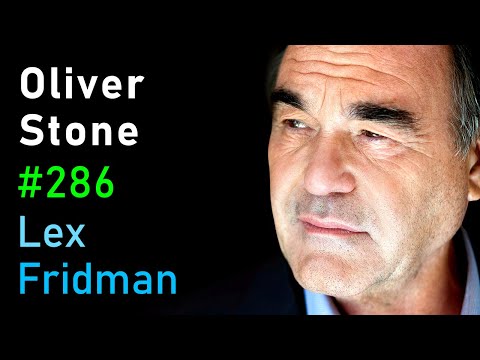
Oliver Stone: Vladimir Putin and War in Ukraine | Lex Fridman Podcast #286
Lex Fridman (host), Oliver Stone (guest), Narrator
In this episode of Lex Fridman Podcast, featuring Lex Fridman and Oliver Stone, Oliver Stone: Vladimir Putin and War in Ukraine | Lex Fridman Podcast #286 explores oliver Stone Defends Putin, Denounces U.S. Power, Warns Nuclear Catastrophe Oliver Stone joins Lex Fridman to discuss Vladimir Putin, the war in Ukraine, U.S. foreign policy, nuclear risk, and his broader worldview on imperialism and media propaganda.
Oliver Stone Defends Putin, Denounces U.S. Power, Warns Nuclear Catastrophe
Oliver Stone joins Lex Fridman to discuss Vladimir Putin, the war in Ukraine, U.S. foreign policy, nuclear risk, and his broader worldview on imperialism and media propaganda.
Stone strongly criticizes the United States and NATO as aggressive imperial powers, frames Russia as primarily defensive, and argues the full war began in 2014 with the Donbas conflict, not in 2022.
He portrays Putin as calm, rational, national-interest focused, and widely misrepresented in the West, while acknowledging that Russia’s invasion of Ukraine was a strategic mistake with grave human costs.
Throughout, they examine media bias, censorship in the West and Russia, the danger of neoconservatism, possible nuclear escalation, and the importance of empathy, education, and love in understanding power and avoiding war.
Key Takeaways
Stone believes Putin is a cautious, rational nationalist, not an imperial aggressor.
Based on years of interviews, Stone describes Putin as calm, analytical, power-aware but not personally corrupt or expansionist, and argues Western portrayals of him as a cartoon villain ignore both his popularity in Russia and the internal factions he must manage.
Get the full analysis with uListen AI
He frames the Ukraine war as the culmination of a conflict that began in 2014.
Stone insists you cannot assess the 2022 invasion without including the 2014 Maidan coup (in his view, U. ...
Get the full analysis with uListen AI
Stone calls the invasion of Ukraine wrong yet argues it may have been a pressured, miscalculated response.
He says Russia was “wrong to invade” and made serious strategic errors, but speculates that looming Ukrainian moves on Donbas, NATOization, and internal pressure not to appear weak pushed Putin toward a decision he misjudged in terms of resistance, sanctions, and NATO unity.
Get the full analysis with uListen AI
U.S. neoconservative strategy and NATO expansion are seen as primary drivers of global instability.
Stone cites the Project for the New American Century and a doctrine of preventing any rival power, linking it to Iraq, Afghanistan, Syria, and current policy toward Russia and China, and argues that NATO has become a tool for U. ...
Get the full analysis with uListen AI
Media ecosystems on all sides distort reality, but Stone is especially alarmed by Western censorship.
He argues Western media has erected a “wall of propaganda” around Ukraine, suppressing dissenting views, shutting down Russian outlets like RT, and reviving a climate reminiscent of 1950s McCarthyism, while acknowledging Russia and China also maintain significant controls.
Get the full analysis with uListen AI
The risk of nuclear escalation is real, and U.S. first‑strike thinking worries Stone deeply.
Recalling Cold War scares and doctrines like SIOP‑62, he fears current U. ...
Get the full analysis with uListen AI
Empathy, broad education, and love are central to understanding power and resisting dehumanization.
Stone defends empathic interviewing—even with figures like Putin or hypothetically Hitler—as essential to uncovering truth rather than scoring moral points, and he urges young people to pursue deep historical and literary education, cultivate love, and recognize the preciousness of life amid ever-present death.
Get the full analysis with uListen AI
Notable Quotes
“Russia was wrong to invade. It has made too many mistakes.”
— Oliver Stone
“When people refer to Russia as Putin, they’re mistaken. It’s Russia that’s doing it.”
— Oliver Stone
“I’ve never seen in my lifetime such a wall of propaganda as I’ve seen in the West.”
— Oliver Stone
“The United States scares me.”
— Oliver Stone
“To fail is not tragic. To be human is.”
— Oliver Stone (quoted by Lex Fridman from *The Untold History of the United States*)
Questions Answered in This Episode
Where does reasonable criticism of U.S. foreign policy end and apologetics for authoritarian leaders begin, and how can viewers tell the difference?
Oliver Stone joins Lex Fridman to discuss Vladimir Putin, the war in Ukraine, U. ...
Get the full analysis with uListen AI
How much weight should be given to Stone’s account of Ukraine’s 2014 events and Donbas casualties versus mainstream academic and journalistic histories?
Stone strongly criticizes the United States and NATO as aggressive imperial powers, frames Russia as primarily defensive, and argues the full war began in 2014 with the Donbas conflict, not in 2022.
Get the full analysis with uListen AI
Is it possible for Western leaders or media to engage empathetically with Putin without being seen as legitimizing or “platforming” him?
He portrays Putin as calm, rational, national-interest focused, and widely misrepresented in the West, while acknowledging that Russia’s invasion of Ukraine was a strategic mistake with grave human costs.
Get the full analysis with uListen AI
What concrete diplomatic steps could realistically reduce nuclear risk between NATO and Russia in the current climate of mutual distrust?
Throughout, they examine media bias, censorship in the West and Russia, the danger of neoconservatism, possible nuclear escalation, and the importance of empathy, education, and love in understanding power and avoiding war.
Get the full analysis with uListen AI
How can individuals navigate tightly controlled information environments—East and West—to form more accurate, less propagandized views on war and power?
Get the full analysis with uListen AI
Transcript Preview
If you could talk to Vladimir Putin once again, now, what kind of, wha- what kind of things would you talk about here? What kind of questions would you ask? The following is a conversation with Oliver Stone. He's one of the greatest filmmakers of all time, with three Oscar wins and 11 Oscar nominations. His films tell stories of war and power, fearlessly, and often controversially, shining a light on the dark parts of American and global history. His films include Platoon, Wall Street, Born on the Fourth of July, Scarface, JFK, Nixon, Alexander, W, Snowden, and documentaries where he has interviewed some of the most powerful and consequential people in the world, including Fidel Castro, Hugo Chavez, and Vladimir Putin. And in this conversation, Oliver and I mostly focus our discussion on Vladimir Putin, Russia, and the war in Ukraine. My goal with these conversations is to understand the human being before me, to understand not just what they think, but how they think, to steel man their ideas, and to steel man the devil's advocate, all in service of understanding, not derision. I have done this poorly in the past. I'm still struggling with this, but I'm working hard to do better. I believe the moment we draw lines between good people and evil people, we'll lose our ability to see that we're all one people in the most fundamental of ways, and we'll lose track of the deep truth expressed by the old Solzhenitsyn line that I return to time and time again, that the line between good and evil runs through the heart of every man. Oliver Stone has a perspective that he extensively documents in his powerful controversial series, The Untold History of the United States, that imperialism and the military-industrial complex pave the path to absolute power, and thus corrupt the minds of the leaders and institutions that wield it. From this perspective, the way out of the humanitarian crisis and human suffering in Ukraine, and the way out from the pull of the beating drums of nuclear war is not simple to understand. But we must, because all of humanity hangs in the balance. I will talk to many people who seek to understand the way out of this growing catastrophe, including to historians, to leaders, and perhaps most importantly, to people on the ground in Ukraine and Russia. Not just about war and suffering, but about life, friendship, family, love, and hope. This is the Lex Fridman Podcast. To support it, please check out our sponsors in the description. And now, dear friends, here's Oliver Stone. You're working on, uh, a documentary now about nuclear energy.
Yes.
So it's interesting to talk about this. Energy is such a big part of the world, about the geopolitics of the world, about the way the world is. What do you think is the role of nuclear energy in the 21st century?
Good question. And first of all, obvious- everyone's talking about climate change, right? So here I wake up to that a few years ago, and c- clearly were concerned, huh? Uh, I, uh, picked up a book by Josh Goldstein and his, his co-author who's Swedish, those two wrote a book called Bright Future, A Bright Future. It came out a few years ago, and I lapped it up. It was a book, fact-based, w- clear, not too long, and not too technical. And, uh, it was very clear that they were i- in favor of all kinds of re- uh, renewables, renewable energy, yes. They hated, uh, made it very clear how dangerous oil and, uh, gas were, methane, and made it very clear to the layman like me, and at the same time said that this renewables can work so far, but the gap is enormous as to what, how much electricity this count- the world is gonna need in, uh, 2050 and beyond. Two, three, four times, we don't even know the damage. But we have India, we have China, we have Africa, we have Asia coming onto the scene wanting more and more electricity. So they address the problem as a global one, not just as often in the United States you get the ethnocentric United States point of view that we nee- we, w- you know, we're doing well, blah, blah, blah. We're not doing well. But we, we, we, we sell that to people that we're comfortable, we spend more energy than anybody, this country, per c- per capita, th- than anybody. And at the same time, we don't seem to understand the global picture. So that's what they did, and they made me very aware. So the only way to close that gap, the only way in their mind is nuclear energy. And talking about a gap of building a huge amount of reactors over the next 30 years, and starting now. Uh, they make that point over and over again. Uh, so o- obviously this country, the United States, is not gonna go in that direction, because it just is incapable with its, of having that kind of will, political will. And fear is a huge factor, and still a lot of shibboleths, a lot of myths about nuclear energy ha- have, uh, confused and confounded the landscape. The environmentalists have played a huge role in outdoing good things, many good things, but also confusing and confounding the landscape, and making accusations against nuclear energy that were exaggerated. So taking all these things into consideration, we set about making this documentary, which is about, uh, finished now, almost finishing. It's an hour and 40 minutes, and that was the hard part, getting it down from about three and a half hours to about this, something more manageable. And-
Install uListen to search the full transcript and get AI-powered insights
Get Full TranscriptGet more from every podcast
AI summaries, searchable transcripts, and fact-checking. Free forever.
Add to Chrome