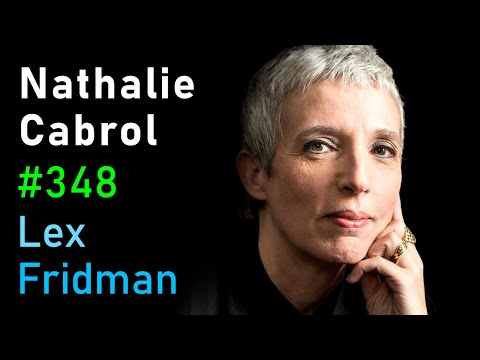
Nathalie Cabrol: Search for Alien Life | Lex Fridman Podcast #348
Nathalie Cabrol (guest), Lex Fridman (host)
In this episode of Lex Fridman Podcast, featuring Nathalie Cabrol and Lex Fridman, Nathalie Cabrol: Search for Alien Life | Lex Fridman Podcast #348 explores volcano Diving for Mars Clues and the Deeper Nature of Life Lex Fridman talks with astrobiologist Nathalie Cabrol about her work at the SETI Institute, her expeditions to extreme volcanic lakes in the Andes, and how these analog environments inform the search for life on Mars.
Volcano Diving for Mars Clues and the Deeper Nature of Life
Lex Fridman talks with astrobiologist Nathalie Cabrol about her work at the SETI Institute, her expeditions to extreme volcanic lakes in the Andes, and how these analog environments inform the search for life on Mars.
They trace the history of Mars exploration, from Viking and Mariner to today’s rovers, and discuss how early Mars may have paralleled early Earth, potentially allowing simple life to arise and persist underground.
Cabrol emphasizes shifting from merely asking “Is there life?” to understanding the universal nature of life as a process that fights entropy, gathers information, and co‑evolves with its environment.
The conversation also explores AI’s role in science, UFOs and public folklore, humanity’s adolescent relationship with technology and the planet, and Cabrol’s personal journey through danger, near-death, love, grief, and responsibility to Earth’s biosphere.
Key Takeaways
Use Earth’s harshest environments to design better life‑detection strategies for Mars.
By studying microbes in high‑altitude, ultra‑dry, UV‑intense volcanic lakes, Cabrol learns what signatures life leaves, what instruments and resolutions are needed, and where to search for potential fossils or extant life on Mars.
Get the full analysis with uListen AI
Shift the main question from “Is there life?” to “What is the nature of life?”.
Cabrol argues that understanding life as a universal physical process—one that fights entropy and maximizes information storage and exchange—will give us biosignatures that don’t depend on Earth‑like biochemistry alone.
Get the full analysis with uListen AI
Expect ancient and possibly current life on Mars to be simple, subsurface, and sparse.
Given Mars’ early habitability, rapid loss of atmosphere and magnetic field, and strong climate cycles, any life is likely microbial, sheltered underground or in micro‑niches near the surface, leaving mostly morphological and chemical traces.
Get the full analysis with uListen AI
Life’s resilience comes from adaptable toolkits, not single perfect conditions.
Cyanobacteria at extreme altitudes keep their UV defenses permanently on and can switch traits on or off across generations, illustrating how evolution arms organisms with modular ‘Swiss‑Army‑knife’ adaptations to environmental change.
Get the full analysis with uListen AI
AI is a powerful extension of human cognition, not yet an independent knower.
Cabrol views AI like AlphaZero or AlphaFold as sophisticated tools that reveal patterns and strategies beyond human intuition but still embody human-designed ways of gathering and processing information, at least for now.
Get the full analysis with uListen AI
UFO folklore has materially harmed serious SETI science and funding.
Because politicians conflate rigorous SETI work with sensational UFO culture, government support for message‑searching has been minimal, forcing SETI to rely on private funding while NASA cautiously funds broader ‘technosignature’ studies.
Get the full analysis with uListen AI
Personal encounters with death can fuel a ferocious commitment to life and inquiry.
Cabrol’s suicide attempt, near‑drowning, and brushes with disaster on expeditions led her to a rule of ‘always give tomorrow a chance,’ powering her drive to pursue difficult questions and extreme science with urgency and gratitude.
Get the full analysis with uListen AI
Notable Quotes
“The day we understand the nature of life, then we have a universal biosignature.”
— Nathalie Cabrol
“If we are alone, then the universe is a statistical absurdity.”
— Nathalie Cabrol
“Right now we are like teenagers with enough brain to create cool tools, but we don't have enough brain to understand yet the consequences of what we are doing.”
— Nathalie Cabrol
“You have to give tomorrow a chance. You never can think about tomorrow in the terms of the present.”
— Nathalie Cabrol
“I would hope for humanity to reach that point where you can feel the same love for the person that is unknown in the street that you feel for the people you love.”
— Nathalie Cabrol
Questions Answered in This Episode
If life is fundamentally a process that fights entropy, what concrete, measurable features should we prioritize when searching for non–Earth-like life in the universe?
Lex Fridman talks with astrobiologist Nathalie Cabrol about her work at the SETI Institute, her expeditions to extreme volcanic lakes in the Andes, and how these analog environments inform the search for life on Mars.
Get the full analysis with uListen AI
How could a global network of high‑resolution environmental stations on Mars transform our understanding of both Martian habitability and planetary protection?
They trace the history of Mars exploration, from Viking and Mariner to today’s rovers, and discuss how early Mars may have paralleled early Earth, potentially allowing simple life to arise and persist underground.
Get the full analysis with uListen AI
In what ways might our current definitions of ‘intelligence’ be blinding us to forms of complex life or civilizations that already exist but are invisible to our tools and assumptions?
Cabrol emphasizes shifting from merely asking “Is there life? ...
Get the full analysis with uListen AI
How should scientists and institutions balance engaging the public’s UFO fascination with protecting the rigor and funding of serious astrobiology and SETI research?
The conversation also explores AI’s role in science, UFOs and public folklore, humanity’s adolescent relationship with technology and the planet, and Cabrol’s personal journey through danger, near-death, love, grief, and responsibility to Earth’s biosphere.
Get the full analysis with uListen AI
What would it practically mean for human civilization to be ‘mature’—in our technology use, environmental stewardship, and ethics—before we seriously attempt to become a multi‑planet species?
Get the full analysis with uListen AI
Transcript Preview
"My friend is telling me that the volcano seems to be starting to erupt. If that volcano goes off, we have nowhere to go." That got my attention. So, if you say scared, I would say that I got the realization that what that meant. I went cold for, like, a fraction of a second. But that meant that just my adrenaline started to kick in. And it was a very, very strange experience because now you have tunnel vision. It's about survival.
The following is a conversation with Nathalie Cabrol, an astrobiologist and scientist at the SETI Institute, directing the Carl Sagan Center for the Study of Life in the Universe. She explores some of the harshest places on Earth, including free diving in volcanic lakes, all in the pursuit of understanding living organisms beyond Earth. For this, she holds the woman's world record for diving at altitude, both scuba and free diving. She's amazing. This is the Lex Fridman Podcast. To support it, please check out our sponsors in the description. And now, dear friends, here's Nathalie Cabrol. You are the director of the Carl Sagan Center For Research at the SETI Institute. SETI, of course, stands for Search for ExtraTerrestrial Intelligence. One of the things you do as part of that is travel to some of Earth's most extreme and dangerous environments in search of organisms that live in conditions analogous to those on Mars. First, let me ask what the job posting for the work you do looks like. Is it like Shackleton's ad in, uh, 1900 that said people wanted for hazardous journey to the South Pole?
(laughs)
Small wages, bitter cold, long months of complete darkness, constant danger? And also, where do I apply?
(laughs) That's funny because there was not really a job application. In fact, when you're a scientist, you have questions in your mind and you have hypothesis, and you start to list the kind of thing you need to answer. Um (laughs) , and then when you, you see the kind of thing you have to answer, then you kind of know the places where you need to go to do that. As far as science is concerned, started with analyzing data from the Mars missions. And, uh, I had written a PhD about water on Mars, first looking at, uh, channels and the history evolution of, of water. Uh, but then during my postdoc, I started to look where that water was ponding. Interestingly enough, everybody was about channels and water and whether catastrophic or whatnot, or seepage. But when you are talking about ponding water like lakes or ocean, people were starting waving their arms a little bit. So, it was a little bit of a happy battle, interestingly enough. Yeah. But that got us on track with my husband. Uh, we were working together and, uh, we started developing the idea, the concept of lakes in impact craters. So, why in impact craters? Just because the Viking, uh, mission at the time, which is what we were working with, uh, the resolution and the topography were so poor that there was really no way of telling where you had a real low in the topography. The only thing you knew was a hole in the ground was an impact crater. So, when you saw valleys.
Install uListen to search the full transcript and get AI-powered insights
Get Full TranscriptGet more from every podcast
AI summaries, searchable transcripts, and fact-checking. Free forever.
Add to Chrome