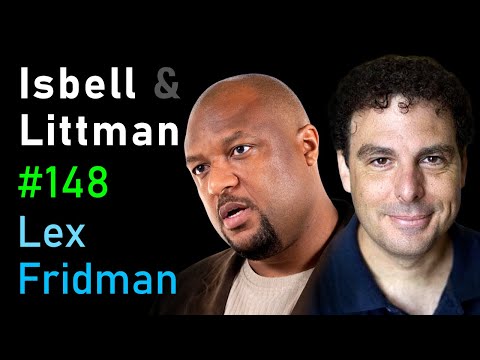
Charles Isbell and Michael Littman: Machine Learning and Education | Lex Fridman Podcast #148
Lex Fridman (host), Charles Isbell (guest), Michael Littman (guest), Michael Littman (guest), Lex Fridman (host), Lex Fridman (host)
In this episode of Lex Fridman Podcast, featuring Lex Fridman and Charles Isbell, Charles Isbell and Michael Littman: Machine Learning and Education | Lex Fridman Podcast #148 explores machine learning, statistics, and reimagining education in a digital age Lex Fridman hosts Charles Isbell and Michael Littman for a wide-ranging discussion on what machine learning really is, how it relates to statistics and software engineering, and how neural networks and data reshape the field. They dive deeply into teaching: how to design meaningful machine learning courses, the role of struggle and hope in learning, and what MOOCs and COVID have revealed about the true value of the college experience. They also reflect on Bell Labs, research culture, debugging, simulations, and how online degrees like Georgia Tech’s OMSCS expand access without replacing traditional campuses. The conversation is threaded with their long friendship, playful debate, and a shared belief that education is fundamentally about human connection.
Machine learning, statistics, and reimagining education in a digital age
Lex Fridman hosts Charles Isbell and Michael Littman for a wide-ranging discussion on what machine learning really is, how it relates to statistics and software engineering, and how neural networks and data reshape the field. They dive deeply into teaching: how to design meaningful machine learning courses, the role of struggle and hope in learning, and what MOOCs and COVID have revealed about the true value of the college experience. They also reflect on Bell Labs, research culture, debugging, simulations, and how online degrees like Georgia Tech’s OMSCS expand access without replacing traditional campuses. The conversation is threaded with their long friendship, playful debate, and a shared belief that education is fundamentally about human connection.
Key Takeaways
Machine learning is more than computational statistics; it’s also about rules, representations, and software engineering.
Isbell and Littman argue that while statistics is central, ML practice also involves design choices, loss functions, metrics, debugging, and code—making it closer to computer science and software engineering than pure statistics.
Get the full analysis with uListen AI
Data and the questions you ask of it matter more than obsessing over algorithms.
In their ML course, students are told to reuse existing implementations and instead focus on choosing interesting datasets and analyzing why different algorithms behave differently—building intuition for data characteristics and problem formulation.
Get the full analysis with uListen AI
Productive learning requires struggle with hope, not hopeless suffering.
They distinguish between challenging students enough that they wrestle with concepts versus overwhelming them to the point of despair; the goal is to maintain a sense that success is possible so that struggle becomes motivating rather than crushing.
Get the full analysis with uListen AI
The real threat from AI is current, opaque decision systems, not distant superintelligence.
They emphasize that today’s dangers are biased data-driven systems that amplify bad decisions at scale (e. ...
Get the full analysis with uListen AI
The “college experience” is primarily social and developmental, not just instructional.
COVID exposed that students don’t mainly miss lectures; they miss campus life, independence, peers, and identity. ...
Get the full analysis with uListen AI
Online degrees expand access and can build strong loyalty when they serve unmet needs.
Georgia Tech’s low-cost online MSCS serves working adults who could never relocate or stop working; many alumni are so grateful they return as TAs, showing that well-designed online programs can create real affinity and impact.
Get the full analysis with uListen AI
Passion and long-term persistence matter more than early optimization of career choices.
Both guests describe choosing computer science out of curiosity, not foresight about its boom, and advise young people to pursue what genuinely fascinates them, accept uncertainty, and trust that life is long enough to course-correct.
Get the full analysis with uListen AI
Notable Quotes
“Statistics is how you're gonna keep from lying to yourself.”
— Michael Littman (quoting his mentor Tom Landauer)
“The reward for good work is more work. The reward for bad work is less work.”
— Charles Isbell
“You have to thwart people in a way that they still believe that there's a way through.”
— Michael Littman
“Research is a social process… the sort of pointlessness and the interaction was, in some sense, the point.”
— Charles Isbell
“Life is long and you'll have enough time to build it all out.”
— Charles Isbell
Questions Answered in This Episode
How should curricula in machine learning and AI evolve to balance statistical rigor, software engineering practice, and ethical considerations?
Lex Fridman hosts Charles Isbell and Michael Littman for a wide-ranging discussion on what machine learning really is, how it relates to statistics and software engineering, and how neural networks and data reshape the field. ...
Get the full analysis with uListen AI
What concrete design patterns or tools could make debugging complex neural network systems more systematic and less art-like?
Get the full analysis with uListen AI
Given that students crave connection, how can online programs deliberately build community and identity beyond discussion forums and video lectures?
Get the full analysis with uListen AI
What responsibilities do AI researchers and educators have to address the everyday harms of current data-driven systems, not just speculative AGI risks?
Get the full analysis with uListen AI
How should universities rethink the professor role, given the tension between research, teaching, and the growing importance of dedicated teaching faculty?
Get the full analysis with uListen AI
Transcript Preview
The following is a conversation with Charles Isbell and Michael Littman. Charles is the Dean of the College of Computing at Georgia Tech, and Michael is a computer science professor at Brown University. I've spoken with each of them individually on this podcast, and since they are good friends in real life, we all thought it would be fun to have a conversation together. Quick mention of each sponsor, followed by some thoughts related to the episode. Thank you to Athletic Greens, the all-in-one drink that I start every day with to cover all my nutritional bases, Eight Sleep, a mattress that cools itself and gives me yet another reason to enjoy sleep, Masterclass, online courses from some of the most amazing humans in history, and Cash App, the app I use to send money to friends. Please check out these sponsors in the description to get a discount and to support this podcast. As a side note, let me say that, uh, having two guests on the podcast is an experiment that I've been meaning to do for a while, in particular because, uh, down the road, I would like to occasionally be a kind of moderator for debates between people that may disagree in some interesting ways. If you have suggestions for who you would like to see debate on this podcast, let me know. As with all experiments of this kind, it is a learning process. Both the video and the audio might need improvement. I realized, I think, I should probably do three or more cameras next time as opposed to just two, and also try different ways to mount the microphone for the third person. Also, after recording this intro, I'm going to have to go figure out the, uh, thumbnail for the video version of the podcast since I usually put the guest's head on the thumbnail and, uh, now there's two heads and two names to try to fit into the thumbnail. It's a kind of a bin packing problem which in, uh, theoretical computer science happens to be an NP-hard problem. Whatever I come up with, if you have better ideas for the thumbnail, let me know as well. And in general, I always welcome ideas how this thing can be improved. If you enjoy it, subscribe on YouTube, review it with five stars on Apple Podcast, follow on Spotify, support on Patreon, or connect with me on Twitter @lexfridman. And now, here's my conversation with Charles Isbell and Michael Littman. You'll probably disagree about this question, but what is your biggest, would you say, disagreement about either something, uh, profound and very important or something completely not important at all?
I don't think we have any disagreements at all.
Ah, I'm not sure that's true.
(laughs) We walked into that one, didn't we?
(laughs) Yeah. That's, that's pretty good.
So, so one thing that you sometimes mention is that... and we did this one on air too, as it were, whether or not machine learning is computational statistics.
Install uListen to search the full transcript and get AI-powered insights
Get Full TranscriptGet more from every podcast
AI summaries, searchable transcripts, and fact-checking. Free forever.
Add to Chrome