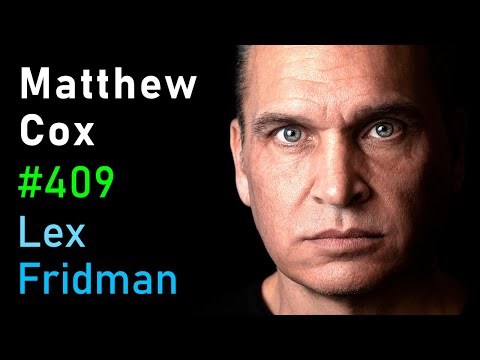
Matthew Cox: FBI Most Wanted Con Man - $55 Million in Bank Fraud | Lex Fridman Podcast #409
Matthew Cox (guest), Lex Fridman (host), Lex Fridman (host), Lex Fridman (host), Lex Fridman (host), Lex Fridman (host), Lex Fridman (host), Lex Fridman (host), Lex Fridman (host), Lex Fridman (host), Lex Fridman (host), Lex Fridman (host), Lex Fridman (host), Lex Fridman (host)
In this episode of Lex Fridman Podcast, featuring Matthew Cox and Lex Fridman, Matthew Cox: FBI Most Wanted Con Man - $55 Million in Bank Fraud | Lex Fridman Podcast #409 explores master Con Man Reveals $55M Fraud, Fake Identities, Prison Redemption Matthew Cox, a former mortgage broker turned master fraudster, describes how small "gray area" document tweaks evolved into a $55 million web of mortgage, identity, and bank fraud that put him on the FBI and Secret Service most wanted lists. He details creating synthetic identities from homeless people and children, building fake banks, bribing a politician, and running large-scale property scams while on the run for three years. After receiving a 26‑year federal sentence, he explains how prison life, teaching real estate, writing true‑crime books, and an eccentric jailhouse lawyer led to significant sentence reductions and a shift in perspective. Cox ends by reflecting on loyalty, snitching, regret over his crimes and family losses, and rebuilding life as a true‑crime content creator.
Master Con Man Reveals $55M Fraud, Fake Identities, Prison Redemption
Matthew Cox, a former mortgage broker turned master fraudster, describes how small "gray area" document tweaks evolved into a $55 million web of mortgage, identity, and bank fraud that put him on the FBI and Secret Service most wanted lists. He details creating synthetic identities from homeless people and children, building fake banks, bribing a politician, and running large-scale property scams while on the run for three years. After receiving a 26‑year federal sentence, he explains how prison life, teaching real estate, writing true‑crime books, and an eccentric jailhouse lawyer led to significant sentence reductions and a shift in perspective. Cox ends by reflecting on loyalty, snitching, regret over his crimes and family losses, and rebuilding life as a true‑crime content creator.
Key Takeaways
Major white-collar crime often starts with a small rationalized lie.
Cox’s first fraud was simply whiting out a 30‑day rent delinquency at his manager’s suggestion; the fact that it worked, and he got paid, emboldened him to escalate to forging W‑2s, appraisals, and eventually multi‑million‑dollar schemes.
Get the full analysis with uListen AI
Mortgage and credit systems are structurally vulnerable to sophisticated fraudsters, not casual scammers.
He explains that normal borrowers are heavily documented and verified, but someone who understands underwriting, document flows, and internal checks can systematically forge pay stubs, rental histories, appraisals, and even entire banks to defeat controls.
Get the full analysis with uListen AI
Synthetic identities can be built from scratch by exploiting how credit bureaus and government records work.
Cox used children’s Social Security numbers, midwife birth stories, and homeless individuals’ data to create “phantom borrowers,” then aged their credit with secured cards before leveraging them for mortgages, loans, and credit lines worth millions.
Get the full analysis with uListen AI
Banks and institutions often prioritize recovering money over prosecuting fraud.
He recounts multiple instances where lenders, upon discovering fraud, accepted full repayment or negotiated losses rather than involve the FBI—highlighting how economic incentives can blunt enforcement.
Get the full analysis with uListen AI
In criminal networks, loyalty largely collapses under legal pressure.
Nearly everyone around Cox cooperated with authorities when threatened with charges, which reshaped his view of "honor among thieves" and led him to argue that expecting integrity from people already committing crimes is unrealistic.
Get the full analysis with uListen AI
Prison can become a perverse catalyst for new skills, purpose, and influence.
Inside, Cox taught real-estate classes, wrote true‑crime manuscripts, helped others with appeals, and partnered with a brilliant but mentally ill jailhouse lawyer who ultimately shaved 12 years off his 26‑year sentence.
Get the full analysis with uListen AI
Financial success without integrity often destroys what matters most.
Cox says he’d trade his entire “adventurous” criminal past for a boring middle‑class life with his family, noting he lost his freedom, parents, marriage, and relationship with his son and now lives with deep regret despite public notoriety.
Get the full analysis with uListen AI
Notable Quotes
“Anytime you lie to the bank, you’ve committed fraud. There is no gray area.”
— Matthew Cox
“I wasn’t some mastermind. I was just willing to do things other people wouldn’t and keep pushing the line when it worked.”
— Matthew Cox
“You can’t go around behaving like a scumbag, dealing with scumbags, and then expect those same scumbags to suddenly abide by some kind of street code.”
— Matthew Cox
“I felt like James Bond. I walked into Bank of America with seven fraudulent documents and walked out with a $250,000 check.”
— Matthew Cox
“I’d scrap all of this. I’d much rather be some middle‑class guy with a wife and kids than a 54‑year‑old felon starting over, broke, calling myself a scumbag.”
— Matthew Cox
Questions Answered in This Episode
Where should regulators and banks focus if they genuinely want to close the systemic loopholes Cox exploited, without shutting out honest borrowers?
Matthew Cox, a former mortgage broker turned master fraudster, describes how small "gray area" document tweaks evolved into a $55 million web of mortgage, identity, and bank fraud that put him on the FBI and Secret Service most wanted lists. ...
Get the full analysis with uListen AI
How should courts ethically handle cooperation and sentence reductions when nearly everyone in a criminal ecosystem is incentivized to snitch?
Get the full analysis with uListen AI
Is there a realistic path for people like Cox to fully redeem themselves in society, or are they permanently defined by their biggest crimes?
Get the full analysis with uListen AI
What responsibilities do media and true‑crime creators have when platforming charismatic criminals whose stories can glamorize illegal ingenuity?
Get the full analysis with uListen AI
How might early interventions—in education, financial stress, or career failure—have redirected Cox before his first “small” fraud, and what does that imply for prevention strategies?
Get the full analysis with uListen AI
Transcript Preview
She found like, $40,000 in cash in my freezer one night. So she's like, "What is going on?" You know? And I, so we have this conversation and I tell her, "Look, people are looking for me." "Who?" "Law enforcement." "Which ones?" "All of them." You know, and she's like, "That doesn't even, what, for what?" I go, "Mostly bank fraud." And she's like, "Well how are they not finding you? I mean everybody, you know, people know you, like, you know, your general contractor," which I met four months before, this guy six months before, this one two months before." You know? She's like, "So-and-so, so-and-so, so..." And I'm like, "Right, right, well," I said, "Well..." She's like, "I mean, they've got your name, they've got your..." I go, "Well, that's identity theft." And she was like, "W- what do you mean?" I said, "Well my name's not, you know, my name's not, it's not Joseph Carter." "And wha- what is your name? What is your name?" I go, "Look, you know, it's, it's, you don't need, don't even worry about it."
The following is a conversation with Matthew Cox, a con man recently released from federal prison where he served 13 years for bank fraud, mortgage fraud, identity theft, passport fraud and other charges. He has admitted guilt to all of it. He has written true crime stories of many of his fellow prisoners and now he continues this work by interviewing criminals about their crimes on his YouTube channel that I recommend called Inside True Crime. Exploring the mind of a criminal is exploring human nature at the extremes, often in its most raw and illuminating form, and that is something I definitely want to do with this podcast, to understand the human mind and everything it is capable of. This is the Lex Fridman Podcast. To support it, please check out our sponsors in the description, and now, dear friends, here's Matthew Cox. What was the first crime you committed?
The first mortgage I ever did.
A mortgage is me borrowing money from a bank to buy a house.
Yeah.
How can you find a way to commit crime in this? How can you do fraud in this space?
It's, it's very difficult for the average guy to commit fraud.
Mm-hmm.
Because there's so many safeguards set up. Um, you know, if you were to go in and say, "Um, I make $300,000 a year," okay well we want your W-2s, we want your pay stubs, we're gonna call your employer, we're gonna check to make sure your employer, how long they've been incorporated, we're gonna check to make sure they're registered, we're gonna... It's like, ugh, your whole plan fell apart. You know? Because the average guy can't do that. He can't even come up with a, with the pay stub and W-2. So the average person, you know, or I'm gonna put down this much money, but you're gonna borrow that money from the seller, you know? Okay, well then they start asking for bank statements, where did the money come from, how long has it been in your bank? Like you can't even have it put in your bank for a day, get a letter, you know, it's gotta have been there for 90 days or 60 days depending on the bank. And, and so there's all these ways, for the average person it's very difficult to commit fraud. The average guy that works at Walmart and makes $60,000 a year and he's been there for five years and he's saved his deposit, like, it's very, that's really the guy that those transactions are set up for. To borrow a mortgage from Bank of America, that's the guy they're looking for.
Install uListen to search the full transcript and get AI-powered insights
Get Full TranscriptGet more from every podcast
AI summaries, searchable transcripts, and fact-checking. Free forever.
Add to Chrome