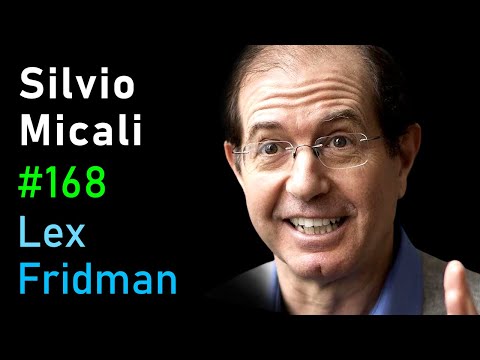
Silvio Micali: Cryptocurrency, Blockchain, Algorand, Bitcoin & Ethereum | Lex Fridman Podcast #168
Lex Fridman (host), Silvio Micali (guest)
In this episode of Lex Fridman Podcast, featuring Lex Fridman and Silvio Micali, Silvio Micali: Cryptocurrency, Blockchain, Algorand, Bitcoin & Ethereum | Lex Fridman Podcast #168 explores silvio Micali Explains Blockchain, Money, Algorand, and Decentralized Future Silvio Micali and Lex Fridman explore what blockchains are, why common knowledge and decentralization are powerful, and how cryptocurrencies fit into the broader concept of money as a social construct.
Silvio Micali Explains Blockchain, Money, Algorand, and Decentralized Future
Silvio Micali and Lex Fridman explore what blockchains are, why common knowledge and decentralization are powerful, and how cryptocurrencies fit into the broader concept of money as a social construct.
Micali contrasts Bitcoin and Ethereum’s designs with Algorand’s approach to solving the scalability–security–decentralization “trilemma” using cryptographic lotteries and random committees.
They branch into topics like NFTs, governance, privacy, quantum threats to cryptography, interactive and zero‑knowledge proofs, and mechanism design, repeatedly returning to human incentives and social structures.
The conversation closes on philosophical themes: leadership, limitations as strength, emotion, love, mortality, and the idea that life’s meaning lies in seeking rather than arriving.
Key Takeaways
Blockchain’s core innovation is public, immutable common knowledge.
A blockchain is a shared ledger where everyone sees and writes to the same pages, and no one can alter history. ...
Get the full analysis with uListen AI
Money is fundamentally a shared belief system, not a physical thing.
Micali frames money—whether gold, livestock, fiat, or crypto—as a social construct: it works only because people collectively believe others will accept it later. ...
Get the full analysis with uListen AI
Proof of work delivers security but drives centralization and poor scalability.
Bitcoin’s cryptographic puzzles make rewriting the ledger extremely hard, but require enormous computational power and energy, concentrating control in a few mining pools and limiting transaction throughput. ...
Get the full analysis with uListen AI
Algorand uses cryptographic lotteries to balance scalability, security, and decentralization.
In Algorand, tokens randomly “self-select” into small, temporary committees via verifiable lotteries run privately on users’ machines. ...
Get the full analysis with uListen AI
Decentralized governance must be adaptive, not “code-is-law” rigid.
Micali argues that systems fixed “in stone” are doomed; like a ship that never adjusts its course, they eventually fail. ...
Get the full analysis with uListen AI
Transparency and privacy are complementary, not mutually exclusive, goals.
Public ledgers enable powerful accountability and anti-corruption, but cryptography (e. ...
Get the full analysis with uListen AI
Core cryptographic concepts like one-way functions and interactive proofs reshape what can be trusted and verified.
One-way functions (easy forward, hard backward) underlie encryption, signatures, and pseudorandomness; interactive and zero-knowledge proofs show that you can verify statements efficiently—and even without learning why they’re true—vastly expanding what is practically provable in computation and protocols.
Get the full analysis with uListen AI
Notable Quotes
“Money is really a shared belief. It’s a social construct.”
— Silvio Micali
“If it is not decentralized, how can it be common knowledge?”
— Silvio Micali
“Limitations are our strength. If we embrace our limitations, we find very creative solutions.”
— Silvio Micali
“Leadership ought to be really: lead, ignite, and disappear.”
— Silvio Micali
“There are three meanings of life: to seek, to seek, and to seek.”
— Silvio Micali
Questions Answered in This Episode
How might Algorand’s random-committee approach behave under extreme real-world adversaries, like state-level actors or coordinated cartels of token holders?
Silvio Micali and Lex Fridman explore what blockchains are, why common knowledge and decentralization are powerful, and how cryptocurrencies fit into the broader concept of money as a social construct.
Get the full analysis with uListen AI
What kinds of legal and institutional changes are needed for blockchains to meaningfully augment or replace parts of today’s court and financial systems?
Micali contrasts Bitcoin and Ethereum’s designs with Algorand’s approach to solving the scalability–security–decentralization “trilemma” using cryptographic lotteries and random committees.
Get the full analysis with uListen AI
How can we design practical privacy tools on public blockchains so that ordinary users understand and trust them rather than treating them as opaque magic?
They branch into topics like NFTs, governance, privacy, quantum threats to cryptography, interactive and zero‑knowledge proofs, and mechanism design, repeatedly returning to human incentives and social structures.
Get the full analysis with uListen AI
In mechanism design terms, what incentive structures around governance voting and token distribution best avoid new forms of plutocracy on-chain?
The conversation closes on philosophical themes: leadership, limitations as strength, emotion, love, mortality, and the idea that life’s meaning lies in seeking rather than arriving.
Get the full analysis with uListen AI
If interactive and zero-knowledge proofs can separate verification from understanding, what does that imply for scientific practice and for how we, as humans, define ‘knowing’ something?
Get the full analysis with uListen AI
Transcript Preview
The following is a conversation with Silvio Micali, a computer scientist at MIT, winner of the Turing Award, and one of the leading minds in the fields of cryptography, information security, game theory, and most recently, cryptocurrency and the theoretical foundations of a fully decentralized secure and scalable blockchain at Algorand, a company of cryptographers, engineers, and mathematicians that he founded in 2017. Quick mention of our sponsors, Athletic Greens nutrition drink, The Information in-depth tech journalism website, Four Sigmatic Mushroom Coffee, and BetterHelp online therapy. Click the sponsor links to get a discount and to support this podcast. As a side note, let me say that I will be having many conversations this year on the topic of cryptocurrency. I'm reading and thinking a lot on this topic. I just recently finished reading the Bitcoin Standard, a book I highly recommend. As always, with this podcast, I'm approaching it with an open mind, with compassion, with as little ego as possible, and yes, with love. I hope you go along with me on this journey and don't judge me too harshly on any likely missteps. As usual, I will play devil's advocate. I will, on purpose, sometimes ask simple, even dumb questions, all to try and explore the space of ideas here with as much grace as I can muster. I have no financial interests here, I only have a simple curiosity and a love for knowledge, especially about a set of technologies that may very well transform the fabric of human civilization. If you enjoy this thing, subscribe on YouTube, review it on Apple Podcasts, follow on Spotify, support it on Patreon, or connect with me on Twitter @lexfriedman. And now, here's my conversation with Silvio Micali. Let's start with the big and the basic question. What is a blockchain and why is it interesting, why is it fascinating, why is it powerful?
All right. So a blockchain, think of it, is a- is really a common database, distributed. Think about it as a ledger in which everybody can write an entry in a page. You can write, I can write, and everybody can read, and you have a guarantee that everybody has the same copy of the ledger that is in front of you. So if- whatever you see on page seven, anyone else sees on page seven. So what is, uh, extraordinary about this is this common knowledge thing that I think is a really- a first for humanity. I mean, if you look at communication, like right now you can communicate very quickly images or pho- photos, but do you ever the certainty that whatever you have received has been received by everybody else? Not really. And so this commonality of knowledge and the certainty that everybody can write, nobody has- has been prevented from writing whatever they want. Nobody can erase, nobody can tear a page of a ledger, nobody can swap page, nobody can change anything, and, uh, that is immutable common record is, uh, extremely powerful.
Install uListen to search the full transcript and get AI-powered insights
Get Full TranscriptGet more from every podcast
AI summaries, searchable transcripts, and fact-checking. Free forever.
Add to Chrome