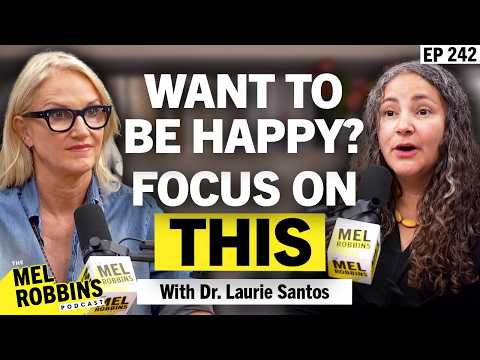
The Science of Well-Being: Powerful Happiness Hacks That 5 Million People Are Using
Dr. Laurie Santos (guest), Mel Robbins (host), Narrator
In this episode of The Mel Robbins Podcast, featuring Dr. Laurie Santos and Mel Robbins, The Science of Well-Being: Powerful Happiness Hacks That 5 Million People Are Using explores yale Happiness Expert Reveals Daily Habits To Boost Your Well-Being Mel Robbins interviews Dr. Laurie Santos, Yale professor and host of The Happiness Lab, about science-backed ways to increase happiness by 5–15% in everyday life. Santos explains why our brains are not wired for happiness, how modern life and phone addiction worsen loneliness and anxiety, and why circumstances like money and status matter less than we think once basic needs are met. Together they break down five core happiness skills—social connection, other-orientation, presence, gratitude, and self-compassion—and how to practice them in tiny, repeatable ways. The episode ends with concrete “happiness homework” so listeners can immediately start inflating their metaphorical ‘leaky tire’ of well-being.
Yale Happiness Expert Reveals Daily Habits To Boost Your Well-Being
Mel Robbins interviews Dr. Laurie Santos, Yale professor and host of The Happiness Lab, about science-backed ways to increase happiness by 5–15% in everyday life. Santos explains why our brains are not wired for happiness, how modern life and phone addiction worsen loneliness and anxiety, and why circumstances like money and status matter less than we think once basic needs are met. Together they break down five core happiness skills—social connection, other-orientation, presence, gratitude, and self-compassion—and how to practice them in tiny, repeatable ways. The episode ends with concrete “happiness homework” so listeners can immediately start inflating their metaphorical ‘leaky tire’ of well-being.
Key Takeaways
Happiness is a buildable skill, not a fixed trait.
Research shows you can become roughly 5–15% happier by consistently practicing certain habits. ...
Get the full analysis with uListen AI
Your circumstances matter less than you think once basics are met.
After basic needs (food, shelter, safety) are covered—roughly around $75K–$100K income in U. ...
Get the full analysis with uListen AI
Social connection is the strongest, most reliable happiness booster.
Happy people spend more time with others, especially friends and family, and even brief interactions with strangers (like chatting with a barista) increase positive emotion and reduce loneliness—introverts benefit just as much as extroverts, even though they predict they won’t.
Get the full analysis with uListen AI
Use money and choices to buy time, not things.
“Time affluence” (feeling you have enough free time) predicts happiness as strongly as employment status. ...
Get the full analysis with uListen AI
Presence, gratitude, and savoring interrupt negativity and hedonic adaptation.
Our brains fixate on threats and get used to good things. ...
Get the full analysis with uListen AI
Self-compassion works better than self-criticism for motivation and happiness.
Constantly berating yourself drains energy, increases procrastination, and lowers well-being. ...
Get the full analysis with uListen AI
Improving your happiness helps you help others and the world.
Data show happier people volunteer more, donate more, and are more willing to help; feeling good fuels doing good. ...
Get the full analysis with uListen AI
Notable Quotes
““Happiness is kind of like a leaky tire. You fill it up with certain behaviors and mindsets, but then you’ve got to keep filling it again and again.””
— Dr. Laurie Santos
““We’re not wired for happiness. We’re wired to survive and reproduce, and that means our brains are built with a negativity bias.””
— Dr. Laurie Santos
““Wherever you’re feeling right now on how happy you are with your life, you can kind of pop up a little bit. You’re not going to go from zero to 100.””
— Dr. Laurie Santos
““Nobody waves, but everybody waves back.””
— Dr. Laurie Santos
““You shouldn’t be comparing your insides to other people’s outsides.””
— Dr. Laurie Santos
Questions Answered in This Episode
Which of the five happiness practices (social connection, other-orientation, presence, gratitude, self-compassion) feels most natural to you, and which feels most challenging—and why?
Mel Robbins interviews Dr. ...
Get the full analysis with uListen AI
If money beyond a certain point doesn’t buy more happiness, what concrete changes could you make in how you spend your time and money this month?
Get the full analysis with uListen AI
How is your phone use crowding out micro-moments of connection, presence, or savoring in your daily life, and what specific boundaries might you experiment with?
Get the full analysis with uListen AI
When you think about being happy ‘in’ your life vs. ‘with’ your life, where are your scores different, and what does that reveal about the changes you actually need to make?
Get the full analysis with uListen AI
In what situations do you notice your inner self-critic the loudest, and how could you rewrite that internal script using the three steps of self-compassion?
Get the full analysis with uListen AI
Transcript Preview
What does the science really say, practically, that you can do to kind of feel better right now? You can actually become happier, somewhere between 5 to 15% happier. If I said, "All things considered, how satisfied are you with your life?" You're like, "Five out of 10." Wherever you're feeling right now on how happy you are with your life, you can kind of pop up a little bit. You're not going to go from zero to 100. Everyone wants to go from zero to 100. I think one of the disappointing things about happiness is that it takes constant work, like all good things in life, right? These are lasting effects where you really go up a small but significant amount, and then I think things are getting worse.
Wha- what do you mean things are getting worse?
Like rates of loneliness have nearly doubled, right, since we've been measuring these things. Like rates of depression and anxiety in the adult population are going up.
Is happiness the anecdote? Hey, it's your friend Mel. Welcome to the Mel Robbins Podcast. I am so excited that you're here. I'm so happy you hit play on the conversation today. First of all, it's always such an honor to be able to spend time with you and to be together. And if you're brand new, I want to welcome you to the Mel Robbins Podcast family, and you have picked one amazing episode to hit play on, and it tells me something about you. It tells me that you're the type of person who not only values your time, but you're also interested in learning about ways that you can be happier. And I am really fired up for today's episode because I've brought in the best of the best, someone who's going to guide you toward a happier life using the exact steps and research that will boost your happiness day-to-day. Dr. Laurie Santos is in our Boston studios. She is a cognitive scientist and professor at Yale who teaches the single most popular course that has been taught at Yale in 300 years. It's a course she created called The Psychology of a Good Life. It's so popular that 1,200 students signed up within three days of it being announced. Now, Dr. Santos has spent her entire career researching what truly makes you happy, and she has one of the most popular podcasts on the topic. It's called The Happiness Lab. And I personally, I love her research. I have used it, I've cited it, I've written about it, I've even taught it in online courses that I teach and in the work that I do with some of the world's leading global brands. That's how powerful her work is, and you're going to feel that power today, and that's why you can hear your friend Mel just bubbling over. That's why I can't wait for you and for the people that you love and for me to learn absolutely everything that she has to share with us today. So please help me welcome Dr. Laurie Santos to the Mel Robbins Podcast.
Install uListen to search the full transcript and get AI-powered insights
Get Full TranscriptGet more from every podcast
AI summaries, searchable transcripts, and fact-checking. Free forever.
Add to Chrome