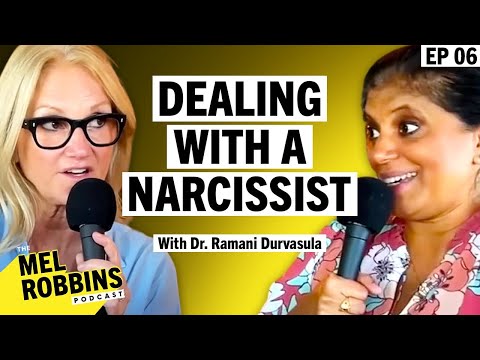
Are You Dealing with a Narcissist? Here’s How to Spot Them | The Mel Robbins Podcast
Mel Robbins (host), Dr. Ramani Durvasula (guest)
In this episode of The Mel Robbins Podcast, featuring Mel Robbins and Dr. Ramani Durvasula, Are You Dealing with a Narcissist? Here’s How to Spot Them | The Mel Robbins Podcast explores how To Recognize Narcissists And Stop Sacrificing Your Sanity Mel Robbins interviews Dr. Ramani Durvasula, a leading expert on narcissism, to clarify what narcissism is, how it develops, and how it impacts relationships, especially in families.
How To Recognize Narcissists And Stop Sacrificing Your Sanity
Mel Robbins interviews Dr. Ramani Durvasula, a leading expert on narcissism, to clarify what narcissism is, how it develops, and how it impacts relationships, especially in families.
Dr. Ramani explains that narcissism is a maladaptive personality style—not a clinical diagnosis—distinct from narcissistic personality disorder, and that it is essentially unchangeable from the outside.
They outline clear behavioral signs of narcissism, the developmental roots in childhood (insecure attachment, overindulgence, or trauma), and the damaging roles children assume in narcissistic family systems.
The conversation focuses heavily on empowering survivors: accepting that you cannot change a narcissist, dismantling guilt, setting boundaries without confrontation, and prioritizing your own “true north” over lifelong people-pleasing.
Key Takeaways
Narcissism isn’t a diagnosis; it’s a maladaptive personality style.
‘Narcissism’ describes a stable way of being (like introversion or agreeableness) characterized by antagonism and lack of empathy; only narcissistic personality disorder is a formal diagnosis, and most narcissistic people are never diagnosed or treated.
Get the full analysis with uListen AI
You cannot change a narcissist—only your response to them.
Dr. ...
Get the full analysis with uListen AI
Core traits of narcissism are driven by deep insecurity and shame.
Behind the arrogance, entitlement, rage, and need for control is a profound, often unconscious fear of being exposed as “not enough,” which fuels hypersensitivity to criticism and constant validation-seeking.
Get the full analysis with uListen AI
Key warning signs include reactivity, entitlement, superficial empathy, egocentrism, contempt, and gaslighting.
Watch for explosive reactions to feedback, refusal to be told what to do, performative or transactional empathy, hijacking conversations, putting others down, and systematically denying or warping your reality.
Get the full analysis with uListen AI
Narcissists are made, not born—and still, it’s not your job to save them.
While temperament plus insecure attachment, trauma, chaos, or overindulgence can foster narcissism, many traumatized children do *not* become narcissists; understanding the origins can build compassion, but does not obligate you to stay in harm’s way.
Get the full analysis with uListen AI
Growing up with a narcissistic parent warps self-worth and normalizes guilt.
Children of narcissists often become anxious adults with poor self-appraisal, chronic self-blame, and an internal rule that “not doing what they want is wrong,” which drives lifelong people-pleasing and difficulty setting boundaries.
Get the full analysis with uListen AI
Never “call out” a narcissist; use low-engagement and your ‘true north’ instead.
Directly labeling or confronting them usually triggers rage, smears, and escalation without change; a safer strategy is minimal emotional engagement, neutral responses (not volleying back), and making decisions based on what’s genuinely healthy for you.
Get the full analysis with uListen AI
Notable Quotes
“You cannot change the weather in Chicago, and you cannot change the behavior of a narcissist.”
— Dr. Ramani Durvasula
“Narcissism is not a diagnosis. It is a personality style.”
— Dr. Ramani Durvasula
“The core of narcissism is a deep insecurity.”
— Dr. Ramani Durvasula
“Never ever call out a narcissist.”
— Dr. Ramani Durvasula
“You’re not crazy. You’re around somebody who’s making you believe you are.”
— Mel Robbins
Questions Answered in This Episode
How can someone differentiate between everyday selfishness and a consistently narcissistic personality style?
Mel Robbins interviews Dr. ...
Get the full analysis with uListen AI
If direct confrontation is counterproductive, what are concrete scripts or responses for setting boundaries with a narcissistic parent or partner?
Dr. ...
Get the full analysis with uListen AI
How can adult children of narcissists begin to dismantle the belief that not doing what the narcissist wants is “wrong”?
They outline clear behavioral signs of narcissism, the developmental roots in childhood (insecure attachment, overindulgence, or trauma), and the damaging roles children assume in narcissistic family systems.
Get the full analysis with uListen AI
What are early dating behaviors that reliably predict a narcissistic pattern before you’re deeply invested?
The conversation focuses heavily on empowering survivors: accepting that you cannot change a narcissist, dismantling guilt, setting boundaries without confrontation, and prioritizing your own “true north” over lifelong people-pleasing.
Get the full analysis with uListen AI
How can workplaces recognize and mitigate the damage caused by highly successful but narcissistic leaders?
Get the full analysis with uListen AI
Transcript Preview
(ticking sound) So, Dr. Ramani, (instrumental music plays) I'm so excited to be here with you.
Narcissism is not a diagnosis, okay?
Wait, what?
The core of narcissism is a deep insecurity.
You're not crazy. You're around somebody who's making you believe you are. I'm trying to pick my mouth up off the floor.
If we only said one thing in this entire podcast episode, is, never ever call out a narcissist.
Hey, it's Mel, and welcome to the Mel Robbins podcast. Okay, I am so excited for today's episode because I've been waiting to introduce you to a friend of mine who has profoundly changed my life. She is the world's leading expert on narcissism. She is also the host of the hit podcast, Navigating Narcissism, which has just been renewed for its second season.
Mm-hmm.
She's a best-selling author. She has just left academia after several decades so that she can fulfill her mission to get information out into the world to help people understand narcissism, to protect themselves from narcissism, and more importantly, to heal-
Yes.
... from the experiences of interacting, being raised by, or dating narcissists.
Mm-hmm.
So, so, Dr. Ramani, I'm so excited to be here with you.
I'm so happy. It's so good to see you. It's been a while. The pandemic, you know, changed the game, right? We've been, we've been in touch electronically. Think I'd even done something with you electronically-
Yes.
... over the pandemic. But it's, it's such a different game to be in person. It's so good to see you, and thank you.
So, I mean it, you profoundly changed my life.
Oh, thank you.
And the reason why is because I have, like many people, had a lot of experience with folks that are narcissists, and you, what I learned from you about what narcissism is, what it isn't, the tools that you have taught me in order to spot narcissism and to protect myself from it, have just completely-
Hmm.
... transformed my life. And so, I'm really excited to be able to introduce you to our audience and to have you do the same for them.
Great.
And so, narcissism I find to be an absolutely fascinating topic. And the reason why I don't think it's dark is because I believe that when you understand what it is and what it isn't-
Hmm, hmm.
... and when you have tools-
Mm-hmm, mm-hmm.
... all of a sudden, there is a light at the end of the tunnel-
Mm-hmm.
... that you're walking down, and you realize, you're not crazy. You're around somebody who's making you believe you are.
Correct. That's beautifully put, and I, I agree with you. In a way, what it is, is you're giving, you know, back in the day, we would have said a roadmap. Now, I like to think of it as GPS. I'm giving people a... I'm hoping to give people a guide to what they're dealing with, and not in an accusatory, "You're bad, I'm good," way, but in more of a, "This may not be good for me." And to not... The challenge in this space, in the narcissism space, is so many people invest themselves and will, "Can I get this person to change? Can I be better? Can I do different to pull something different out of them?" And it's to say, "Stop. That, that's not going to change," right? It's like trying to change the weather. There's nothing you can do to make Chicago w- warmer in February. It is going to be cold. Bundle up. Great city, but it's going to be cold.
Install uListen to search the full transcript and get AI-powered insights
Get Full TranscriptGet more from every podcast
AI summaries, searchable transcripts, and fact-checking. Free forever.
Add to Chrome