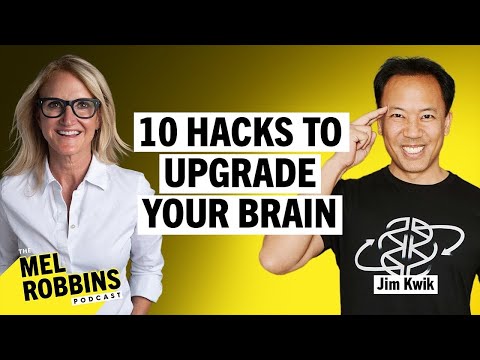
Super Brain: 10 Things to Eat, Think, & Do to Improve Your Memory and Learn Faster
Mel Robbins (host), Jim Kwik (guest)
In this episode of The Mel Robbins Podcast, featuring Mel Robbins and Jim Kwik, Super Brain: 10 Things to Eat, Think, & Do to Improve Your Memory and Learn Faster explores unlock Your Super Brain: Simple Habits To Boost Memory Fast Mel Robbins interviews brain coach Jim Kwik about how anyone can dramatically improve memory, focus, and learning speed by using specific techniques rather than just “trying harder.” Jim shares his backstory of overcoming a childhood brain injury and limiting beliefs to become a world‑class memory and learning expert. Together they walk through practical tools to read up to 50% faster, remember names easily, never lose your keys, and encode information using visualization. They also outline 10 foundational lifestyle levers—what to eat, think, and do daily—to build and maintain a “super brain.”
Unlock Your Super Brain: Simple Habits To Boost Memory Fast
Mel Robbins interviews brain coach Jim Kwik about how anyone can dramatically improve memory, focus, and learning speed by using specific techniques rather than just “trying harder.” Jim shares his backstory of overcoming a childhood brain injury and limiting beliefs to become a world‑class memory and learning expert. Together they walk through practical tools to read up to 50% faster, remember names easily, never lose your keys, and encode information using visualization. They also outline 10 foundational lifestyle levers—what to eat, think, and do daily—to build and maintain a “super brain.”
Key Takeaways
Intelligence and memory are largely trainable, not fixed at birth.
About one‑third of brain performance is genetic, but Jim argues the remaining two‑thirds are shaped by skills, habits, and environment—meaning most people can massively improve their memory and learning ability at any age.
Get the full analysis with uListen AI
Upgrade how you learn, not just what you learn.
Traditional schooling focuses on content (math, history, languages) but rarely teaches core learning skills like how to focus, read efficiently, encode memories, or manage information overload; deliberately training these “meta‑skills” unlocks everything else.
Get the full analysis with uListen AI
Use a visual pacer to instantly boost reading speed and focus.
Running your finger, pen, or cursor just under the line you’re reading reduces back‑skipping, harnesses your eyes’ attraction to motion, and links touch with sight—often increasing reading speed by 25–50% without sacrificing comprehension.
Get the full analysis with uListen AI
Remembering names is a skill built on motivation, attention, and method.
Jim’s MOM + SUAVE systems (Motivation, Observation, Methods; Say, Use, Ask, Visualize, End) show that if you care why a name matters, stay fully present when you hear it, and attach a vivid mental image to it, recall becomes much easier and more reliable.
Get the full analysis with uListen AI
Turn ordinary moments into extraordinary images to remember where things are.
To avoid losing keys or other items, consciously encode the moment you put them down by imagining something outrageous happening there (e. ...
Get the full analysis with uListen AI
Small, consistent actions driven by clear reasons beat vague willpower.
Jim frames motivation as having a reason, energy, and tiny next action; asking, “What is the tiniest action I can take right now toward this goal where I can’t fail? ...
Get the full analysis with uListen AI
Ten daily levers create a ‘super brain’ foundation.
A brain‑healthy lifestyle includes: a good brain diet (e. ...
Get the full analysis with uListen AI
Notable Quotes
“Adults have to be very careful of their external words, because they often become a child’s internal words.”
— Jim Kwik
“Your brain is like this incredible supercomputer, and your self‑talk is the program it will run.”
— Jim Kwik
“Genius is not so much born; genius really is more built.”
— Jim Kwik
“As your body moves, your brain grooves.”
— Jim Kwik
“We shrink what’s possible to fit our minds when we could expand our minds to fit all that’s possible.”
— Jim Kwik
Questions Answered in This Episode
Which limiting beliefs about your own intelligence or memory are you still unconsciously “fighting for,” and what would change if you added the word “yet” to them?
Mel Robbins interviews brain coach Jim Kwik about how anyone can dramatically improve memory, focus, and learning speed by using specific techniques rather than just “trying harder. ...
Get the full analysis with uListen AI
If you applied the visual pacer technique to your reading for 30 days, what could you do with the extra hours you’d reclaim each week?
Get the full analysis with uListen AI
How would your relationships and career shift if you became the person who reliably remembers everyone’s name and details about them?
Get the full analysis with uListen AI
Looking at Jim’s 10 brain levers, which single area—diet, sleep, stress, movement, environment, or peer group—would have the biggest impact if you upgraded it first?
Get the full analysis with uListen AI
What is one piece of information or skill you’ve been telling yourself is “too hard” that you could now approach differently using visualization and tiny, consistent actions?
Get the full analysis with uListen AI
Transcript Preview
(ticking clock) I can't remember anything. Do you ever walk into the kitchen, and you get to the kitchen, and then you're like, "Wait a minute. Why did I come into the kitchen?" I have brought in today the most respected brain coach on the planet to help you and me. You're gonna know his technique for remembering people's names. And personally, I need this one, a super interesting thing you can do to never lose your keys again. How cool is that? (upbeat music) Hey, it's your friend Mel, and welcome to the Mel Robbins Podcast. Have you ever worried about your memory? You know, like, you put your keys down and then you can't find 'em, and you're like, "I know they were right there." And then you start to wonder, "Am I freaking losing my mind or something?" Well, this happens to me all the time. Do you ever walk into the kitchen, and you get to the kitchen, and then you're like, "Wait a minute. Why did I come into the kitchen?" And then you walk out of the kitchen 'cause you can't remember why you walked into the kitchen. And I have had this happen so often recently that I'm starting to wonder, is this early-onset dementia? Now, look, I'm not trying to make a joke about a serious topic, but I will be honest with you. Here is a thought that crosses my mind at least once a week. There's something wrong with my brain. There's something wrong with my brain. Like, I can't remember people's names. I, I, I just feel overloaded all the time. I'm forgetting things. And I don't know about you, I can't stay on top of it all, and I've got a million excuses for why. Oh, it's menopause. Oh, it's busy. Oh, it's the three kids, and a husband, and a full-time job, and two dogs, and a cat that's on medication for a UTI, and I need to give it to him twice a day and I keep forgetting, and that makes me a bad pet owner. But the bottom line is, I can't remember anything. It's like information is just dripping through the holes in my brain. I don't even know if your brain has holes, but I know you feel what I feel, right? Between the information overload, way too much going on at work or school or at home, you're overloaded too. Well, guess what? You and I are in luck, because I have brought in today the most respected brain coach on the planet to help you and me. He says that we have super brains, we just don't know how to tap into it. And in fact, you wanna know why I believe him? I'll tell you why. Because I first met Jim Kwik, that's his name, I'll tell you more about his credentials in a minute, but let me tell you how I met Jim. So Jim and I were both hired to come in and give a presentation at one of the largest, uh, management consulting firms in the world. And so he's on stage and he's teaching all of these skills and amazing things that you're about to learn to increase your memory, to help you read faster, to tap into the super power of your brain. And all of a sudden, he does this thing where he says, "All right, everybody who's wearing red, raise your hand." And we're talking an audience of several thousand people, and I'd say a couple hundred people raised their hand. And he asked them all to stand up. And then he did this insane trick in front of all of our eyes. This is what he did. He had the person in the back left-hand corner of the room start, and he had everybody standing say their name. I'm talking a couple hundred people. And without skipping a beat, as soon as they were done, he said their names and he did it in reverse. Now, I was standing backstage 'cause I was going on after him, and I'm very kinda skeptical of this kinda stuff. So I had my, like, super eagle eyes on him, and he was not wearing anything in his ears. He was not writing anything down. This was his memory. You wanna talk about a super brain? And here's what Jim Kwik says. Jim Kwik says that he can teach you and me how to do it. In fact, he's going to reveal the secret of how he remembered 200 names in reverse later in our conversation today. But the bottom line is, one-third of your brain is predetermined by genetics and biology. Jim Kwik is here to teach you that two-thirds of your brain is within your control, and you have way more influence over your brain and how it works than you think. By the end of the conversation today, you will know a simple technique that will help you read up to 50% faster and retain it all. You're gonna know his technique for remembering people's names. And personally, I need this one, a super interesting thing you can do to never lose your keys again. How cool is that? For the past 30 years, Jim has worked with elite athletes, actors, and executives. He's taught what you're about to learn to people at Harvard, Google, Nike, Zappos, and even the United Nations. And his New York Times bestselling book, which is the handbook on how to create limitless capacity in your brain, now has a new expanded edition and is here to teach you absolutely all the tricks and tools that you need to know. If you've ever wondered, like I've wondered, how the heck does a Broadway actor remember two hours of a script? Well, Jim is a memory coach that has worked with some of the most famous actors in Hollywood and on Broadway. That's how. You are simply not going to believe what he's about to teach you in less than an hour. This is a skills-packed, brainiac, amazing episode that is gonna help you and me tap into the two-thirds of our brain and create what Jim calls a super brain. And make sure you stick around all the way to the very end, because at the end of this conversation you're about to hear, he reveals the secret to memorizing 200 names. And in fact, he's going to teach you, in real time, 10 things to remember to create a super brain so you never forget it. This is so cool. I can't wait for you to drop into this conversation. Without further ado, meet your brain coach, Jim Kwik. Hey, it's Mel. And before we get to the episode, I just wanna thank you for being here and watching the Mel Robbins Podcast on YouTube. We were just named the number five most followed podcast of 2023 by Apple Podcasts, and I've got a favor to ask you. Are you a subscriber?I found out that almost 70% of the people that watch our YouTube channel are not subscribers, and one way that you could really help our small but mighty show out is to just hit subscribe. It is free, it means you will never miss out an episode, and it would really help us out. My goal is to get to 50%, so if you could help us by hitting subscribe and continuing to share the episodes that you get value out, I would really, really, really appreciate it. All right, don't forget. And that's kinda funny for me to say that 'cause the episode today is about building a super brain. Let's go to it.
Install uListen to search the full transcript and get AI-powered insights
Get Full TranscriptGet more from every podcast
AI summaries, searchable transcripts, and fact-checking. Free forever.
Add to Chrome