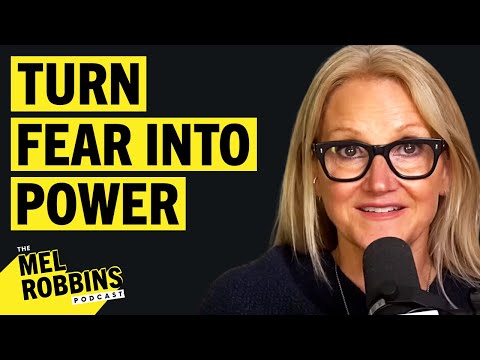
How to Get Confident, Beat Your Insecurities, and Overcome Fear | The Mel Robbins Podcast
Mel Robbins (host), Michelle Poler (guest)
In this episode of The Mel Robbins Podcast, featuring Mel Robbins and Michelle Poler, How to Get Confident, Beat Your Insecurities, and Overcome Fear | The Mel Robbins Podcast explores mel Robbins Turns Stage Fright Into Fuel For Confident Expression Mel Robbins uses a behind-the-scenes look at a 3,000-person keynote to unpack the fear of public speaking and everyday self-expression. She shares her own journey from debilitating stage anxiety to becoming one of the highest-paid female corporate speakers, emphasizing preparation, reframing, and embracing imperfection. Guest speaker Michelle Poler joins to discuss her ‘100 fears in 100 days’ project, showing how deliberately facing fear leads to authenticity and a more fully lived life. Throughout, Mel explains science-backed tools—especially reframing nerves as excitement—to help listeners speak up at work, in relationships, and on any stage.
Mel Robbins Turns Stage Fright Into Fuel For Confident Expression
Mel Robbins uses a behind-the-scenes look at a 3,000-person keynote to unpack the fear of public speaking and everyday self-expression. She shares her own journey from debilitating stage anxiety to becoming one of the highest-paid female corporate speakers, emphasizing preparation, reframing, and embracing imperfection. Guest speaker Michelle Poler joins to discuss her ‘100 fears in 100 days’ project, showing how deliberately facing fear leads to authenticity and a more fully lived life. Throughout, Mel explains science-backed tools—especially reframing nerves as excitement—to help listeners speak up at work, in relationships, and on any stage.
Key Takeaways
Preparation is the most reliable antidote to speaking anxiety.
Robbins attributes a major early breakthrough to obsessive practice and even investing half her first fee into slide design; rehearsal builds muscle memory, reduces uncertainty, and gives your brain something solid to lean on when nerves spike.
Get the full analysis with uListen AI
Reframe nervousness as excitement to unlock better performance.
Drawing on Harvard research, she explains that the body’s stress and excitement responses are physiologically identical; telling yourself “I’m excited” before a talk or hard conversation stabilizes your mind and helps you access what you prepared instead of choking.
Get the full analysis with uListen AI
Tie every scary speaking moment to a clear personal ‘why.’
Before going on stage, Mel reminds herself she’s speaking to one specific person whose life might change; similarly, advocating for a raise or speaking at a town meeting becomes easier when you anchor it to purpose—fair compensation, community impact, or someone who needs to hear you.
Get the full analysis with uListen AI
Your imperfections make you more relatable and trustworthy.
Robbins cites the “pratfall effect” and her own wardrobe disaster (see-through dress on a jumbotron) to show that visible flaws and stumbles humanize you; audiences often like you more when you’re real rather than polished and distant.
Get the full analysis with uListen AI
Fear often disguises itself as intuition and keeps you small.
Michelle Poler realized that the physical ‘don’t do it’ feeling wasn’t always wisdom but ego trying to avoid rejection; she now recognizes that same feeling as a signal of growth and intentionally chooses the path that leads to expansion.
Get the full analysis with uListen AI
Own your story instead of repeating generic information.
For presentations, Poler shifted from Googling “answers” to telling personal stories—like her experience with imposter syndrome—because only your lived experience can differentiate you, build connection, and make a talk truly memorable.
Get the full analysis with uListen AI
Add something meaningful to your life to ‘create’ more time and energy.
Michelle completed her 100-day fear challenge while working full-time and doing a master’s degree, illustrating research Mel cites: when you pursue something deeply meaningful or challenging, you often become more energized and effective with the time you already have.
Get the full analysis with uListen AI
Notable Quotes
“I was alive, but I was not living.”
— Michelle Poler
“One of the best fricking tools for nerves is preparation.”
— Mel Robbins
“The idea here is not that you're gonna get it perfect. It's that you're willing to try.”
— Mel Robbins
“It's not a matter of being liked by everybody. It's a matter of resonating with the right people.”
— Michelle Poler
“Those aren't butterflies. Those are the wings of possibility.”
— Mel Robbins
Questions Answered in This Episode
In what areas of my life am I ‘alive but not living’ because I’m avoiding fear?
Mel Robbins uses a behind-the-scenes look at a 3,000-person keynote to unpack the fear of public speaking and everyday self-expression. ...
Get the full analysis with uListen AI
How could I deliberately reframe my next high-stakes situation from ‘I’m terrified’ to ‘I’m excited’ and see what changes?
Get the full analysis with uListen AI
What personal story or experience could I bring into my next presentation or meeting to make it uniquely mine?
Get the full analysis with uListen AI
Which ‘worst that can happen’ scenarios have been quietly governing my decisions, and what’s the genuine ‘best that can happen’ if I act anyway?
Get the full analysis with uListen AI
If I imagined speaking up as a way to reach one specific person who needs it, how would that change the way I communicate at work, at home, or in my community?
Get the full analysis with uListen AI
Transcript Preview
(ticking sound) (upbeat music) Can you hear that? That right there is the Dallas Convention Center, 3,000 women in the audience. I am taking the stage today, and I am taking you to work with me. The fear of public speaking is the number one fear that people have. And I don't even mean necessarily talking on a stage like I do for a living. I'm talking about the fear of speaking in public, sharing your ideas at work, expressing what you need to other people. Here's the big trick, we reframe fear into excitement. (upbeat music) Hey, it's your friend Mel. Welcome to the Mel Robbins podcast. Can you hear that? That right there is the Dallas Convention Center, 3,000 women in the audience. I am taking the stage today, and I am taking you to work with me. Are you ready for this? I'm ready for this. Let's fucking go. Alrighty, you ready? I'm serious. It's take you to work day for Mel Robbins. I've been wanting to take you on the road with me for, woo, months, ever since we launched this podcast. Um, and I do want to thank those of you that come up literally every single day, it doesn't matter where I am, grocery store, airplane, hotel lobby, standing in line at a gas station, I love meeting you. Love it. If you ever see me, I want you to know something, I would be mad if you didn't use the five-second rule, five, four, three, two, one, to push yourself to come up and say hello. And the reason why is this is our podcast. The 17 million downloads that we have had in just over four months, that means 17 million people in 200 countries have been impacted by this show because of us, you and me. We're sharing the episodes, we're showing up twice a week, and so I love meeting you, because it means that when I'm sitting in a hotel room in Dallas, like I am right now, or I'm above my garage in southern Vermont, like I often am, that no matter where I am, I'm thinking of you, and I'm thinking of the fact that this conversation is happening between us, and that makes me show up in a way that I wouldn't show up if I weren't meeting you or hearing from you and reading your letters. And so just thank you for that. And today we're gonna talk about the biggest fear that people have in life. You know, Seinfeld famously joked that, um, the person in the coffin isn's scared, it's the person who has to speak about the person in the coffin who is. The fear of public speaking is the number one fear that people have, and I don't even mean necessarily talking on a stage like I do for a living. I'm talking about the fear of speaking in public, sharing your ideas at work, expressing what you need to other people, having hard conversations with friends and family, talking at a meeting at school, uh, pushing back on something, uh, with a doctor. Like, just being able to express yourself. And the reason why this is such a huge fear for people is because it is a moment of intense vulnerability. The second that you go to speak at work, what happens? Everybody turns and all eyes are on you, and suddenly you feel like there's a spotlight on you and you get really worried about being judged. Uh, same thing happens when you have to speak in class, right? When you got called on in class, whoop, most people get a little nervous, lot of people hated that moment in elementary school when you had to read out loud, that's a moment of public speaking, and we are so afraid in that moment when the spotlight is on us. And I've shared in a number of episodes that I used to be terrified of public speaking. I would turn bright red when I got called on as a little kid. Uh, in law school I would start coughing attacks or I would leave the room. Uh, as a young, uh, lawyer I would wear a scarf because I'd get these neck rashes as I was talking to the judge and to the prosecutor in a small, uh, courtroom, and I just figured I would be the kind of person that always had a bright red face, always had an awful case of hives on my chest, always felt my tongue going dry, and I hated it. I hated it, hated it, hated it. And today what I'm gonna talk about is how I went from being afraid of public speaking to becoming... I- I- I'm almost like, you know, like I- I- I- It sounds braggadocious, but the truth is, I went from that to being the most successful female speaker in the world. More than 111 speeches a year, um, on the corporate circuit, so Microsoft, Starbucks, JP Morgan, AT&T, any kind of company you can imagine, I've been there. Now, the first question I always get is, "How did you get into the speaking business and how did you become the most sought after female speaker on the corporate speaking circuit, Mel?" Well, the truth is, I didn't set out to do anything. I've told you guys the story about how that TEDx talk happened by accident in 2011 and how I had a 21-minute-long panic attack while I was giving that talk and I never thought I would speak ever, ever, ever again, and then something crazy happened. A year later somebody put the TEDx talk online, and for another year it went crazy viral. And I didn't even know it was online, and so we're talking 2013. Now, by mid-2013 people start to reach out to me on Facebook and say, "Hey, I saw that thing in San Francisco." And I'm like, "Were you there?" They're like, "No, it's online." I'm like, "It's online?" And I realized, holy cow, this thing's online and it's got like a million views, that's crazy. And people kept reaching out and it was mainly women's conferences, and they were asking if I wanted to come and do like a breakout session and they wanted me to just repeat that...... TEDx talk, and so I had no idea that this was an industry or a business. I looked at speaking as something that famous people do, something that sports people do, something that people that are major, major authors must do. So I didn't have a bo- I didn't have anything. I just had my little secret five-second rule in my back pocket. I had a TEDx talk that had mistakenly gone viral online, and now I had people asking me if I would come and I would talk, uh, in breakout sessions at women's conferences. And I'm like, "Okay, that sounds fun." Now, keep in mind, in my life, uh, this is the moment when Chris has left the restaurant industry. He is bottomed out, not functioning, focused on getting sober, and I am working two jobs trying to keep things afloat. I mean, it is a really scrambling time in our life. And so I said yes to these things, and I'll never forget it. In 2013, I did seven talks, I think it was, all for free. I had no idea that people got paid to do this, and, um, I was doing it because I wanted to escape (laughs) the pressure of my life. And if I'm being perfectly honest, as nervous as I was that, about doing this, and I'd get a big neck rash, and I'd turn bright red in my face, as nervous as I was, there was something about being asked to tell my story and inspire other people that really lifted me up and made me feel, I don't know, like, it's sort of like how you fluff a pillow up when it's looking deflated. It just lifted my spirits a little bit to, to have the focus be on helping other people, and so it was like a lifeline. But I was still so nervous. When I tell you I was nervous, I mean, I was so nervous, I not only wore Spanx. I would put, like, a pad in the Spanx because I was sweating so much. I had all kinds of wardrobe fails because I would, I would literally sweat like Niagara Falls. I, that's what I do. I have a hot flash as I get nervous. So, um, I'll never forget it. It was, um, the Pennsylvania Women's Conference. It was Hilary Clinton, I think, was the keynote speaker and, uh, then there was this incredible woman who was the principal of Strawberry Hill Mansion who, um, I just love, and she spoke in the main room, 14,000 women there. And I was in this breakout session, and it was the largest room I had ever been in. I almost had a heart attack. There were like a thousand seats set up, and I had never been in a room that size. So I give this talk, which was largely just a mimic of the, the, the TEDx talk that I did, and this woman comes up to me afterwards, and she's like, "Oh my God, you were so great." You know, which was really nice to hear, and she said, "Can I ask you a question? You know, I, I was also a speaker this morning. I was in a breakout room on a panel, and I just wanna ask you a question speaker to speaker." And I was like, "Of course." And she said, "Did you get your check yet?" And I said, "Check? Wait a minute. You, you got paid for this?" And she looked at me with horror and said, "Oh my God, I'm really sorry. I just assumed, like, you had a bigger... I just assumed that you got paid." I'm like, "People get paid for this? Like, people, like normal people get paid for this?" And I was so flabber- it was one of those moments where you're just like, am I the stupidest fucking idiot on the planet? Does everybody else know this shit but me? And I was so dumbfounded that for two weeks I was just, like, stunned at what an idiot I was. I didn't even think to ask anybody to pay me to do this because I didn't think I was any good at it. So, um, I made myself a promise. I said, "You know what? I have no idea what to charge. You don't have a book. You should probably write one of those too. But, um, first you gotta figure out how to keep the lights on in the house and, uh, keep the family afloat and keep paying the bills," and I thought, here's what I'm gonna do. I am going to just, when the next person calls and says, "We'd like to book you to speak," I'm gonna pause, five, four, three, two, one, take a breath, and then I'm gonna say, "I think I'm available. What's your budget?" And then I'm going to wait, I'm gonna listen to the number, and then I'm gonna go five, four, three, two, one, pause, normally I'm double, and pause and see what happens 'cause I, I didn't even know what to price myself at. So two weeks later the phone rings and it's this guy in Dallas, Darren Paul, and he had been in the speaking business for like 20 years, and he says, "You know, blabbity blah, heard da da da da da da da." And I gotta thank his wife Lori 'cause she's the one that saw my TEDx talk going viral on Facebook, and she said to her husband, "You gotta book this woman for our sales conference for J Hilburn." And so Darren calls me, first phone call I receive, no joke, when I've made myself this promise, and he asks if I'm available five months from now in Dallas in August to speak at the national sales conference for this company, J Hilburn. I said, "I think I'm available. What's your budget?" And he said, "$10,000." I dropped the fucking phone. We had liens on our hou- ten thou- I, I, I had ne- I, I had no fucking idea people. Wh- what the f- 10,000 fucking dollars? Are you fucking kidding me? I will, I will literally di- I'll strip for that. I mean, that's unbelievable. So I, I forgot the second part. I was like, "Okay, I'm in. I'm in. Yes, yes, yes." Now, luckily I was so nervous and, you know, sometimes fear is a fantastic thing because it motivates you. I was so nervous because I felt so unworthy of that amount of money that I did something really smart, and fear motivated me to do this. I was so nervous that I would fall flat on my face because I believed I was not worthy of that kind of money because I had never made that kind of money.... that I ha- used half of the budget to pay a graphic designer to help me create a PowerPoint, because I needed at least something that would look like that. And I practiced, and I practiced, and I prepared, and that's one of the big things that you gotta take away. One of the best fricking tools for nerves is preparation. The more you prepare, what you're actually doing is working through your own resistance to this shit. You're creating muscle memory. You're rehearsing. Will you choke? Maybe, but not after I teach you the tools that I'm gonna teach you today, but you will never get better or conquer your fear of doing this public speaking if you're unwilling to prepare. So, part of the nerves might be that you're not even preparing enough. You're not rehearsing, you're not rehearsing in front of people, you're not taking the time to edit your mar- Like, it takes time, and rehearsal is so important. If you prepare, you're removing nerves, you're setting yourself up to win. And so, think about preparing like you're just building this muscle. It doesn't take the nerves away, or the fear away, or the stakes away, but by God, it's gonna help these tools work because you will have the preparation. There's this really famous quote that I love, uh, that I talk about all the time. It's by Charlie "Bird" Parker. I don't even know if this is a real story, but I love this quote. Apparently, Charlie "Bird" Parker, the famous jazz musician, was asked by a journalist who was writing a big article about him, "How the hell do you do what you do with that horn?" And you know what Charlie "Bird" Parker said? He said, "Well, first you gotta learn your instrument, and that takes years, decades of practice. You gotta study it. You gotta rehearse. You gotta do your scales. You gotta practice over, and over, and over, and over, and over again until you learn that instrument. And then, you forget all that shit they taught you and you just wail." And so, preparation allows you to tap into your genius. Preparation is what allows you to improv, to freestyle, to be fully express the highest you, to channel, to, like, tap into something, and it's in there, in you. That's why you feel this push-pull and this desire to show up more in your life. So, I spent all this time preparing, and I showed up, and there are moments in your life that really matter, and this was one of them. I met this moment. I stepped on that stage with my neck rash, and my rosy cheeks, and my dry mouth, and I fucking destroyed it, because I had prepared because I was afraid. Now, I also had the biggest wardrobe failure I have ever had on a stage. So, I wore this dress, 'cause at the time, I was a commentator for CNN, and I used to wear this dress all the time on CNN, and I thought, "Okay, if somebody's paying you that kind of money, you gotta look like you're on TV." So, I wore this, like, kind of power lady dress. You can already imagine it, right? It's got, like, sort of the, the V-neck and the pencil skirt, and it's hard to walk in. It looks good on television, but you're not moving and you're sitting in a chair. I had never looked at it with a light behind me, and at the end of the speech, I just flay this thing. I walk off that stage. It was the first time I'd ever been projected on a jumbotron in an arena, and after the speech, this woman came up to me. She was darling. She's like, "Oh, my God. Oh, my God. I love The Five-Second Rule. Thank you so much for those. It was amazing." I'm like, "Oh, my God. Yeah. I'm gonna pay my mortgage this month. This is great." And she said, "You were so great. I have to tell you something." And I'm like, "What?" She said, "Don't ever wear that dress again." I said, "Why?" She said, "I don't even wanna tell you this." I said, "What?" She said, "I could not only see that you were wearing Spanx, but that you had a thong on underneath them. That dress is so see- see-through, and you could see it all on the jumbotron." Okay. We went from winning to wanting to melt and crawl into a hole, but fuck it, you know? I, honestly, when you fuck up, you know what the research shows? People like you more, and that shows in that comment. That, by the way, is called the pratfall effect, that your imperfections make you more likable, more trustworthy. It makes you, as an expert, be somebody that people lean toward, and you've had this experience, haven't you? Where you might have somebody that's got a PhD, that's a know-it-all, that's really snooty and talking down to you. You're kind of like, "I don't want to learn from you." But when you got somebody that is, you know, on a stage, or teaching you something, or just somebody you meet, if there's something that humanizes them, it so builds trust, and that's an important thing to understand, because the idea here is not that you're gonna get it perfect. It's that you're willing to try. So, maybe that's why I destroyed it. I don't know. Everyone was rooting for me, 'cause you could see the Spanx and the thong underneath the dress, but that dress went in the fricking trash can at the hotel, never to see the light of day again. Although, I hope somebody pulled it out and used it. Um, but I never looked back from that moment, because Darren, who booked me, had been in this business for 20 years, and he said, "I gotta tell you, you are top three of all time, and the single best female speaker I have ever seen in my entire life. Who manages your business?" And I said, "You do." And he has run my speaking business ever since. And so, along the way, it took me several years to truly get over my nerves, and I don't get nervous. I care deeply.I get super intentional, um, about the stakes, because I really want to make a huge difference, and I wanna destroy it on these stages, and entertain and empower and inspire and all of it. So, I do care about how I perform when, um, I am stepping on a stage or I'm behind this mic. But I have come up with incredible ways to not only face my fear of public speaking, but to conquer it, and to use science and really amazing mental reframes to tame those nerves, and that's what I'm gonna teach you today. Because you know what I want for you? I want your fullest expression. I want fear to stop holding you back. I want you to trust fall into your life. I want you to take that first step and climb the staircase to the things that you want in your life, and there are too many places where fear holds you back and keeps you silent and has you questioning yourself. And so, that was me too, and I just chipped away at this fucker. And I am so glad that I did, because I just can't even imagine how much I would yearn for what I'm doing now without even realizing it. But the first step is admitting that there are fears that are holding you back, and so we're gonna use public speaking, because it's the number one fear for everybody. All right, let's hit pause. When we come back, I've got a really cool surprise coming up, and I don't even know how this is gonna go. Um, I, as I said, am in Dallas, and while I was taping this, I, I got a text from a woman who is a keynote speaker. She's from Venezuela, and she spoke today at this huge conference in Dallas with 3,000 women at it that I am the closing keynote speaker for. And I guess she has been following my career, and she's always wanted to meet me, and I love meeting other speakers on the corporate circuit. I love supporting other people who are up and coming. I want to get as many diverse and female voices on these stages as I possibly can, and so if I can make the time, I always do. Do you know what her specialty is? What she teaches Google and Microsoft and people around the world? How to conquer your fears. Are you kidding me? Is that not synchronicity? So, I'm gonna take a quick pause for our sponsors, and when we come back, you're gonna hear the moment she knocks on the door of my hotel room. I've never met this woman. Her name is Michelle Poler. She's a best-selling author. She teaches people around the world about conquering their fears, and she's coming up, and she's gonna tell you her best tips for conquering your fear of public speaking, why you need to do it, and more importantly, wha- what fear actually is and why it matters that you face it. We'll be right back. Hey, it's Mel, and I wanted to jump into the middle of that podcast episode you were watching to make sure you knew about a free opportunity that I created for you. It's a new three-part training called Take Control with Mel Robbins. It is packed with science. It is packed with action. It's exactly what you need right now. I know that you are tired of feeling like you're in survival mode. You're tired of merely coping, and it is time to tap back into your excellence and power again. Let me coach you. Let me guide you on the steps that you need to take in order to level up and start executing. It's gonna feel so great to start winning again. All you gotta do is click on the link right there in the caption. It's melrobbins.com/takecontrol. It is free. It is for you, and you need to be in it. Now, let's go back to the podcast. All right, it's Mel, and Michelle Poler's about to walk in (laughs) . I've never met her. I hope this is good. (laughs) I'm sure it will be. Um, you know what's amazing? This entire podcast is one giant trust fall, and we were gonna tape an episode today about ADHD, and I just had not, uh, gotten the studies that I wanted to walk you through printed, and I felt completely, like I just wasn't ready. And so I'm like, "You know what we're gonna do? We're gonna talk about the number one fear in the world, which is public speaking." And I went to sit down. I get this text. It's from a woman who wrote a book called Hello Fear that's speaking at the same thing as me, and I think in life, you gotta learn how to trust fall. You gotta take that step forward before you're ready. There's that famous Dr. Martin Luther King, Jr. quote about how... And I'm gonna just completely get this wrong, but it's about how you don't need to see the whole staircase. You just need to take that first step, and the staircase appears, and it is so true. And that's why I'm so excited for this, and I'm even starting to get nervous because I'm looking at my phone, and she has two hours to catch a flight, and she's speaking at another event across the country tomorrow morning, so she can't miss it. We got like 10 minutes to squeeze this in, 10 minutes, but I'm doing a trust fall and so is she. Are they here? Really? They're here? Knock on the door. Louder. Welcome-
Install uListen to search the full transcript and get AI-powered insights
Get Full TranscriptGet more from every podcast
AI summaries, searchable transcripts, and fact-checking. Free forever.
Add to Chrome