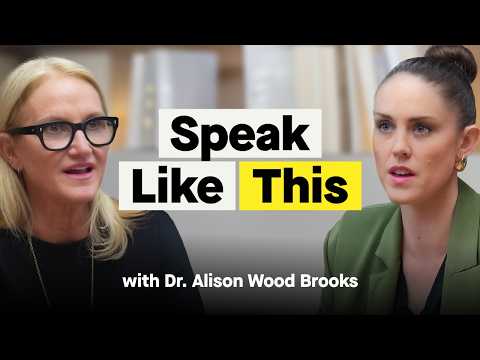
How to Communicate With Confidence & Ease (From Harvard Business School’s #1 Professor)
Alison Wood Brooks (guest), Mel Robbins (host)
In this episode of The Mel Robbins Podcast, featuring Alison Wood Brooks and Mel Robbins, How to Communicate With Confidence & Ease (From Harvard Business School’s #1 Professor) explores harvard Professor Reveals Simple TALK Framework To Transform Every Conversation Mel Robbins interviews Harvard Business School professor Alison Wood Brooks about the science of everyday conversation and how better communication can upgrade every area of life, from work to family to dating.
Harvard Professor Reveals Simple TALK Framework To Transform Every Conversation
Mel Robbins interviews Harvard Business School professor Alison Wood Brooks about the science of everyday conversation and how better communication can upgrade every area of life, from work to family to dating.
Brooks introduces her four-part TALK framework—Topics, Asking, Levity, and Kindness—as a practical way to navigate the countless micro-decisions we make in every interaction.
They explore why egocentrism and poor perspective-taking derail connection, and how tools like topic prep, strategic question-asking, active listening, and respectful language improve status, influence, and intimacy.
The conversation also covers handling interrupters and bulldozers, managing belittling comments and arguments, and moving beyond small talk into deeper, more rewarding conversations.
Key Takeaways
Prep topics in advance to reduce anxiety and improve any conversation.
Spending even 30 seconds brainstorming personalized topics for people you’ll see (kids, partner, colleagues, parents) leads to smoother, more enjoyable conversations and gives you backup options when things stall.
Get the full analysis with uListen AI
Ask more—and better—follow-up questions to deepen connection.
Follow-up questions signal real interest, help you escape egocentrism, and let you access the other person’s perspective directly instead of guessing; they’re a fast track from small talk into meaningful talk.
Get the full analysis with uListen AI
Show your listening with both your body and your words.
Good listening has three parts: hearing, thinking about what you heard, and then proving it by paraphrasing, validating feelings (e. ...
Get the full analysis with uListen AI
Use levity and occasional self-deprecation—especially if you’re high status—to build warmth.
Light humor and sharing failures humanize you, fight boredom, and significantly boost how much people want to follow you; even a single successful joke can increase perceptions of your leadership potential.
Get the full analysis with uListen AI
Apply kindness through respectful language and responsive listening, especially with loved ones.
Kind communicators avoid hurtful, exclusionary comments and consistently try to understand and respond to others’ needs; this is especially critical with partners, where habitual defensiveness and lashing out can trap you in a “bad equilibrium.”
Get the full analysis with uListen AI
Manage difficult behaviors by redirecting, enlisting allies, and using receptive language.
With bulldozers, you can deliberately redirect attention to others using questions and body language; with interrupters or belittlers, you can acknowledge their perspective, calmly name the impact, and, if needed, recruit a colleague or friend to help you reclaim space.
Get the full analysis with uListen AI
Aim to be interested, not interesting—and give yourself grace for imperfection.
You don’t need dazzling stories; every person is an endless source of interesting material if you’re curious enough, and since conversations are inherently messy, it’s healthier to drop the perfectionism and extend grace to yourself and others when things go sideways.
Get the full analysis with uListen AI
Notable Quotes
“Every person you know, every relationship in your life, is a repeated sequence of conversations over time.”
— Alison Wood Brooks
“Communication is everything. Everything.”
— Alison Wood Brooks
“How we talk is who we are and what we’re able to do in the world.”
— Alison Wood Brooks
“The key to being a good conversationalist is not about being interesting. It’s about being interested in the other person.”
— Alison Wood Brooks
“If it’s born of love, count yourself lucky.”
— Alison Wood Brooks
Questions Answered in This Episode
Which part of the TALK framework—Topics, Asking, Levity, or Kindness—do I personally neglect most, and what would change if I focused on improving it for a week?
Mel Robbins interviews Harvard Business School professor Alison Wood Brooks about the science of everyday conversation and how better communication can upgrade every area of life, from work to family to dating.
Get the full analysis with uListen AI
How might my status and influence at work shift if I deliberately asked more follow-up questions and summarized others’ points in meetings?
Brooks introduces her four-part TALK framework—Topics, Asking, Levity, and Kindness—as a practical way to navigate the countless micro-decisions we make in every interaction.
Get the full analysis with uListen AI
Where in my life am I stuck in a “bad equilibrium” of defensive or hostile communication, and what would a first small step toward a new pattern look like?
They explore why egocentrism and poor perspective-taking derail connection, and how tools like topic prep, strategic question-asking, active listening, and respectful language improve status, influence, and intimacy.
Get the full analysis with uListen AI
In what recurring conversations (with family, partner, or colleagues) could simple topic prep dramatically upgrade the quality of our interactions?
The conversation also covers handling interrupters and bulldozers, managing belittling comments and arguments, and moving beyond small talk into deeper, more rewarding conversations.
Get the full analysis with uListen AI
How can I begin using receptive language—acknowledging and affirming others’ feelings—when I feel belittled or attacked, without betraying my own boundaries?
Get the full analysis with uListen AI
Transcript Preview
(instrumental music plays) Every person you know, every relationship in your life, is a repeated sequence of conversations over time. So even if each of those conversations gets a little bit better, this short time that we have on the Earth, everything about it is gonna get better. Communication is everything. Everything. It's a series of tiny choices that you're making at every moment of every conversation.
And you have a four-part framework that helps us communicate more effectively. Can you tell me what the four-part framework is?
Yes, very briefly. T stands for topics. A stands for asking. L is for levity. And K is for kindness. In my class, we do an exercise called never-ending follow-up questions.
Uh-oh. I have a feel like we're about to do this.
Do you wanna try it?
Yes.
It's like we're all on these journeys looking for those magical moments of connection. And sometimes they happen. This is where real power and authority and influence come from. When we think of people who are charismatic and competent, this is what they're doing.
And that's what you're gonna teach us today?
That's what I'm gonna teach you today.
Professor Alison Woodbrooks, welcome to the Mel Robbins Podcast.
I'm so happy to be here, Mel. Thank you.
I am so excited to just dig into your research and learn everything that we can learn from this crazy popular class that you teach at Harvard Business School. But here's where I wanna start. There is a person listening right now who has no time.
Mm-hmm.
And yet they found time and made time-
Mm-hmm.
... to be with you and me right now. What can the person listening expect to change about their life if they take everything that you're about to teach us and they try it and they put it to use?
If they really take what we talk about to heart, I think everything about their life could get better. Your love life, your relationship with your children, your relationship with your parents, your work, your relationships with your colleagues, what you're able to get done together, everything. Every person you know, every relationship in your life is a repeated sequence of conversations over time. So even if each of those conversations gets a little bit better, this short time that we have on the Earth, everything about it is gonna get better.
Wow.
(laughs)
You just said our whole life is gonna get better. Why does communication matter so much?
Communication is everything. Everything. So e- really, you can think of every relationship in your life as this repeated sequence of conversations and then if you zero in on each one of those conversations, it's a series of tiny choices that you're making at every moment of every conversation. And we're about to do it right now, Mel. Um, every moment you're making these choices, "What should we be talking about? What should I be asking the other person about? When should we be laughing? When should we be crying? Uh, when should I ask a question? When should I share something of myself?" We're making these tiny micro-decisions all the way along, and it's gonna determine what we're able to do together, what we're able to accomplish together-
Install uListen to search the full transcript and get AI-powered insights
Get Full TranscriptGet more from every podcast
AI summaries, searchable transcripts, and fact-checking. Free forever.
Add to Chrome