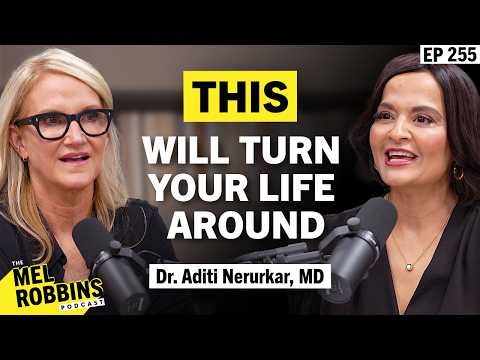
If You Struggle With Stress & Anxiety, This Will Change Your Life
Dr. Aditi Nerurkar (guest), Mel Robbins (host)
In this episode of The Mel Robbins Podcast, featuring Dr. Aditi Nerurkar and Mel Robbins, If You Struggle With Stress & Anxiety, This Will Change Your Life explores transforming Stress: Regain Control From Horizonlessness, Loneliness, And Overload Mel Robbins interviews Harvard physician and stress expert Dr. Aditi Nerurkar about why so many people feel overwhelmed, anxious, and stuck—and what to do about it. They explain stress as a biological brain state where the amygdala hijacks the prefrontal cortex, leaving people unable to plan, hope, or feel motivated. Three major hidden drivers of stress are explored in depth: post‑pandemic “horizonlessness” and delayed stress response, epidemic levels of loneliness, and the intense, under‑recognized stress of parenting and caregiving. Throughout, they emphasize validation (“it’s not your fault”), self‑compassion, tiny daily actions that restore agency, and practical habits like sleep, movement, and simple social interactions.
Transforming Stress: Regain Control From Horizonlessness, Loneliness, And Overload
Mel Robbins interviews Harvard physician and stress expert Dr. Aditi Nerurkar about why so many people feel overwhelmed, anxious, and stuck—and what to do about it. They explain stress as a biological brain state where the amygdala hijacks the prefrontal cortex, leaving people unable to plan, hope, or feel motivated. Three major hidden drivers of stress are explored in depth: post‑pandemic “horizonlessness” and delayed stress response, epidemic levels of loneliness, and the intense, under‑recognized stress of parenting and caregiving. Throughout, they emphasize validation (“it’s not your fault”), self‑compassion, tiny daily actions that restore agency, and practical habits like sleep, movement, and simple social interactions.
Key Takeaways
Stress is a biological brain state, not just a feeling.
When you’re stressed, your prefrontal cortex (planning, focus, anticipation) goes offline and your amygdala (survival, alarm) takes over. ...
Get the full analysis with uListen AI
Post‑crisis ‘horizonlessness’ is a delayed stress response, not laziness or lack of ambition.
After prolonged or acute stress (like the pandemic, illness, divorce, job loss), the “dam” of pent‑up emotion breaks, leaving people feeling blank about the future and unable to feel excitement or direction. ...
Get the full analysis with uListen AI
Normalize and validate your experience before trying to change it.
Data show the majority of people report stress, burnout, loneliness, and parenting overload, so feeling this way is common, not a personal failure. ...
Get the full analysis with uListen AI
Use tiny actions to rebuild agency and shift from potential to kinetic energy.
When you feel stuck or “wading through molasses,” very small, doable actions—looking forward to a cup of coffee, a five‑minute walk, writing down a few gratitudes—convert emotional potential energy into motion. ...
Get the full analysis with uListen AI
Prioritize sleep, movement, and self‑compassion as medical interventions, not luxuries.
Going to bed earlier (especially near 10–11 p. ...
Get the full analysis with uListen AI
Combat loneliness through frequent casual interactions, not just deep relationships.
Research shows that regular brief conversations with “weak ties”—baristas, neighbors, people at the grocery store—significantly reduce loneliness and increase wellbeing. ...
Get the full analysis with uListen AI
Caregivers must parent themselves, because their wellbeing shapes their children’s.
High, unaddressed parental stress and poor mental health are linked to worse physical and general health in children. ...
Get the full analysis with uListen AI
Notable Quotes
“True power lies in our response.”
— Martin Luther King III (as quoted by Mel Robbins)
“Loneliness is a global epidemic… the risk of death of loneliness was equivalent to smoking 15 cigarettes a day.”
— Dr. Aditi Nerurkar
“Your brain and body are not broken. There is nothing wrong with you. There is so much more right with you than wrong with you.”
— Dr. Aditi Nerurkar
“This is not the moment to set new goals. This is not the moment to start an exercise routine… just like if you broke your fricking leg, you wouldn’t be playing pickleball on it this afternoon.”
— Mel Robbins
“You are doing so much better than you think you are.”
— Dr. Aditi Nerurkar
Questions Answered in This Episode
How can I tell the difference between clinical depression and this ‘horizonlessness’ delayed stress response—and when should I seek professional help?
Mel Robbins interviews Harvard physician and stress expert Dr. ...
Get the full analysis with uListen AI
If someone is deeply resistant to small actions like walking or socializing because they feel pointless, how can they practically get started anyway?
Get the full analysis with uListen AI
What are some specific self‑compassion practices that effectively calm the amygdala in moments of intense stress or parenting overwhelm?
Get the full analysis with uListen AI
How should workplaces and schools respond to these biological realities of chronic stress and delayed stress responses in the people they serve?
Get the full analysis with uListen AI
Given the serious health risks of loneliness, what structural or community‑level changes (beyond individual actions) would most effectively reduce social disconnection?
Get the full analysis with uListen AI
Transcript Preview
Loneliness is a global epidemic. Data shows that globally 330 million people go two weeks without speaking to a friend or a family member.
Two weeks?
Two weeks. The risk of death of loneliness was equivalent to smoking 15 cigarettes a day.
Wait.
The first step always when you're going through a difficult experience is to normalize and validate that difficult experience. You are doing so much better than you think you are. Anywhere you are, when you are in a room of 30 people and you think, "Oh, I'm probably the only one who's feeling this way," you are not alone. It is not your fault. Just look at the data.
Hey, it's your friend Mel, and welcome to the Mel Robbins Podcast. I am so excited that you're here. And first of all, it is always such an honor to be able to spend time together with you. I am so excited about today's conversation because I know that by the time we're done today, you're gonna just feel more peaceful, you're gonna feel more in control. And I so want that for you. And I also want to take a moment to welcome you. If you're brand new, this is the first time that you've listened to an episode, welcome to the Mel Robbins Podcast family. The fact that you've hit play on this episode tells me something important about you. It tells me that you're the kind of person that truly values your time, that you're making time to listen to something that can help you improve your life, that can help you feel better. And today's conversation is absolutely going to do that. And we're gonna talk about stress, and we're gonna talk about ways that you can lower your stress. But I wanna put this inside a much bigger context for you, because this episode happens to be releasing on Dr. Martin Luther King Jr. Day here in the United States. And a couple weeks ago, I had the extraordinary honor of sitting down with Dr. Martin Luther King Jr.'s son and his daughter-in-law. They have a brand new podcast called My Legacy. It was an extraordinary experience. And during that wide-ranging conversation, which I can't wait for you to listen to, we covered so many topics. We, of course, talked about the let them theory. And I've been talking a lot about the let them theory, which is a simple mindset tool that helps you identify in a moment what's in your control and what's not in your control. And there was something that Martin Luther King III said to me on his podcast My Legacy that I wanted to share with you, because I think it sets up the conversation that we're about to have in a much more powerful and profound way in terms of what's available to you based on what you're gonna learn today. And here's what he said as we were talking about this issue of recognizing when something is out of your control, and that true power lies in your response. And we're gonna really focus on that today, but I want you to hear these words from Martin Luther King III. As he was reflecting on the power of the let them theory, he said, "Mel, when you say 'let them,' this is a truth that defined my father's leadership, that true power lies in our response. My father believed that non-violence was not passive, but it was the most courageous form of action. Choosing peace when hatred tries to provoke. By refusing to react with bitterness, we reclaim our power and shape a better future." I just love that. He went on to say, "Let them doesn't mean you're giving away control. It means you're reclaiming it. By choosing how we respond, not by feeding into anger, hatred, or negativity, we exercise the ultimate power over ourselves." As both my father, Dr. Martin Luther King Jr.'s legacy says, and his father, Daddy King, and their vision of non-violent action. You know, Daddy King once said, Mel, "In the face of unimaginable loss, I refuse to let hatred reduce me." And when you recognize the strength that you hold in your response, you realize that you hold the power and that you can transform your family, your community, and even the world. And today we are gonna be talking about the fact that true power lies in your response. And if you're feeling stressed out or overwhelmed by the world around you, that today you're gonna get this deep sense of validation that you're not alone, that there are forces outside of you right now. And in fact, you're gonna learn about three things that are causing probably the most amount of stress for you or for the people that you love, because these are the three things that our expert today, Dr. Aditi Nerurkar, based on her research, is saying are things that are out of your control and they create an extraordinary amount of stress for you. When you hear these things, you're gonna feel validated. And more importantly, we're then gonna talk about how your power is not in those things out there, it's actually in your response to them. That's what the conversation is about, and you're gonna absolutely love it. So let me tell you a little bit about Dr. Aditi. Dr. Aditi is a Harvard medical doctor. She's a researcher. She's a best-selling author. She's a world-renowned expert in stress and in public health. She is a lecturer at Harvard Medical School. She's also a mother and she's married, and she's busy just like you, and she understands the pressure that you're in. She was the medical director of Harvard Beth Israel Deaconess Hospitals Integrative Medical Program. What does that mean? That means she ran the largest stress management clinic, seeing patients every day and teaching them all of these integrative approaches, these evidence-based approaches that helped her patients feel better.And today, that's what she's gonna do for you. She is going to help you feel more peaceful. She is going to help you get your power back. She is going to help you focus, not on all the things out there, but on the power in here, and the power of your response. And today specifically, she's gonna highlight three key struggles that she sees in her patients every single day. She is gonna validate how you are feeling. And more importantly, she's gonna give you your power back because you do have the power to change your response to the forces outside of you, and today you're gonna learn how. So without further ado, you and I are gonna go to our Boston studios where Dr. Aditi Nurikar and I are gonna have this extraordinary conversation with you. Let's do it. Dr. Aditi Nurikar, I am so excited to see you. Thank you, thank you, thank you for coming back to the studio.
Install uListen to search the full transcript and get AI-powered insights
Get Full TranscriptGet more from every podcast
AI summaries, searchable transcripts, and fact-checking. Free forever.
Add to Chrome