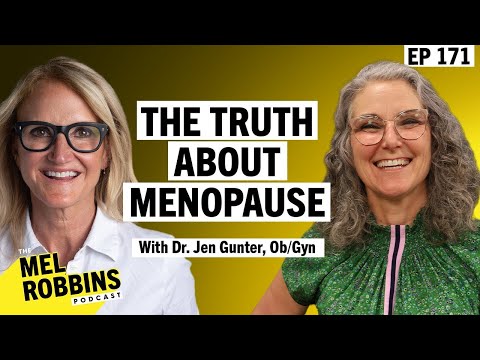
How to Balance Your Hormones: What Your Doctor Isn’t Telling You About Menopause
Mel Robbins (host), Dr. Jen Gunter (guest)
In this episode of The Mel Robbins Podcast, featuring Mel Robbins and Dr. Jen Gunter, How to Balance Your Hormones: What Your Doctor Isn’t Telling You About Menopause explores menopause Demystified: Evidence-Based Hormones, Myths Shattered, Power Restored Mel Robbins interviews OB-GYN Dr. Jen Gunter about what menopause really is, how it affects the body, and how women can safely treat symptoms using evidence-based medicine. They reframe menopause as “puberty in reverse,” a normal life stage that can be both challenging and liberating, not the end of a woman’s value or health. A major focus is separating FDA-approved menopausal hormone therapy from unregulated compounded “bioidentical” products and pellets, and clarifying real versus exaggerated risks such as breast cancer and cardiovascular disease. The conversation also covers non-hormonal strategies, how to talk to doctors and loved ones, and why women should refuse to blame hormones for structural sexism or “mediocre men.”
Menopause Demystified: Evidence-Based Hormones, Myths Shattered, Power Restored
Mel Robbins interviews OB-GYN Dr. Jen Gunter about what menopause really is, how it affects the body, and how women can safely treat symptoms using evidence-based medicine. They reframe menopause as “puberty in reverse,” a normal life stage that can be both challenging and liberating, not the end of a woman’s value or health. A major focus is separating FDA-approved menopausal hormone therapy from unregulated compounded “bioidentical” products and pellets, and clarifying real versus exaggerated risks such as breast cancer and cardiovascular disease. The conversation also covers non-hormonal strategies, how to talk to doctors and loved ones, and why women should refuse to blame hormones for structural sexism or “mediocre men.”
Key Takeaways
Reframe menopause as a normal transition, not a personal decline.
Menopause is a natural stage of the ovulatory cycle, akin to puberty in reverse, with a wide range of normal experiences—some unpleasant, some liberating. ...
Get the full analysis with uListen AI
Prioritize exercise and basic lifestyle habits even before hormones.
Regular exercise (especially resistance training), adequate protein, high fiber intake, and not smoking have powerful effects on bone health, muscle mass, mood, heart and brain health, and fall risk—touching almost every domain affected by menopause.
Get the full analysis with uListen AI
Choose FDA‑approved hormone therapies and avoid routine compounded “bioidentical” products.
“Bioidentical” is a marketing term; compounded creams, pellets, and bespoke mixes are not FDA-approved, not batch-tested, and often deliver unknown doses, potentially increasing risks like endometrial cancer or failing to protect bones. ...
Get the full analysis with uListen AI
Use symptom‑driven, not lab‑driven, decisions for most women over 45.
For women 45 and older with typical symptoms (hot flashes, irregular periods, vaginal dryness), clinicians generally don’t need hormone blood tests to start treatment—symptoms and age are enough. ...
Get the full analysis with uListen AI
Time hormone therapy wisely and individualize risk–benefit decisions.
Starting menopausal hormone therapy within 10 years of the last period and before ~60 is associated with lower risks for dementia and cardiovascular disease; transdermal estradiol plus oral progesterone is the current standard with very low breast cancer risk for most. ...
Get the full analysis with uListen AI
Don’t let menopause become a scapegoat for unfair treatment or bad relationships.
While symptoms can affect mood and tolerance, using menopause to excuse a partner’s lack of contribution or workplace sexism mislabels structural problems as hormonal. ...
Get the full analysis with uListen AI
Prepare, advocate, and bring evidence into your medical visits.
Women can improve care by learning basic terminology (estradiol, Premarin, transdermal vs. ...
Get the full analysis with uListen AI
Notable Quotes
“You can think about menopause as puberty in reverse.”
— Dr. Jen Gunter
“Using FDA‑approved hormones is like going to the gas station… Getting compounded formulations is like buying gas from a dude on the side of the road who says he has bespoke gas for you.”
— Dr. Jen Gunter
“If you could only ever do one thing for your health, it would be to get your exercise.”
— Dr. Jen Gunter
“When people use the word ‘bioidentical,’ it tells me that they think women are dumb.”
— Dr. Jen Gunter
“The answer to being mistreated is not taking hormones. The answer to being mistreated is to be treated correctly.”
— Dr. Jen Gunter
Questions Answered in This Episode
How can I practically assess my personal risk–benefit profile for menopausal hormone therapy with my doctor, using tools like breast cancer and cardiovascular risk calculators?
Mel Robbins interviews OB-GYN Dr. ...
Get the full analysis with uListen AI
If I’ve already been using compounded “bioidentical” hormones or pellets, what steps should I take now to evaluate my current hormone exposure and potential risks?
Get the full analysis with uListen AI
What specific exercise and resistance-training routines are most effective for preserving bone density and muscle mass during and after the menopause transition?
Get the full analysis with uListen AI
How should women with a history of breast cancer, blood clots, or heart disease approach symptom management if systemic hormones are not recommended for them?
Get the full analysis with uListen AI
What conversations and boundary-setting strategies can women use at home and at work to distinguish between hormone-related challenges and unfair expectations or unequal labor?
Get the full analysis with uListen AI
Transcript Preview
Everything you need to know about menopause.
Just like you went through puberty, which might have been challenging and had some symptoms, menopause is n- in many ways the same thing. You can think about it as puberty in reverse.
That actually makes a lot of sense. You know, when I was going through perimenopause, I got bioidentical hormones from a compound pharmacy, and I thought I was fancy.
Move away from using bioidentical and just call them compounded, 'cause bioidentical doesn't mean anything. So bioidentical is a marketing term used to describe hormones that are plant-based. They're just making things up.
There were all these warnings like, "Don't expose to light. Don't do this. Do that." Now, did I follow those? Of course not.
So this is the analogy I use. Using FDA-approved hormones is like going to the gas station. You fill your car and you have a working gas gauge, and you're like, "I know what's in there," and that's important. Getting these compounded formulations is like buying gas from a dude on the side of the road who's telling you he has bespoke gas for you.
I am speechless. Hey, it's Mel. I am so thrilled to bring this episode and conversation to you today. Dr. Jen Gunter is here to tell you everything you need to know about menopause, with a very particular focus on exactly what to do in order to feel better. Now, Dr. Gunter has been called the internet's favorite OBGYN. She is a double board-certified, fellowship-trained medical doctor, and she is a fierce advocate for women's health. She is also the bestselling author of three international bestsellers, including The Menopause Manifesto and her latest best-seller, Blood. She's known for myth-busting and no-nonsense facts, and you are going to love this conversation with her today. And I want to remind you, this is not just for you. Please be generous and share this with every single woman that you know, because what you're about to hear will change her life and yours. Without further ado, please help me welcome Dr. Jen Gunter to the Mel Robbins Podcast. Dr. Gunter, I'm so glad you're here.
I am so glad to be here.
So, Dr. Gunter, thank you so much for jumping on a plane, flying all the way across country to be here with us in Boston. I cannot wait to jump in and talk about menopause, bust the myths, have you empower us. I want to start by having you speak directly to the person who's listening who is either about to hit menopause, going through menopause, or maybe they're listening to this episode because somebody that they love has sent it to them. Could you talk to the person listening about what they are going to experience and what they're going to learn and how they're going to feel after they're done learning from you today?
Yeah. So I want you to feel seen if you're going through the menopause transition. I think so often women are made to feel small and they're not important, and women are uniquely affected by ageism. So you kind of have the double whammy at this time. So I'm hoping that you'll feel that your concerns are valid and they're important, and there are lots of options to do from a health standpoint, and there are many ways to take care of yourself. And I'm hoping that I can give you some tools to reframe what's going on with your body so you kind of know where you are and also give you tools to find help if you're struggling.
Install uListen to search the full transcript and get AI-powered insights
Get Full TranscriptGet more from every podcast
AI summaries, searchable transcripts, and fact-checking. Free forever.
Add to Chrome