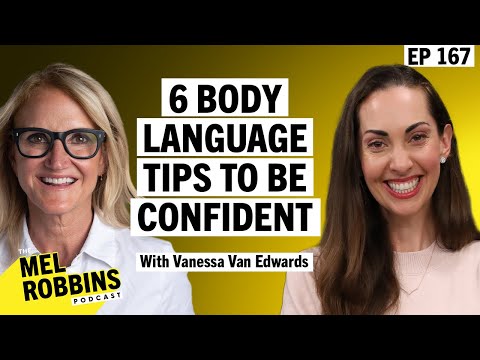
How to Read Body Language to Get What You Want: 6 Simple Psychological Tricks to Be More Confident
Vanessa Van Edwards (guest), Mel Robbins (host), Narrator, Narrator
In this episode of The Mel Robbins Podcast, featuring Vanessa Van Edwards and Mel Robbins, How to Read Body Language to Get What You Want: 6 Simple Psychological Tricks to Be More Confident explores use Body Language And Energy Management To Boost Influence And Success Mel Robbins interviews behavioral researcher Vanessa Van Edwards about how high achievers use body language, communication, and energy management to be more confident and effective.
Use Body Language And Energy Management To Boost Influence And Success
Mel Robbins interviews behavioral researcher Vanessa Van Edwards about how high achievers use body language, communication, and energy management to be more confident and effective.
Vanessa explains the difference between work energy and social energy, the danger of ambivalent tasks and relationships, and how to deliberately design your day around what fuels you instead of what drains you.
They break down specific, research-backed nonverbal cues (posture, hands, seating, room position) and verbal patterns (better questions, priming words, labels) that instantly change how others perceive and respond to you.
The conversation ends with a practical A–B–C–D task audit to focus on your highest-value work, plus guidance on goals, quests, and preventing burnout while still achieving at a high level.
Key Takeaways
Treat work energy and social energy as separate resources you must manage.
Most people only plan their tasks and ignore how social interactions affect their energy. ...
Get the full analysis with uListen AI
Eliminate ambivalent tasks and relationships to reclaim hidden energy.
“Question mark” people and so-so tasks drain you more than clearly good or clearly bad ones. ...
Get the full analysis with uListen AI
Use confident body language loops: shoulders down, chest open, arms uncrossed, hands visible.
Maximize distance between ears and shoulders, keep your chest open and arms slightly away from your torso, and avoid hunching over your phone or crossing your arms. ...
Get the full analysis with uListen AI
Make your hands work for you: steeple and visible, purposeful gestures.
A relaxed steeple (fingertips lightly touching, palms apart) conveys calm authority; visible, congruent gestures (e. ...
Get the full analysis with uListen AI
Prime yourself and others with achievement-oriented and collaborative language.
Single words like “win,” “master,” “success,” or “community” change behavior and motivation. ...
Get the full analysis with uListen AI
Increase likability by genuinely liking more people and showing it.
Research on popular kids found the most liked students had the longest lists of people they liked. ...
Get the full analysis with uListen AI
Design your work around A–B–C–D tasks and protect your “A work.”
List tasks into A (exceptional, energizing), B (good but not best), C (average, clunky), and D (bad, draining). ...
Get the full analysis with uListen AI
Notable Quotes
“Burnout is not a sign of success. Busyness and burnout are not badges of honor.”
— Vanessa Van Edwards
“You want to maximize the distance between your ear and your shoulder pretty much at all times.”
— Vanessa Van Edwards
“Ambivalent relationships are actually the hardest. You have to say no to the bad to make room for the right.”
— Vanessa Van Edwards
“We are in control of our likability. If we find ways to like more people, we become more likable.”
— Vanessa Van Edwards
“You are working enough, you are good enough, you just have to try something a little different.”
— Vanessa Van Edwards
Questions Answered in This Episode
Which people and tasks in my life are truly “A work,” and what concrete steps can I take this week to do more of them and less of my B–C–D work?
Mel Robbins interviews behavioral researcher Vanessa Van Edwards about how high achievers use body language, communication, and energy management to be more confident and effective.
Get the full analysis with uListen AI
Who are the ambivalent relationships I keep investing in, and what would happen if I paused those to deepen connections with the people who genuinely energize me?
Vanessa explains the difference between work energy and social energy, the danger of ambivalent tasks and relationships, and how to deliberately design your day around what fuels you instead of what drains you.
Get the full analysis with uListen AI
How does my default body language on Zoom, at my desk, and when I walk into rooms influence how others see me—and what one cue (posture, arms, hands) will I change first?
They break down specific, research-backed nonverbal cues (posture, hands, seating, room position) and verbal patterns (better questions, priming words, labels) that instantly change how others perceive and respond to you.
Get the full analysis with uListen AI
How could I rename my recurring meetings, calendar blocks, and email subject lines to prime myself and others for collaboration, focus, or achievement instead of autopilot?
The conversation ends with a practical A–B–C–D task audit to focus on your highest-value work, plus guidance on goals, quests, and preventing burnout while still achieving at a high level.
Get the full analysis with uListen AI
What big “quest” do I want to be working toward over the next few years, and how can I design that pursuit so I actually enjoy the process, not just the outcome?
Get the full analysis with uListen AI
Transcript Preview
What's your story?
Oh, I hate that question.
Okay. (laughs) Okay. (laughs) Here is a classic mistake that I see all the time. Hey, everyone.
You're on Zoom and your shoulders-
And your shoulders-
... are up at your ears.
... are up your ears. Morning.
(laughs)
Your first impression is now little, small, defeated. You want to maximize the distance between your ear and your shoulder pretty much at all time. This one little cue completely changes your perception of me.
Hey, it's Mel. I'm so glad you're here. And, you know, lately I've noticed more and more questions are coming in from around the world seeking advice on how to level up your success. So I decided to reach out to a world-renowned researcher who is the founder of the behavior lab called The Science of People. She has flown across the country to be here today for you, and she is armed with the latest research and so many takeaways that are gonna help you achieve the success that you deserve in your life and your career. Vanessa Van Edwards is the founder of The Science of People, which is a behavior lab that studies high achievers and the science of confidence, charisma, and body language. She is the best-selling author of two books on interpersonal science. For all you new listeners, Vanessa is also one of the most popular guests that have ever appeared on The Mel Robbins Podcast because she has the unique ability to give you specific behaviors, specific habits that you can use immediately for greater success. Habits like what high achievers do with their hands to display power and intelligence, the specific place you should stand at a networking event. You'll also learn one thing you should never do in a conversation with someone else. I mean, there are so many takeaways and science-backed shortcuts that you're gonna learn today. I cannot wait for you to start implementing these to help you be more successful and achieve your goals. So please help me welcome Vanessa Van Edwards to The Mel Robbins Podcast.
Woo, I'm so happy to be back. Thanks for-
Uh-
... having me.
I am so excited to see you. And I guess where I wanna start before we jump in-
Mm-hmm.
... to all of the tools and the research, I mean, you just bring it every time I talk to you. Now, why does it matter to either know high achievers or to be one? Like, how does being a high achiever-
Mm-hmm.
... other than the obvious, you're achieving your goals-
Yeah.
... but why does it matter?
I think that what's really crucial is that I've spent a career studying these high achievers, and I've noticed that they have very specific behavior patterns and communication patterns. And what they do is they take what I call communication shortcuts.
Install uListen to search the full transcript and get AI-powered insights
Get Full TranscriptGet more from every podcast
AI summaries, searchable transcripts, and fact-checking. Free forever.
Add to Chrome