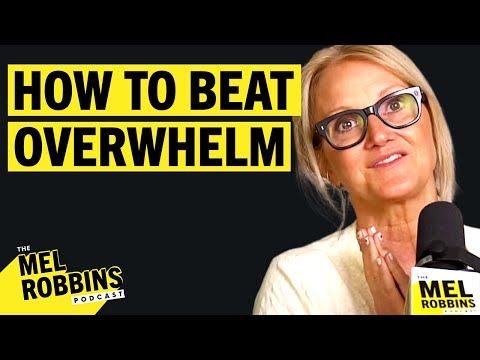
Feeling Overwhelmed? How to Tap Into Your Power and Feel Calmer | The Mel Robbins Podcast
Mel Robbins (host), Laura (guest), Samantha (guest), Cindy (guest), Artist caller (name not given) (guest), Michelle (guest)
In this episode of The Mel Robbins Podcast, featuring Mel Robbins and Laura, Feeling Overwhelmed? How to Tap Into Your Power and Feel Calmer | The Mel Robbins Podcast explores beat Overwhelm: Mel Robbins’ Two-Type Framework To Take Control Mel Robbins explores the feeling of overwhelm through a simple framework that distinguishes between “legitimate overwhelm” caused by life circumstances and “lifestyle overwhelm” created by habits and choices. Through listener questions, she shows how acceptance, rest, and realistic expectations help in legitimate overwhelm, while tools like brain dumps, the rule of three, and scheduling priorities combat lifestyle overwhelm. She challenges four common lies about productivity and pressure, emphasizing that not everything is equally important and more effort isn’t always the answer. The episode blends personal stories, practical routines, and mindset shifts to help listeners reclaim calm, energy, and a sense of control.
Beat Overwhelm: Mel Robbins’ Two-Type Framework To Take Control
Mel Robbins explores the feeling of overwhelm through a simple framework that distinguishes between “legitimate overwhelm” caused by life circumstances and “lifestyle overwhelm” created by habits and choices. Through listener questions, she shows how acceptance, rest, and realistic expectations help in legitimate overwhelm, while tools like brain dumps, the rule of three, and scheduling priorities combat lifestyle overwhelm. She challenges four common lies about productivity and pressure, emphasizing that not everything is equally important and more effort isn’t always the answer. The episode blends personal stories, practical routines, and mindset shifts to help listeners reclaim calm, energy, and a sense of control.
Key Takeaways
Identify whether you’re in legitimate or lifestyle overwhelm.
Legitimate overwhelm comes from heavy life circumstances (new baby, caregiving, grief, major transitions), while lifestyle overwhelm is self-created through overcommitment, poor boundaries, and trying to do everything; knowing which you’re in clarifies your next move.
Get the full analysis with uListen AI
In legitimate overwhelm, prioritize rest and stamina over adding more.
Treat intense life stretches as a marathon: accept that you can’t do it all, focus on essentials (self-care, responsibilities, basic routines), seek help where possible, and remind yourself this phase is temporary.
Get the full analysis with uListen AI
Use a “brain dump” to move from spinning to strategic action.
Write down everything on your mind—no filtering—so it’s on paper instead of in your head; once it’s externalized you can see it clearly, stop ruminating, and decide what truly matters today.
Get the full analysis with uListen AI
Apply the “rule of three” to beat the lie that everything is important.
After your brain dump, highlight only three tasks that actually matter today; when everything is a priority, nothing is, so committing to three key actions lowers pressure and increases follow-through.
Get the full analysis with uListen AI
Build a short, realistic morning routine instead of chasing perfection.
Mel’s ‘million-dollar morning’ is just 20–30 minutes: get up with the alarm, make your bed, high-five the mirror, put on workout clothes, get light, and move your body—this alone can reduce stress and resentment in busy seasons.
Get the full analysis with uListen AI
Stop managing important work in your head; schedule it and make it easy.
Thinking about something isn’t the same as working on it; if it matters, it needs a time slot in your calendar, plus deliberate “make it easy” tactics (right time of day, accountability, classes, pairing it with someone else).
Get the full analysis with uListen AI
Doing the one avoided task often unlocks surprising “energetic time.”
Avoided tasks—like an unpaid bill or overdue project—drain mental and emotional energy for months; completing them quickly (using tools like the 5-second rule) often produces immediate relief, clarity, and a sense of spaciousness.
Get the full analysis with uListen AI
Notable Quotes
“If everything is important, nothing is important.”
— Mel Robbins
“Life is a marathon, not a sprint.”
— Mel Robbins
“Overwhelm is torture—feeling like you have to do more, move faster, and it keeps you stuck.”
— Mel Robbins
“You don’t need to do more. You just need to do the things that really matter to you.”
— Mel Robbins
“What if it doesn’t have to be hard? What if I can do the damn thing?”
— Michelle (listener, quoted by Mel Robbins)
Questions Answered in This Episode
How can I honestly distinguish whether my current stress is legitimate overwhelm from circumstances or lifestyle overwhelm from my own patterns?
Mel Robbins explores the feeling of overwhelm through a simple framework that distinguishes between “legitimate overwhelm” caused by life circumstances and “lifestyle overwhelm” created by habits and choices. ...
Get the full analysis with uListen AI
What three things—if I did only them today—would truly move the needle in my life or work?
Get the full analysis with uListen AI
Where am I still telling myself the lie that ‘if I just hurry, I can fit more in,’ and how is that sabotaging my wellbeing?
Get the full analysis with uListen AI
Which single avoided task is draining the most mental energy from me right now, and when exactly will I schedule time to do it?
Get the full analysis with uListen AI
If I treated this season of my life as a marathon instead of a sprint, what expectations, routines, or commitments would I immediately change?
Get the full analysis with uListen AI
Transcript Preview
(ticking clock) (upbeat music) I just have to talk about this today, because I'm feeling it. Overwhelm. We are going to unpack this topic of overwhelm, and I've got this framework that you're going to love. There are two types of overwhelm, and seeing which type of overwhelm that you're in, it's going to help you take the steps to deal with being overwhelmed, to become calmer, to tap into your power. I'm ready for the conversation today. (upbeat music) Hey, it's your friend Mel, and welcome to an episode of the Mel Robbins podcast that I really needed today, and I know you need to hear this too. Okay, I'm, I'm, I'm ready for the conversation today, 'cause this is one of those podcast episodes where, yes, I'm talking with you, but this is really a topic I need to talk about. And we're going to talk about overwhelm. But I'm Mel Robbins. I'm a New York Times best-selling author and one of the world's leading experts on change, motivation, and habits. And I believe there are simple things that you and I can do based on research and common sense that help us both create a better life. And one of the topics that I h- I just have to talk about this today, because I'm feeling it, is overwhelm. I am feeling so overwhelmed today because I have to pack. I have to get in the car when I'm done talking to you about overwhelm. I have to drive to Boston. I am going to a funeral for a friend, and I'm giving a eulogy, which is both a huge honor and a massive, massive reason to feel overwhelmed. And so it is kind of one of those life imitates art moments right now, where we were planning on talking about overwhelm, and I roll in here behind the microphone. I am a hot mess right now. I didn't even put on underwear yet today. I've got on ripped jeans, a jog bra, and a yellow T-shirt, and I just realized that the T-shirt says, "Mentally elsewhere." And so it may feel a little odd that the person that you're gonna have a conversation with about overwhelm is, uh, a hot mess with a messy bun and, um... But you know what? I've always envisioned the Mel Robbins podcast to be like taking a walk with a really good friend. And when you take a walk with a really good friend, you show up as you are, and you walk and you talk and you sort things out together. And so today's episode I'm really excited for because you and I are going on a walk together. And I've got five other listeners that are going to join that walk with us. And as we walk and we talk, we are going to unpack this topic of overwhelm, and I've got this framework that you're going to love. There are two types of overwhelm, and seeing which type of overwhelm that you're in, it's going to help you take the steps to deal with being overwhelmed, to become calmer, to tap into your power. You probably notice that my voice is starting to gain a little bit of steadiness. That's because I know what's coming. I know that as you and I talk through these frameworks and as I hear other listeners like you sharing what's going on in their life and why they're overwhelmed, and as we talk about what you can do to face those situations in life, I'm starting to feel a little steadier. 'Cause I know by the end of a good walk with friends, you always feel better. And I want you to stay until the end, because at the very end you're going to hear from a listener named Michelle, and she has so much joy in her voice because she has applied what you're about to learn and what I'm about to remind myself of when it comes to overwhelm. So let's dig into our first question, which comes from a listener named Laura.
Install uListen to search the full transcript and get AI-powered insights
Get Full TranscriptGet more from every podcast
AI summaries, searchable transcripts, and fact-checking. Free forever.
Add to Chrome