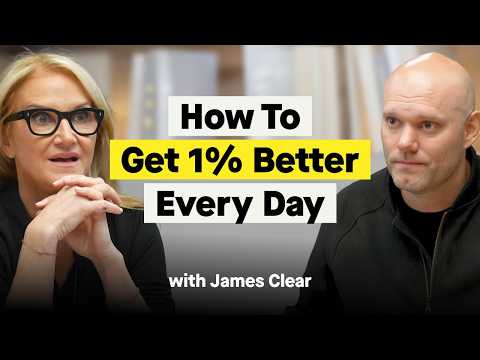
The Science of Making & Breaking Habits: How to Change Your Life in 1 Month
James Clear (guest), Mel Robbins (host)
In this episode of The Mel Robbins Podcast, featuring James Clear and Mel Robbins, The Science of Making & Breaking Habits: How to Change Your Life in 1 Month explores small daily habits compound into identity, resilience, and massive change Mel Robbins interviews James Clear about the science and practice of building habits that make you dramatically better over time. Clear explains that most outcomes are lagging measures of daily behaviors, and that fixing your systems—your repeatable habits—matters far more than obsessing over goals. He introduces concepts like the 1% better principle, identity-based habits, and the Four Laws of Behavior Change as a practical framework. Throughout, they focus on reducing friction, making habits enjoyable, and learning how to recover quickly from setbacks so you stop delaying a better future.
Small daily habits compound into identity, resilience, and massive change
Mel Robbins interviews James Clear about the science and practice of building habits that make you dramatically better over time. Clear explains that most outcomes are lagging measures of daily behaviors, and that fixing your systems—your repeatable habits—matters far more than obsessing over goals. He introduces concepts like the 1% better principle, identity-based habits, and the Four Laws of Behavior Change as a practical framework. Throughout, they focus on reducing friction, making habits enjoyable, and learning how to recover quickly from setbacks so you stop delaying a better future.
Key Takeaways
Focus on systems, not goals, to change your life.
Goals set direction, but your daily habits (your system) determine your actual results; if there’s a gap between goals and habits, habits win every time.
Get the full analysis with uListen AI
Tiny improvements compound into massive change over time.
Getting 1% better each day can make you roughly 38 times better in a year; time magnifies whatever you repeatedly do, turning small habits into dramatic outcomes.
Get the full analysis with uListen AI
Build identity-based habits by asking, “Who do I want to become?”
Instead of chasing outcomes like losing 40 pounds, focus on becoming the kind of person who doesn’t miss workouts; every action is a vote for your desired identity.
Get the full analysis with uListen AI
Use the Four Laws of Behavior Change to design habits.
Make the habit obvious (clear cues), attractive (fun/appealing), easy (low friction, small scope), and satisfying (immediate reward) to increase the odds you’ll stick with it.
Get the full analysis with uListen AI
Make habits so small you can do them even on bad days.
Scale behaviors down using tools like the two-minute rule and “reduce the scope, stick to the schedule” so you keep the streak alive and maintain momentum.
Get the full analysis with uListen AI
Design your environment and relationships to reduce temptation.
People with “high self-control” are usually just exposed to fewer temptations; rearranging your space, tools, and social circle often beats relying on willpower.
Get the full analysis with uListen AI
Bounce back quickly from setbacks with the rule “never miss twice.”
Missing once is human; the key is to pour your energy into getting back on track the very next chance you get so one lapse doesn’t spiral into a long-term slide.
Get the full analysis with uListen AI
Notable Quotes
““Procrastinating on something important is choosing to delay a better future.””
— James Clear
““You do not rise to the level of your goals. You fall to the level of your systems.””
— James Clear
““Every action you take is like a vote for the type of person you wish to become.””
— James Clear
““Action relieves anxiety.””
— James Clear
““The secret to winning is knowing how to lose.””
— James Clear
Questions Answered in This Episode
How can I redesign one current goal in my life into a clear, sustainable system of daily habits?
Mel Robbins interviews James Clear about the science and practice of building habits that make you dramatically better over time. ...
Get the full analysis with uListen AI
If every action is a vote for my identity, what am I currently voting for with my daily routines?
Get the full analysis with uListen AI
Where am I confusing motion (planning, researching) with action (doing the thing that actually moves the needle)?
Get the full analysis with uListen AI
What environmental or social changes would most reduce my exposure to temptations that derail me?
Get the full analysis with uListen AI
In what area of my life do I most need the “never miss twice” rule to recover faster from setbacks?
Get the full analysis with uListen AI
Transcript Preview
Procrastinating is choosing to delay a better future. It's choosing to ignore the results that you could be having, the potential that you could be fulfilling. Fix the inputs, and the outputs will fix themselves. Fix the daily habits, and you'll be led to a different destination. Time is precious.
Today, you and I are getting to learn from the incredible James Clear. He's widely regarded as one of the top experts in the world on habit formation and behavior change, whose book on habits has sold 25 million copies. I'm talking about none other than Atomic Habits.
I feel like if I sit there and I ruminate about something, it just gets worse. It gets bigger in my head. But if I take one small action on it, if I just get started on it, now I'm influencing the outcome. You know, now I'm shaping what's gonna happen. Action relieves anxiety.
You said at the very beginning is that the secret to winning is knowing how to lose. How do you start the engine up again, and what's the mistake you see people making?
There's just a period where you just gotta get through them. Life might be bad now, but that doesn't mean it's always gonna be that way. Life might be hard now, but it's not always gonna be hard. And you're gonna be okay. You're gonna make it out the other side. I think we should all give ourselves permission for our habits to shift based on the season that we're facing.
Explain the four laws of behavior change.
The first law is to make it obvious. The second law is to make it attractive. The third law is to make it easy. The easier, more convenient, frictionless, simple a habit is, the more likely it is to be performed. And the fourth and final law is- (beep)
That's amazing. Hey, it's your buddy Mel, and before we jump into this unbelievable conversation with James Clear, you're about to learn that you're not the problem. The fact that you don't have systems is the problem. You're gonna learn these systems. We're gonna get right into it. You're gonna love this. It's gonna help you achieve your goals. But I have a goal too. My goal is that 50% of you who watch here on YouTube are subscribers. And right before we were about to start this episode, my team showed me this. 57% of you who watch the Mel Robbins Podcast here on YouTube are not subscribers. You're the kind of person who likes supporting people who support you. My goal is that we get to 50%. So please, if that subscribe button is lit up, it means you're not a subscriber. Please hit Subscribe. It's free. That's how you can show your support to your friend Mel Robbins, and that way you don't miss a thing. It also tells me and the team, oh my gosh, you love the guests that we're bringing you, the content that we're putting here, and an attempt to support you in creating a better life. All right, thanks for doing that. You ready to break bad habits and lock in new ones using James Clear's research? I bet you are. So let's jump in. James Clear, welcome to the Mel Robbins Podcast.
Install uListen to search the full transcript and get AI-powered insights
Get Full TranscriptGet more from every podcast
AI summaries, searchable transcripts, and fact-checking. Free forever.
Add to Chrome