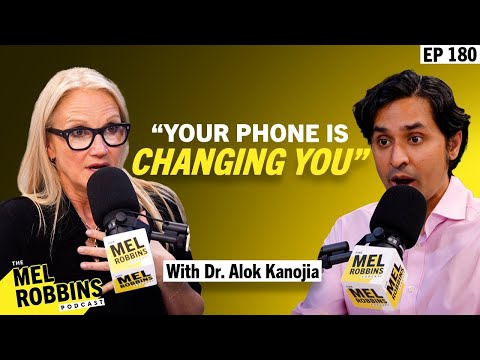
Before You Waste Time, Watch This with Dr. K (@HealthyGamerGG )
Mel Robbins (host), Dr. K (Alok Kanojia) (guest)
In this episode of The Mel Robbins Podcast, featuring Mel Robbins and Dr. K (Alok Kanojia), Before You Waste Time, Watch This with Dr. K (@HealthyGamerGG ) explores how Technology Rewires Your Brain, Identity, And Attention—And Regain Control Mel Robbins and Dr. K (Harvard-trained psychiatrist and creator of HealthyGamerGG) explore how modern technology and social media are deliberately engineered to capture attention, reshape behavior, and infiltrate identity. They explain that unlike traditional addictions targeting a single brain system, today’s apps activate multiple circuits at once—pleasure, emotion regulation, attention, social validation, and identity—making them uniquely invasive. The conversation links constant phone use to emotional numbing, shortened attention spans, weakened motivation, and a sense of disconnection from self and life. Dr. K then offers practical behavioral strategies and conversational tools to reclaim control of your attention, rebuild boredom tolerance, and create a healthier relationship with technology for yourself and your loved ones.
How Technology Rewires Your Brain, Identity, And Attention—And Regain Control
Mel Robbins and Dr. K (Harvard-trained psychiatrist and creator of HealthyGamerGG) explore how modern technology and social media are deliberately engineered to capture attention, reshape behavior, and infiltrate identity. They explain that unlike traditional addictions targeting a single brain system, today’s apps activate multiple circuits at once—pleasure, emotion regulation, attention, social validation, and identity—making them uniquely invasive. The conversation links constant phone use to emotional numbing, shortened attention spans, weakened motivation, and a sense of disconnection from self and life. Dr. K then offers practical behavioral strategies and conversational tools to reclaim control of your attention, rebuild boredom tolerance, and create a healthier relationship with technology for yourself and your loved ones.
Key Takeaways
Stop asking if you’re ‘addicted’; ask if you’re happy with your tech use.
Clinically, addiction is defined by impaired function, but most people are harmed long before they hit that threshold; the real question is whether your current phone, gaming, and social media habits match the life you actually want.
Get the full analysis with uListen AI
Add friction between the impulse to use your phone and actual access.
Disable Face ID/biometrics, remove addictive apps from your home screen, consider uninstalling native apps and using only clunky web versions, and avoid carrying your phone on your body—this slows down impulsive checking and weakens the habit loop.
Get the full analysis with uListen AI
Protect the first hour after waking and the hour before bed from screens.
Using high‑dopamine tech first thing in the morning ‘squeezes the lemon’—depleting dopamine early so work and meaningful tasks later feel unrewarding; at night, devices suppress emotional processing and then cause a flood of thoughts once you stop, which ruins sleep.
Get the full analysis with uListen AI
Boredom is withdrawal from dopamine, not a harmless feeling to avoid.
Just as hunger or opiate withdrawal are negative signals that drive behavior, boredom is your brain punishing you for not feeding it stimulation; learning to simply endure boredom (pacing, walking, doing nothing) is the core skill that lets you resist compulsive tech use.
Get the full analysis with uListen AI
Constant tech use numbs emotions and erodes your sense of self.
By endlessly distracting yourself, you block the brain’s natural emotional processing time, which blunts feelings and severs the emotional experiences that build identity; you become disconnected, on autopilot, and more easily filled with externally imposed ‘shoulds.’
Get the full analysis with uListen AI
Short‑form content and always‑on screens decondition your ability to focus.
When platforms do the attentional work for you—auto‑hooking you every few seconds—you stop practicing sustained focus, making books, deep work, and even standing in line feel intolerable without stimulation, which reinforces more scrolling.
Get the full analysis with uListen AI
To help a loved one, lead with ownership, apology, and curiosity.
Instead of lecturing, start with, “I’m concerned about your tech use, and I’m sorry I’ve been judging and pushy,” then ask, “Help me understand how you see it,” and reflect back what they say; this lowers defensiveness and opens the door for ongoing, respectful conversations.
Get the full analysis with uListen AI
Notable Quotes
“Technology is shaping the way that you think, perceive the world, and even what you want—all without your knowledge or consent.”
— Dr. K
“The problem is, it doesn’t matter which platform wins; the one person who always loses is you, because you don’t have control of your attention.”
— Dr. K
“Boredom is your brain’s way of punishing you for not giving it dopamine.”
— Dr. K
“When your life is a haze of technology use, you don’t become a person—you become a blank slate for external things to fill in your values.”
— Dr. K
“If you want to get control of your technology, what you need to learn how to do is nothing.”
— Dr. K
Questions Answered in This Episode
If I honestly mapped my tech use over a week, where would I see the biggest gap between how I’m living and how I want to live?
Mel Robbins and Dr. ...
Get the full analysis with uListen AI
What specific frictions (e.g., removing Face ID, moving my phone, uninstalling certain apps) am I willing to introduce today to slow down my impulsive checking?
Get the full analysis with uListen AI
How comfortable am I with boredom right now—and what happens in my mind and body if I sit for 10–15 minutes without a screen?
Get the full analysis with uListen AI
Which parts of my identity and goals might actually be coming from social media ‘shoulds’ rather than my own internal desires?
Get the full analysis with uListen AI
Who in my life might be silently struggling with technology overuse, and how could I open a nonjudgmental, curiosity‑driven conversation with them using Dr. K’s approach?
Get the full analysis with uListen AI
Transcript Preview
What exactly is modern technology doing to our brains?
The short answer is, a lot. (instrumental music plays) Technology used to activate just one part of our brain, but then over time, people are adding more features to technology. Now, it's my identity is becoming virtual, my profession is becoming virtual, my relationships are becoming virtual. It does everything. When we use technology to suppress our emotions, our brain does not process emotions. Because what does technology offer you? It offers you an instant relief of boredom. It is your resistance to boredom that will allow you to resist technology. If you wanna get control of your technology, what you need to learn how to do is- (clock ticks)
Hey, it's your friend Mel. I am so glad you're here with me today. It is always such an honor to spend some time together, and I really wanna acknowledge you for choosing to listen to something that will help you create a better life. I mean, I just think it's really cool that you're taking time for yourself, and I just love spending that time with you. If you are a brand new listener to the Mel Robbins Podcast, welcome to the Mel Robbins Podcast family. I'm Mel Robbins. I'm on a mission to empower and inspire you with tools and expert resources that will help you create a more meaningful life. Now, a couple weeks ago, I heard a professor from NYU say that you and I are gonna spend 20 years of our life on our phone. 20 years. And when I heard him say that, it scared the hell out of me and I wanted to figure out what I could do to change that, 'cause I don't want 20 years to go by and I've just wasted it scrolling on social media. So I reached out to Dr. K, who is a Harvard-trained psychiatrist. He has a massive following on YouTube and also on Twitch. He has hopped on a plane and he is here today in our Boston studios to talk to you about how technology is changing your brain, your relationships, and your identity. And the fact is, technology is not going anywhere. So it's not a matter of getting rid of it, it's all about, how do you get control of it so it doesn't control you? I'm so excited to be able to share this episode with you, because I know it's gonna change your life. It's gonna change how you think about this very important topic, but it's also gonna be a resource that you're gonna wanna share with everyone that you know and love. Alrighty, let's jump into this with Dr. K. Dr. K.-
Well-
Thank you for jumping on a plane. Thank you for being-
(laughs) .
... here in Boston. I have been dying to talk to you, and I cannot wait to dig into all things just brain and neuroscience and gaming and addiction and what tech is doing to us. But I wanna start by saying, could you tell the person that's listening right now what they might experience in terms of a change in their life if they really take to heart everything you're about to teach us today?
Install uListen to search the full transcript and get AI-powered insights
Get Full TranscriptGet more from every podcast
AI summaries, searchable transcripts, and fact-checking. Free forever.
Add to Chrome