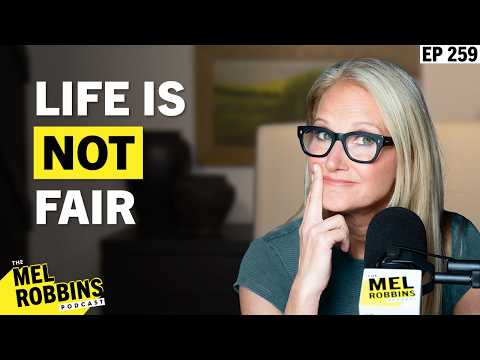
When Nothing Seems to Be Going Your Way, Here’s Exactly What To Do
Mel Robbins (host)
In this episode of The Mel Robbins Podcast, featuring Mel Robbins, When Nothing Seems to Be Going Your Way, Here’s Exactly What To Do explores turn Life’s Unfair Moments Into Power: Mel Robbins’ Four-Step Reset Mel Robbins tackles the hard truth that life is fundamentally unfair and validates the pain, anger, and grief that come with that realization.
Turn Life’s Unfair Moments Into Power: Mel Robbins’ Four-Step Reset
Mel Robbins tackles the hard truth that life is fundamentally unfair and validates the pain, anger, and grief that come with that realization.
She explains that while external events are often uncontrollable, our response to them is not, and that staying stuck in resentment and denial only prolongs suffering.
Robbins outlines a four-step process: set a deadline for feeling your feelings, accept reality, make a concrete action plan, and find meaning through choosing your attitude.
Drawing on psychological research, 9/11 coping studies, and Viktor Frankl’s work, she argues that healing comes from how we use time and adversity, not from time alone.
Key Takeaways
Give yourself a clear deadline to fully feel your emotions.
Intentionally decide how long you will allow yourself to be sad, angry, or disempowered; this creates safe space to grieve while signaling to yourself that this chapter will not define your entire life.
Get the full analysis with uListen AI
Recognize that painful emotions are often a sign of mental health, not weakness.
As psychologist Lisa Damour notes, feeling depressed, anxious, or overwhelmed after loss or trauma is a normal, healthy response that shows you care and your mind is working as it should.
Get the full analysis with uListen AI
Stop resisting reality and accept what has happened.
Clinging to how you wish things were (“this shouldn’t have happened”) intensifies suffering; accepting that the relationship ended, the house burned, or the diagnosis arrived allows life to ‘move through you’ instead of keeping you stuck.
Get the full analysis with uListen AI
Differentiate what you can control from what you cannot, then act on it.
Once you’ve accepted the “poop sandwich” on your plate, focus on concrete actions—learning skills, seeking support, looking for work, or restructuring finances—rather than obsessing over what can’t be changed.
Get the full analysis with uListen AI
Use available tools and others’ experience to build a specific plan.
Search online, consume stories of people who’ve navigated similar hardships, or even prompt AI (like ChatGPT) to generate a 30‑day step-by-step plan so you have daily, doable actions instead of vague intentions.
Get the full analysis with uListen AI
Guard your attitude and hope; despair keeps you from taking helpful steps.
When you tell yourself nothing will change, you stop trying; cultivating even a small belief that improvement is possible is what keeps you doing the small, compounding actions that actually shift your situation.
Get the full analysis with uListen AI
Find meaning by choosing your attitude, even when you can’t change circumstances.
Inspired by Viktor Frankl, Robbins emphasizes that the “last human freedom” is to choose your attitude and how you respond; when you can’t alter the external situation, you can still grow, learn, and redefine who you are through it.
Get the full analysis with uListen AI
Notable Quotes
“This moment where things are not fair, this is just a scene in your life. It’s not how the movie ends.”
— Mel Robbins
“It’s not time that actually heals, it’s what you do with that time that matters.”
— Mel Robbins
“When life hands you a poop sandwich, you don’t have to shove it down your throat. You can just put it down on the plate beside you and move on.”
— Mel Robbins
“Everything can be taken from a man but one thing, the last of the human freedoms: to choose one’s attitude in any given set of circumstances.”
— Viktor Frankl, quoted by Mel Robbins
“When we are no longer able to change a situation, we are challenged to change ourselves.”
— Viktor Frankl, quoted by Mel Robbins
Questions Answered in This Episode
How do I realistically distinguish between allowing myself to grieve and using grief as a reason to stay stuck?
Mel Robbins tackles the hard truth that life is fundamentally unfair and validates the pain, anger, and grief that come with that realization.
Get the full analysis with uListen AI
What does genuine acceptance look like in my current situation, and how will I know I’ve stopped resisting reality?
She explains that while external events are often uncontrollable, our response to them is not, and that staying stuck in resentment and denial only prolongs suffering.
Get the full analysis with uListen AI
If I asked for a 30‑day plan right now, what small daily actions would most change my circumstances?
Robbins outlines a four-step process: set a deadline for feeling your feelings, accept reality, make a concrete action plan, and find meaning through choosing your attitude.
Get the full analysis with uListen AI
Where in my life have I been silently wishing things were different instead of choosing a new attitude or response?
Drawing on psychological research, 9/11 coping studies, and Viktor Frankl’s work, she argues that healing comes from how we use time and adversity, not from time alone.
Get the full analysis with uListen AI
What meaning or personal growth might eventually emerge from the most unfair experience I’m facing today?
Get the full analysis with uListen AI
Transcript Preview
Life isn't fair. There, I said it. And it's important to say it because it is the truth. But here's another truth, it's always gonna be unfair because there are always going to be things that are out of your control, and there are gonna be things that happen that are cruel and painful and heartbreaking. They're gonna happen to you, but they're not gonna happen to the person standing next to you. Yes, life isn't fair. So what are we gonna do about it? (clock ticking) Hey, it's your friend Mel, and welcome to The Mel Robbins Podcast. It is always such an honor to spend time and to be together with you. And if you're brand new, I just wanted to personally welcome you to The Mel Robbins Podcast family. I'm absolutely thrilled that you're here. And because you hit play and you made the time to listen to this particular episode, it tells me something about you. I know you're the type of person, you value your time, and you've made the time to listen to this because you're looking to feel a little bit better right now. And I'm gonna tell you, today's conversation, and by the time that you're done listening to this, it is the perfect thing for you to listen to at this exact moment in time, and you will feel better. Because based on what I'm seeing in the inbox, the headlines, the news, and the DMs that you are sending me from all over the world, I just felt in my heart that today we had to have a conversation. I need to be honest with you about something, and it's something that people don't like to talk about, but we need to. Life isn't fair. There, I said it. Life isn't fair, especially right now. I mean, so much of life right now feels backwards or wrong and out of control, overwhelming. It's not fair that you lost your house, or that your dad died, or that the polar ice caps are melting, or that big tech is now suddenly taking over the world, or that corporations get bailed out left and right and don't seem to pay taxes, but you can barely pay yours, or that you were born diabetic, or that you're the one who is always caring for your aging parents or your young kids and you're doing it alone. And that's just the big stuff about life that's not fair. It's also not fair that your skin is breaking out, or that your sister looks like a supermodel, or that your parents favor your brother, or that your friend is pregnant and you just had another miscarriage, or that the housing market is so insane that you can't find a house or an apartment to buy and you can't afford one. And, you know, it's kind of liberating, isn't it, to just say the truth out loud? It's not fair. So for whatever it is that you feel is cruel or it's unfair or you don't deserve it, I want to validate that, because ignoring it isn't working, feeling bad about it isn't working. I mean, letting it paralyze you or make you anxious or demoralize you, is that working? Of course not. I just want to call it out, I want to validate it. In fact, why don't you say it with me? Scream it if you want. Life isn't fair. And it's important to say it because it is the truth, so let's acknowledge the truth. But here's another truth that we need to acknowledge. It's always gonna be unfair because there are always going to be things that are out of your control and there are gonna be things that happen that are cruel and painful and heartbreaking. They're gonna happen to you, but they're not gonna happen to the person standing next to you. Yes, things are going to be out of your control, but here's the thing, I am not gonna allow you or me to get stuck in this place. And I'm not saying your feelings aren't valid. I'm not saying that this situation isn't really difficult. I'm not saying that it's not valid to feel overwhelmed or scared or this sense of like, "Why me? Why is this happening to me?" To feel this weight of the loss that you're dealing with for what you thought your life would be and now you're like waking up in this nightmare, because there is a time and it is important to allow yourself to feel what you need to feel, whether that is feeling sorry for yourself or whether it's allowing yourself to be in a depressive or a disempowered state because you're moving through grief or heartbreak. And yes, there is a lot of value in complaining, in venting, and just really saturating yourself in this and talking about it. But I'm gonna tell you, this is just one stop on the leg of the journey called life. This is not where you stop. This moment where things are not fair, this is just a scene in your life. It's not how the movie ends because it's not where you live. And today, I am going to remind you of another fact, an important fact, a powerful fact, a fact that is so much more powerful than life is unfair. Because the fact is that no matter what is happening around you, you have the power within you to face it, because you have limitless ability and you have this capacity to accept the things that you cannot change, to recognize that there are aspects of life that are always gonna be unfair and aspects of life that seem fair, but that through your attitude and your actions, your response, that you can move the needle on the situation, that you can make the situation a little better. You can move things forward. Because validating your experience, very important, very, very important, and that's why I'm validating it, but I'm also reminding you-Yes, you can make your life, the situation, and the world around you a little better place. So if any of what I'm saying is resonating, if you're currently in a situation that simply is cruel or unfair, like you're being bullied by your narcissistic ex in a divorce, or your house was burnt down, or it was taken out by a flood and you're still waiting for the power to come back on, your health insurance claim was denied, your rent was increased, you're a Dreamer, you could be deported, or you got that flat on the way to work this morning, you're right. Life isn't fair. Let's say it together one more time. Let's get it out of us. You ready? Let's do it. Life isn't fair. God, it feels so good to just say it, doesn't it? So what are we gonna do about it? Well, I'm gonna tell you what I'm gonna do about it. I am gonna walk you through four things that you should do right now. Okay? And the first step is to give yourself a deadline. And you may be thinking, "A deadline? What is the deadline for?" Great question. You are going to give yourself a deadline for how long you're gonna allow yourself to stay in this sad and overwhelmed, grieving and disempowered state. And here's why. Yes, it's important for you to not only call out the situation and say, "This isn't fair," but it is more important that you recognize that you deserve and need time to process your feelings about the situation. And by setting a deadline for how long you are going to allow yourself to move through your feelings, that you're gonna give yourself the grace of just being low, of being sad, of feeling disempowered, you know what you're doing? You're doing something that is so important. You're acknowledging that you deserve to be in this state. And I love this step of giving yourself a deadline and creating the space and the grace that you need to be able to process what you're feeling. It's because it reminds me of this powerful research from the amazing Dr. Lisa Damour. She's a clinical psychologist, New York Times bestselling author, and she said something to me once that altered the way that I look at life. She said that in life, when you're going through a really difficult situation, if you feel sad or overwhelmed or depressed or you're grieving, that's a sign that you're mentally healthy. I mean, just stop and think about that. Isn't it a mentally healthy response to an unfair or cruel situation in life to feel depressed or overwhelmed or anxious? Of course it is. When you lose somebody that you love, it is a mentally healthy response to be in a depressive state. It's a sign that your mind and body are working well. If you have somebody break up with you, of course you're gonna be sad and overwhelmed and lost. That's a sign that everything is working as it should. It's a sign that you care. It's a sign that you are feeling things. That's a good thing. You don't need to be scared of these emotions. You don't need to run away from them, because it's a sign that you're reacting to something that's unfair or cruel in a healthy and appropriate way. As she says, do the emotions and feelings match the situation? And so if you're facing something unfair, you need time to grieve. You need time to be upset. You deserve to be angry about it, and you have to give yourself the time to feel those emotions or else you're gonna be in trouble, and I'm telling you this not because this is my opinion. I'm telling you this because I found a research study and I want to share the science with you about why it's so important to give yourself this defined moment where you go, "Okay, I am going to allow myself to feel what I need to feel." After 9/11, researchers at UC Irvine did a study on how people across the United States were coping with the trauma of this mass tragedy, and they found that even six months after the attacks, so many people were still experiencing heightened anxiety, post-traumatic stress symptoms. Of course they were. But what made a big difference though was how people coped with those feelings immediately after the 9/11 attack. See, the people who took active steps to manage their emotions, like seeking support, planning ways to move forward, and finding ways to process what happened, they were able to heal much faster. And that last piece, finding ways to process what happened, that's what we're doing by setting a deadline. You're actually intentionally in time saying, "I have to find ways to process what happened, so I'm gonna give myself this defined space to do it." And it's so important because check out what happened to the people who didn't give themselves the space and the grace to process what happened. Well, they found the worst thing that you could do, like the worst thing, was to shove the emotions down, to just try to move on, to deny yourself the time to feel the emotions, to s- try to distract yourself, to get back to work, to just kind of pull up your big girl panties and move on, to kind of give up. You want to know what happened to the people who did that, who didn't give the space to manage and like process these emotions? They were still experiencing PTSD and anxiety symptoms months and years after 9/11. See, your emotions and feelings and all that stored tension, it doesn't go anywhere if you shove it down. It just builds up. That's why if you're in a situation where life is unfair or something cruel has just happened or you're overwhelmed or you're just feeling like you can't catch a break, you have to give yourself time to feel what you need to feel, and that's exactly uh why step one is give it a deadline.... because it creates the space for you to do what you need to do to not run from these emotions, but to acknowledge them. And to acknowledge them and say, "Wow, I'm actually mentally healthy, because I'm responding to this overwhelming situation with these overwhelming feelings." And managing your emotions by seeking support, processing what happened, planning ways to move forward, that's what's gonna allow you to move forward. Because it's not time that actually heals, it's what you do with that time that matters, and that's what we're talking about. So, let's first create the time, because I'm not just suggesting that you do it, I am telling you this is what the science and the research says, and I want you to benefit from it. And I know you're thinking, "Mel, how do I even know how long I need to give myself?" Well, the answer is, it depends on you, and it depends on the situation that you're in, and it depends on, like, the emotions that you're feeling. And I don't really care as much about how long the deadline needs to be or what the exact date is. That's not really what matters. What truly matters is the intentional act of acknowledging this is unfair and cruel, and then acknowledging that you have appropriate feelings, of course you would in response to this, and then acknowledging that you need the space and you need some time to allow those feelings to rise and fall, to allow yourself the time to process what you actually are going through. And I want to give you some just kind of rules of thumb or some of the research from what the experts say. Like, for example, when I was researching the Let Them Theory and I was talking to a lot of psychologists and psychiatrists, the research shows that after somebody breaks up with you, it takes people about 11 weeks before they start feeling better. And we also know that grief, after you lose somebody that you love or you lose the home, you know, that you have lived in forever, that it can take anywhere from six months to two years before you can start to settle into a new normal. And the advice that I've always heard after somebody that you love dies is make no changes for one year. Now, these are just rules of thumb. These are what the experts and the research sort of advise for the kinds of situations that feel so unfair and that can feel cruel. And yeah, it may take you a little longer than 11 weeks. It might take you a little less, but you need to give yourself a date. And the other thing that I love about setting a date is that it's a sign to you in a calendar that this is not gonna take over your life, because it doesn't have to. What I'm recommending is something else. I'm recommending that you give yourself permission, and you also set this date so you know this chapter ends, this scene is gonna be over, the movie is gonna go on, and you are going to be okay, that there is an end to this. But while we're in it, let's be in it. Let's play the sad songs. Let's be in a depressive state. Let's live in our pajamas. Let's cry. Let's wallow. Give yourself permission, if you have to, to scream into that pillow, "It's not fair." Do what you need to do to feel the emotions, and let 'em come and let 'em go, because I promise you, that deadline's gonna come. And if you gave yourself this space and this grace, you, my friend, are gonna be in a very different place. And by the way, I've been talking about these big, heartbreaking, gut-wrenching things, but let's talk about some of the stuff that we tend to beat ourselves up over that aren't fair, that you've been doing for years and years and years. Like, you beat yourself up over your height or your body or the way your face looks or, you know, your complexion. You've already been grieving the state of things for years. You've already made yourself feel bad and put yourself down and been invalidating yourself. So, if the unfair thing is something that you've been living with for a long time, your friend Mel Robbins has a recommendation. How about the deadline be 5:00 PM today? Because the wallowing has been going on for long enough, and it is time to move on, and the wallowing we know is no longer helping you change this situation. It's not making a positive dent in the situation. It just makes you feel bad. It's chipped away at your confidence. It's made you feel disempowered. And the deadline I want you to give yourself is tonight at 5:00 PM, because this scene in the movie, it's over, and we're gonna move on. And that brings me to step number two, which may seem simple. I- in fact, it might even seem a little stupid or obvious, but it's the most crucial, and a lot of people miss it, because if you don't do this step, you will never be able to move forward, and you're gonna get trapped in this scene. And it's this. You have to accept what has happened. You need to accept reality. And you may be thinking right now, "Wait a minute, Mel, I mean, I just did. Weren't you and I just shouting, 'Life isn't fair'?" Yeah, we were, but you're probably still deep down wishing things were different. See, when you wish things were different, you're resisting reality. It's one thing to accept the fact life isn't fair, this is cruel, I don't deserve this. It's a whole nother ballgame to accept that this is what has happened and it's not changing. And the longer that you hold on to the wish that this didn't happen or that things were different or that somehow the situation wasn't what it was or you weren't in the position that you're in...The longer you hold onto this wish, the longer you prolong your own suffering. I mean, most of human suffering, our internal pain, our anguish, it comes from the desire to have things be different than how they are. I mean, this is philosophies that date back into the beginning of human history, whether it's Stoicism or Buddhism, this notion of learning how to accept the things you cannot control. You know, there's one quote I love from the poet Rumi, "Try not to resist the changes that come your way. Instead, let life live through you." Honestly, that's the let them part of my theory. Let them is when you accept things as they are and as they're not. Let them is when you let life live through you. And to me what that means is that life is always teaching you something. Life is always moving forward, even when you refuse to. Sometimes the most important lessons from life come in the cruelest ways, and the deepest wisdom comes through the most painful experiences. I mean, for myself, I- I can look back and, uh, say certainly about my life that it's always in those moments that I got the worst news that I've ultimately discovered the best things about myself. Now, I didn't wanna have to learn 'em that way, but it's true. And somehow learning how to accept a new reality, you're gonna discover something, that life is gonna move through you, because the truth is, you're already in the new reality. (laughs) The relationship is over. The house has burned down. The person's gone. The diagnosis is here. The acne is on your face. You've been laid off again. Cancer is back. Your bank account, it's still in the red. Wishing it were different doesn't make it different. It just makes the present moment more painful, and you feel all this tension because you're just resisting it. You gotta learn how to let it move through you. And look, I'm not saying this is easy. I mean, when life hands you a poop sandwich, you feel like you're supposed to choke it down. Well, here's what I think this poem means. Let life move through you. It's sort of peaceful, isn't it? You can feel yourself drop the resistance because what that line is actually saying is that when life hands you a poop sandwich, you don't have to shove it down your throat. You could just put it down on the plate beside you and move on. Yes, it's there, and life just served it up to you, but you don't have to carry it. You can accept that life just handed you this poop sandwich and now you're sitting right next to it, and this is the scene of your life. But it's only until you can do that and truly allow it to move through you that your life will start to move forward too. So, how do you move on? Well, that brings me to the next step, which is asking yourself, "As I'm sitting here next to this poop sandwich, what is in my control and what is not in my control?" And when you're feeling really upset about where you're at, it feels like everything's outta your control, and these next two steps are going to put a spotlight on all of the amazing things that are actually in your control. And so let's talk about them one by one. The first one is making a plan, and the second thing that's in your control is finding meaning. One of the things that's so challenging about being in a situation where life is really unfair is that you can get yourself so paralyzed in your mind by how unfair and overwhelming it all seems that you blind yourself to the fact that there's almost always something you can do. In almost any situation, if you're sitting there next to a shit sandwich, there is something you can do through your actions to actually make the situation better. Whether, you know, you've lost your job, you can find a new one. If you're in the red, I've been there, you can learn the skills of how you actually become more responsible with money and you can start to chip away at your debt. In fact, there is so much information out in the world today that you are fully equipped in this super amazing way to simply go to the internet, and don't type in, "Life isn't fair." I want you to type in the situation that you're in, "The cancer just came back. My marriage just ended." And then ask, "What should I do?" And you wanna know what's gonna come up? Like a bazillion videos, and podcast episodes, and books, and blog articles all about people who have been in this situation, sitting next to this shit sandwich, who figured it out. And by watching those videos, and by reading those articles, and checking out those books at the library, or hopping onto YouTube, you can make a plan. And here's one more hack that I think is absolutely incredible. Go to ChatGPT and literally write in there, "Act like the world's best life coach and tell me exactly what I should do if I'm in a situation where X, Y, Z happened and I feel it's very unfair and I feel hopeless and powerless. Tell me exactly what to do. Create a plan every day for the next 30 days and give me the five things I need to do every day in order to change this situation."ChatGTP will spit out your plan in a nanosecond, and you wanna know what? It's gonna work. And one of the reasons why I'm telling you this is because it is very dangerous to allow yourself to stay in that state next to that shit sandwich, convincing yourself you have no choice but to eat it. It's not true. There is almost always a plan that you can make, 99.9% of the time, and I am 1,000% convinced because of the work that I do, and because of how many people I interact with every single day, I am 1,000% convinced there is a person in this world that has been in a situation, and even been in a situation way worse, who has figured it out. They have made a plan, and through their actions and their attitude and the space and time they gave themselves to process their emotions and accept the reality and let life move through them, they have made the situation better, and that means so can you. I refuse to believe that you are not capable of meeting this moment in your life. In fact, I believe the opposite. I believe you have within you the ability and the capacity to make this situation better, to make yourself better. There is something you can do. There always is something that you can do, and I also gave you this beautiful hack using ChatGTP for free to give yourself a plan and empower yourself. But what I've noticed over time, and this really troubles me, is that it's not your capacity and your capability that is stopping you, it's your attitude. See, if you allow yourself to get into the hole of despair, you won't do anything, because when you have despair, and you continue to tell yourself that you're never gonna get out of this or nothing's gonna ever make a dent or this is just too big and too much, you lose hope. And without the hope that things are gonna change, you don't do the little things that I'm sharing with you right now that actually do change your life and this situation for the better. That's why this matters. And so the third step is as you're sitting there and you've shouted, "Life isn't fair," and then you've accepted that life has handed you this sh- poop sandwich, and now you've put it down on the plate, and you say, "Let them," like, "I'm gonna let life move through me. This is what life has handed me. I am not gonna choke it down. I'm gonna put it there and see it. I'm gonna recognize that this worst experience is gonna bring out some of the best things in me. I'm gonna trust in that. Now, I'm gonna make a plan because I do see that there is something that I can do, and I'm gonna use ChatGTP to do all the work for me 'cause I am gonna do the work of following the plan so I don't need to come, come up with a plan." I mean, that is so cool. Do you know how much luckier you and I are than people 10 years ago that we can do this? We can empower ourselves this way? But I wanna leave you with a fourth step because this is going to really fuel your ability to move forward, and this fourth step is find meaning. In these moments where life is unfair or things seem out of control or cruel, I wanna remind you of a truth about life, and that is the power of your attitude. That is always in your control. And whenever I'm in a situation where I just feel like things are so unfair or I start to doubt my ability to meet the moment that I'm in, I think about a book that has had probably the single biggest difference in my life, and it's a book you may be familiar with. It's Man's Search for Meaning. The author is Viktor Frankl, and Frankl was a psychiatrist who endured one of the cruelest and most traumatic and horrific situations a human being could ever experience. In the 1930s, Frankl was cast into the Nazi network of concentration and extermination camps. He went to four of them, and miraculously, he survived. And in the book, he details the accounts of his survival and how he did it and how he kept himself alive and he kept hope alive by summoning up thoughts of his wife and the prospect that he might see her again, that they would be reunited. I mean, the scenes where he's explaining this are just riveting. And he would also keep hope alive by dreaming that at one point, way after the war, he would be lecturing about the psychological lessons to be learned from Auschwitz. Well, his wife, his family members, they did not survive, but he did, and when he was freed, he wrote Man's Search for Meaning, which is one of the most important books in my life and arguably one of the greatest books of all time. And the copy that I'm holding in my hand right now, it says that more than 15 million copies of it are in print, and this copy of mine is pretty old, so I would imagine there's millions more in copy right now. Now, the biggest impact that this book has had on me is perhaps Frankl's most important insight after this horrific experience, and it's this.... that there are always going to be forces beyond your control that can take away everything from you, except for your ability to choose how you want to respond to the situation. See, you're not in control of what happens to you in life, but you can always control what you feel, do, think, say about what happens to you. This is what we've been talking about with "Let Them and Let Me." It's not a new idea, but it is a life-changing idea. And I want to read to you one of my favorite quotes from this book. "Everything can be taken from a man, but one thing, the last of the human freedoms: to choose one's attitude in any given set of circumstances." And he goes on to write, "When we are no longer able to change a situation, we are challenged to change ourselves." That is where your power is. No matter how unfair life may seem, no matter how cruel or overwhelming the situation may be, you have the power because you can change yourself. You are free to choose your attitude in any given set of circumstances, and you are also free to choose what you do or don't do in response. And so no matter what you're facing, I need you to hear this. The four steps that we talked about: life isn't fair, say it out loud, set a deadline and give yourself the space and the grace to feel what you need to feel. Second, accept that this is what your life is. Try not to resist the changes that come your way. Instead, let life live through you. In the Mel Robbins world, that means when life hands you a poop sandwich, don't choke it down. Let it go right back down on the plate. Third, there's always something that you can do, because you can choose how you respond to this. And so the third thing that you're gonna do is you're gonna make a plan. And I gave you the perfect, modern, amazing hack to be able to do it. Just go to the computer, go to Google, go to ChatGPT, put in the prompt, tell them what's not fair, ask them to give you a 30-day step-by-step, day-by-day plan of what you need to do. Boom, you got your plan. And based on the research that you learned about from UC Irvine, we know that these are the steps that work. And finally, don't forget that when you are no longer able to change the situation, and I'm gonna remind you, 99.9% of the situations you're in, you absolutely, through your actions and that plan, you can change it for the better. But if you're not able to change a situation, you are challenged to change yourselves. And in any situation, it is your attitude, that is your power, and that's what you get to choose. And I also want to remind you that that matters, because when you have an attitude of hope, when you can see beyond the deadline, beyond the scene of your life, you are now anchoring on a better future, and you know that taking the actions and changing your attitude and following these steps matter, because this is not how the movie ends. It is just one scene in your absolutely amazing, magnificent, and yet sometimes cruel and unfair life. And in case no one else tells you, I wanted to be sure to tell you that I love you, and I believe in you. And I'm proud of you for hitting play on this episode. I'm proud of you for recognizing that while you may be here, you're not staying here, because you're not meant to stay here. And there's no doubt in my mind that everything that you learned is going to help you create a better life. Now go do it, and just know that your friend Mel is gonna be waiting for you to welcome you back the second you hit play on the very next episode. And I'll see you there. And thank you for watching all the way to the end here on YouTube. I love, love, love spending time with you. Thank you for sharing this with somebody. You know that this is gonna help every single person that you share this with. And one other thing, because I know you're the kind of person that loves supporting people that support you, support your friend Mel. My goal is that 50% of the people that watch this channel are subscribers. It's free. It's how you can tell me that you enjoy what I'm putting out here for free, that it's making a difference in your life. So thank you in advance for hitting subscribe. And now I know you're like, "Mel, what do I watch?" Well, I think you should watch this one. I think you're gonna love it, and it's gonna keep things moving through you and help you move your life forward. And I'll be waiting for you the moment you hit play. I'll see you there.
Install uListen to search the full transcript and get AI-powered insights
Get Full TranscriptGet more from every podcast
AI summaries, searchable transcripts, and fact-checking. Free forever.
Add to Chrome