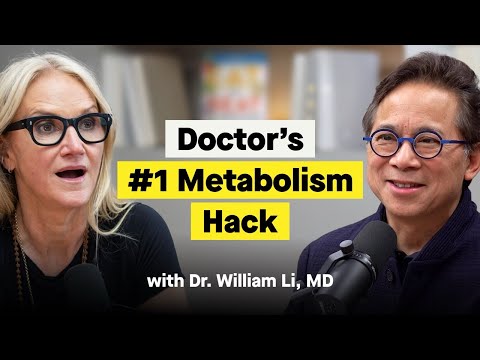
Do THIS to Boost Your Metabolism, Lose Fat, & Feel Better Now With Dr. William Li
Dr. William Li (guest), Mel Robbins (host)
In this episode of The Mel Robbins Podcast, featuring Dr. William Li and Mel Robbins, Do THIS to Boost Your Metabolism, Lose Fat, & Feel Better Now With Dr. William Li explores unlocking Metabolism: Science-Based Steps To Burn Fat And Feel Better Dr. William Li joins Mel Robbins to debunk major myths about metabolism and explain why most people’s bodies are still hardwired to burn fat effectively well into later life. Drawing on a landmark study of 6,000 people across 20 countries, he outlines four universal phases of metabolism and emphasizes that differences in weight are driven more by lifestyle factors and excess body fat than by fixed “fast” or “slow” metabolisms. He explains how fat forms and functions in the body, why visceral fat and even a “fat tongue” matter, and how stress, alcohol, poor sleep, and overeating impair metabolic health. Dr. Li then shares practical, research-backed strategies—like intermittent fasting, movement, stress reduction, portion control, and specific foods—to reactivate and support a healthy metabolism without obsessing over calorie counting.
Unlocking Metabolism: Science-Based Steps To Burn Fat And Feel Better
Dr. William Li joins Mel Robbins to debunk major myths about metabolism and explain why most people’s bodies are still hardwired to burn fat effectively well into later life. Drawing on a landmark study of 6,000 people across 20 countries, he outlines four universal phases of metabolism and emphasizes that differences in weight are driven more by lifestyle factors and excess body fat than by fixed “fast” or “slow” metabolisms. He explains how fat forms and functions in the body, why visceral fat and even a “fat tongue” matter, and how stress, alcohol, poor sleep, and overeating impair metabolic health. Dr. Li then shares practical, research-backed strategies—like intermittent fasting, movement, stress reduction, portion control, and specific foods—to reactivate and support a healthy metabolism without obsessing over calorie counting.
Key Takeaways
Most people are born with the same metabolic ‘operating system.’
According to Dr. ...
Get the full analysis with uListen AI
Metabolism does not automatically slow in middle age as much as believed.
A massive study adjusting for body size and excess fat found that from ages 20 to 60, metabolism is essentially flat and stable; only after 60 does it decline modestly (about 17% by age 90), meaning many midlife weight changes are from habits and life stress, not inevitable metabolic collapse.
Get the full analysis with uListen AI
Excess body fat slows metabolism, not the other way around.
Dr. ...
Get the full analysis with uListen AI
Fat is a critical, early-forming organ that stores fuel near blood vessels.
Body fat forms very early in development, wrapping blood vessels like bubble wrap so it can act as an accessible fuel tank; fat cells can expand up to three times their size, which is why chronic overeating gradually leads to large increases in stored fat.
Get the full analysis with uListen AI
Stress, poor sleep, and alcohol quietly sabotage fat-burning.
Chronic stress and associated hormones, shallow or disrupted sleep, and alcohol intake all interfere with efficient fat burning, reduce motivation to exercise, and can increase fat storage—making emotional state and recovery as important as diet and exercise.
Get the full analysis with uListen AI
Intermittent fasting and everyday movement are powerful, accessible tools.
Using natural fasting windows (especially overnight) and modest daily movement—like walking, swimming, dancing, even fidgeting—helps the body tap stored fat for fuel; long-term, consistent habits matter more than extreme, unsustainable weight-loss promises.
Get the full analysis with uListen AI
Focus on food quality and portions, not obsessive calorie-counting.
Dr. ...
Get the full analysis with uListen AI
Certain foods actively support fat-burning and metabolic health.
Beans (with extra virgin olive oil) feed gut microbes that help regulate weight, tomatoes supply lycopene to reduce harmful fat, and onions and caper-rich quercetin activate brown fat to burn white fat—all practical additions to everyday meals.
Get the full analysis with uListen AI
Notable Quotes
“We’re all born with the same metabolism, because our metabolism is like the operating system of a computer.”
— Dr. William Li
“It’s our body fat that slows our metabolism, not the other way around.”
— Dr. William Li
“Between the ages of 20 and 60, our metabolism is rock solid, flat as an ocean on a calm day.”
— Dr. William Li
“One of the most powerful things that you can do to reset your health is to really address the stress in your life.”
— Dr. William Li
“My message to you is that you’re perfectly normal… Don’t compare yourself to other people. Compare yourself to you.”
— Dr. William Li
Questions Answered in This Episode
If my metabolism is hardwired like everyone else’s, what specific lifestyle changes should I prioritize first to see noticeable improvements in energy and weight?
Dr. ...
Get the full analysis with uListen AI
How can I practically reduce chronic stress and improve sleep in a busy life so that my metabolism can function better?
Get the full analysis with uListen AI
What signs, besides snoring, might indicate that I’m accumulating harmful visceral fat before it shows up externally?
Get the full analysis with uListen AI
How can I implement intermittent fasting in a sustainable way that fits my schedule and doesn’t trigger overeating when I do eat?
Get the full analysis with uListen AI
What are some simple, realistic meal examples that incorporate beans, tomatoes, onions, and capers to support fat-burning without feeling like I’m on a strict diet?
Get the full analysis with uListen AI
Transcript Preview
Your body's metabolism is your energy source, and if you want more energy in your life, what you wanna do is-
Well, hold on. Let me just stop you right there.
Yeah. Everybody can do it, no matter where you are in your health journey, no matter what type of struggles you've had, in order to be able to lose weight and be able to achieve better health.
The world-renowned Dr. William Li is back to unpack the science of metabolism. Dr. Li is a renowned physician and scientist. Dr. Li's work has impacted more than 50 million people worldwide and has led to the prevention, treatment, and even reversal of diseases spanning cancer, obesity, heart disease, and diabetes. Whether you're looking to lose weight, burn fat, or just be healthier, Dr. Li has the science, the research, and the simple steps to help you unlock the power of your metabolism.
Everyone thinks they know a lot about metabolism, but there are a lot of myths about it. Everyone's metabolism is different.
Is that true?
Not true. The second myth is that when we reach middle age, our metabolism's gonna automatically slow down. Not true. Third thing, teenagers, in their adolescence, their metabolism is going sky high. Not true. Fourth myth is that-
Holy cow. What do I do to jumpstart my metabolism?
All right, so... (clock ticks) (drum roll)
Dr. Li, I'm so excited that you're here, and the way that I wanted to start is, could you tell the person that's listening how they could experience life differently if they take to heart everything that you're about to teach us about the science of metabolism and they put that to use in their life today?
Your body's metabolism is your energy source, and if you want more energy in your life, what you wanna do is tap into your, what's already hardwired into you in order to be, to unleash that energy, and everybody can do it, no matter where you are in your health journey, no matter what type of struggles you've had previously, in order to be able to lose, uh, weight or, and be able to achieve better health.
Wow. Well, uh, about a third of our listeners have set a goal to either lose weight or to start a new diet, and I would love to know how to leverage my metabolism to be healthier, to be in better shape. But what does metabolism mean? Because maybe when you say metabolism, I'm thinking something else. Let's start there. What does metabolism actually mean?
Okay, so if you go to (clears throat) Google-
Yes.
... when you look up metabolism, they'll give you as, a chemistry definition, a science definition of it. It's the sum of all the chemical reactions in your body, blah, blah, blah, to give you energy. I like to think about it (clears throat) in a much simpler way.
Install uListen to search the full transcript and get AI-powered insights
Get Full TranscriptGet more from every podcast
AI summaries, searchable transcripts, and fact-checking. Free forever.
Add to Chrome