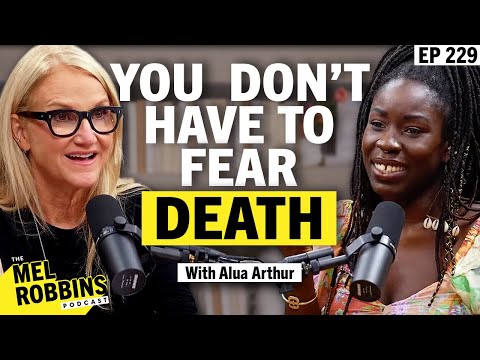
Don’t Learn This Too Late: Make An Authentic Life Now, By Getting Real About The End
Mel Robbins (host), Alua Arthur (guest)
In this episode of The Mel Robbins Podcast, featuring Mel Robbins and Alua Arthur, Don’t Learn This Too Late: Make An Authentic Life Now, By Getting Real About The End explores facing Death Now To Live Authentically, Joyfully, And Without Regret Mel Robbins interviews death doula and author Alua Arthur about how actively contemplating death can radically transform how we live. Arthur explains how seeing her own future deathbed exposed the inauthentic life she was living and pushed her to redesign it. They explore practical end-of-life planning, how to talk about death with loved ones, and how grief and regret often center on unlived authenticity and unsaid words. Throughout, Arthur offers questions, rituals, and perspectives that turn death from a taboo fear into a powerful teacher and motivator for an honest, meaningful life.
Facing Death Now To Live Authentically, Joyfully, And Without Regret
Mel Robbins interviews death doula and author Alua Arthur about how actively contemplating death can radically transform how we live. Arthur explains how seeing her own future deathbed exposed the inauthentic life she was living and pushed her to redesign it. They explore practical end-of-life planning, how to talk about death with loved ones, and how grief and regret often center on unlived authenticity and unsaid words. Throughout, Arthur offers questions, rituals, and perspectives that turn death from a taboo fear into a powerful teacher and motivator for an honest, meaningful life.
Key Takeaways
Let your future deathbed self evaluate the life you’re living now.
Regularly picturing yourself on your deathbed clarifies whether your current work, relationships, and choices match who you truly want to be; if they don’t, that imagined moment becomes a powerful prompt to change course while you still can.
Get the full analysis with uListen AI
Use birthdays as an annual ritual to reflect on death and life.
Arthur reviews her end-of-life plans and asks deeper questions every birthday—about medical decisions, care preferences, relationships, and values—which keeps her practical affairs current and her daily life aligned with what matters most.
Get the full analysis with uListen AI
Talk openly about death; silence doesn’t prevent it, it just leaves you unprepared.
Avoiding conversations about mortality doesn’t change the outcome, it only increases fear, confusion, and logistical chaos later; talking about it early allows for clearer planning, emotional honesty, and more intentional goodbyes.
Get the full analysis with uListen AI
Lead with honesty when you don’t know what to say to the grieving or dying.
Instead of offering platitudes like “It’ll be okay,” Arthur suggests simply acknowledging the difficulty (“I don’t know what to say; this sounds really hard”) and asking how they’re doing, which validates their reality instead of minimizing it.
Get the full analysis with uListen AI
Ask three core questions regularly: Who did I love, how did I love, was I loved?
These questions, often answered only at the end of life, become powerful guides when we ask them now, revealing where forgiveness, vulnerability, or reconnection are needed so we don’t die with avoidable relational regrets.
Get the full analysis with uListen AI
Design your death and funeral as an expression of your values and story.
Thinking about how you want to die (environment, people, tone) and what happens to your body and memorial (e. ...
Get the full analysis with uListen AI
Grief can be a catalyst that births a new, more honest self.
Arthur’s experience losing her brother-in-law showed her that grief doesn’t disappear but changes form; by allowing anger, pain, and love to fully surface, she discovered her purpose, changed her work, and channeled sorrow into service.
Get the full analysis with uListen AI
Notable Quotes
“Our deaths are practically begging us to live.”
— Alua Arthur
“I’m gonna be the one who has to meet myself on my deathbed. I want to make sure that I’ve been happy with what it was that I did while I was here.”
— Alua Arthur
“Talking about sex won’t make you pregnant, and talking about death won’t make you dead.”
— Alua Arthur
“I want them to clap because I died well. But I died well only because I lived well.”
— Alua Arthur
“Grief allows a new version of ourselves to emerge.”
— Alua Arthur
Questions Answered in This Episode
If I honestly imagined myself on my deathbed today, what parts of my life would I immediately feel compelled to change?
Mel Robbins interviews death doula and author Alua Arthur about how actively contemplating death can radically transform how we live. ...
Get the full analysis with uListen AI
What would it look like to build an annual ritual—such as on my birthday—where I review both my practical end-of-life plans and the way I’m spending my time and love?
Get the full analysis with uListen AI
Which relationships in my life currently hold unspoken ‘I love yous,’ ‘thank yous,’ or ‘please forgive mes’ that I would deeply regret leaving unresolved?
Get the full analysis with uListen AI
How do my cultural, family, or religious beliefs about death shape the way I’m living now—and are those beliefs actually serving the life I want to lead?
Get the full analysis with uListen AI
If my loved ones were to design my funeral based on how I live today, what kind of legacy would they describe—and is that the legacy I want to leave?
Get the full analysis with uListen AI
Transcript Preview
We're all dying, and we're all gonna die.
Correct. We are all dying, and we should be talking about death. When I'm thinking about my death, it allows me to see exactly who I've become, and knowing that I'm still living, I have an opportunity to change it. I think death can be a great inspiration for us to start living more authentically and be real with who we are and who we wanna be. I'm gonna be the one who has to meet myself on my deathbed. I wanna make sure that I've been happy with what it was that I did while I was here.
Wow. I've seen this amazing talk that you did online, where you talk about how you wanna die. You said, "And when my loved ones notice that I've released my last breath, I want them to clap. I want them to clap because I died well. But I died well only because I lived well."
I want them to clap in honor of a life that I lived and the grace with which I let it go. There are three big questions that I suggest people ask themselves when thinking about their lives and their relationship and their death, which is, "Who did I love? How did I love?" And-
Hey, it's Mel. I am so excited that you're here. Welcome to The Mel Robbins Podcast. It is always such an honor to spend time with you and to be together. And if you're brand new, welcome to The Mel Robbins Podcast family. Thank you for choosing to listen to this podcast. And you know what it tells me? It tells me that you're the type of person that values your time, and you're interested in learning ways that you can improve your life. I love that. Me too. You know, recently, I read something that just stopped me in my tracks. It was written by a woman named Alua Arthur. Here's what she wrote. "Our deaths are practically begging us to live. When I'm thinking about my death, I can see very clearly who I want to be." I've never thought about death that way, that it's gonna help me clearly see who I wanna be. Well, that's exactly what we're gonna talk about today. Alua, she's a best-selling author and a death doula. And she's the founder of Going With Grace, an organization that has trained thousands of people in end-of-life planning. And she's flown here today from Los Angeles to be in our Boston studios to speak to you and me. She says that simply allowing yourself to think about your death, how you wanna feel, where you wanna be, who do you wanna be surrounded by, what kind of life do you wanna live so that you're proud of yourself? Just thinking about it unlocks a deeper joy, purpose, and happiness in your life in ways you can never imagine. She also has three questions to ask you today, and a powerful exercise for you to do every year on your birthday. And if you answer these three questions with courage and honesty, it will inspire you to make some incredible changes in your life. After you and I spend time with Alua today, I promise you, we'll both be looking at our lives and our death in a whole new way. Alua, welcome to The Mel Robbins Podcast.
Install uListen to search the full transcript and get AI-powered insights
Get Full TranscriptGet more from every podcast
AI summaries, searchable transcripts, and fact-checking. Free forever.
Add to Chrome