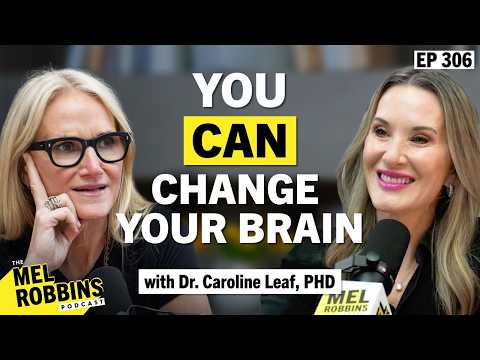
You Can Change Your Brain: Neuroscientist Explains How to Rewire Your Mind & Stop Negative Thoughts
Dr. Caroline Leaf (guest), Mel Robbins (host)
In this episode of The Mel Robbins Podcast, featuring Dr. Caroline Leaf and Mel Robbins, You Can Change Your Brain: Neuroscientist Explains How to Rewire Your Mind & Stop Negative Thoughts explores neuroscientist Reveals How To Rewire Your Mind And Stop Spirals Dr. Caroline Leaf explains the critical distinction between the mind (an energetic, driving force) and the brain (a physical responder) and why understanding this difference gives people hope and control over their mental life.
Neuroscientist Reveals How To Rewire Your Mind And Stop Spirals
Dr. Caroline Leaf explains the critical distinction between the mind (an energetic, driving force) and the brain (a physical responder) and why understanding this difference gives people hope and control over their mental life.
She argues that most negative thinking, anxiety, depression, and even trauma responses are signals of an overloaded mind-brain-body system, not fixed brain diseases, and that these can be changed through deliberate "mind management."
Using decades of clinical and neuroscience research, Leaf introduces her five-step NeuroCycle method to systematically notice, unpack, and rewire toxic thought patterns over a 63‑day cycle, with evidence showing significant reductions in anxiety and depression.
She also shares quick 63‑second tools to interrupt emotional spirals in the moment, emphasizing that while you can’t change your past, you can change how it is wired into you and how it shapes your future.
Key Takeaways
Your mind is not your brain—and it’s 99% of who you are.
Leaf defines the mind as an energetic, non-physical force (thoughts, feelings, choices) that drives the brain and body, which are merely hosts and responders. ...
Get the full analysis with uListen AI
Thoughts are physical: your mind literally builds them into your brain and body.
Every experience you focus on becomes an energetic "cloud" in the mind that is copied into the brain as neural networks (like trees) and mini-versions in every cell. ...
Get the full analysis with uListen AI
Anxiety, depression, and PTSD are warning signals, not fixed brain diseases.
Leaf criticizes the biomedical model for treating mental states like diabetes; instead, she frames them as emotional and behavioral signals that you are out of alignment because of adverse experiences. ...
Get the full analysis with uListen AI
Use the five-step NeuroCycle daily to rewire patterns in about 63 days.
The NeuroCycle—(1) gather awareness, (2) reflect, (3) write/mind‑storm, (4) recheck/reconceptualize, (5) active reach—is a structured way to move from messy feelings to clear understanding and new responses. ...
Get the full analysis with uListen AI
A simple 10‑second breathing prep and 63‑second "mini NeuroCycle" can stop spirals fast.
Before deeper work, a brief breath pattern (e. ...
Get the full analysis with uListen AI
Recognizing and naming what you feel immediately weakens its hold.
Simply articulating "This text makes me feel terrified because…" gets the emotional charge out of your system, much like crying releases stress hormones. ...
Get the full analysis with uListen AI
You can’t change your past, but you can change how it lives in you.
Through repeated NeuroCycling, you don’t erase traumatic memories; you shrink their toxic power and rebuild a new, more empowered meaning and response pattern. ...
Get the full analysis with uListen AI
Notable Quotes
“This brain does absolutely nothing except what you tell it to do with your mind.”
— Dr. Caroline Leaf
“The mind is 99% of who you are. It’s the prism through which life is processed.”
— Dr. Caroline Leaf
“You aren’t depression; you are feeling depressed because of.”
— Dr. Caroline Leaf
“You can’t change your story, but you can change what it looks like inside of you, and therefore how it plays out into the future.”
— Dr. Caroline Leaf
“You cannot control the events and circumstances of your life, but you can control your reactions to the events and circumstances.”
— Dr. Caroline Leaf
Questions Answered in This Episode
If my mind is driving my brain and body, what is one recurring negative thought loop I want to start NeuroCycling today—and what might its deeper "because of" be?
Dr. ...
Get the full analysis with uListen AI
How would my relationship to anxiety or depression change if I saw them as useful warning signals instead of permanent labels or diagnoses?
She argues that most negative thinking, anxiety, depression, and even trauma responses are signals of an overloaded mind-brain-body system, not fixed brain diseases, and that these can be changed through deliberate "mind management."
Get the full analysis with uListen AI
What evidence from my own life suggests that I can, in fact, change long‑standing patterns if I work on them consistently for 63 days?
Using decades of clinical and neuroscience research, Leaf introduces her five-step NeuroCycle method to systematically notice, unpack, and rewire toxic thought patterns over a 63‑day cycle, with evidence showing significant reductions in anxiety and depression.
Get the full analysis with uListen AI
In high-trigger moments (texts, conflicts, criticism), what quick grounding cue—like a phrase or a physical gesture such as wiggling my toes—could I use to interrupt an automatic spiral?
She also shares quick 63‑second tools to interrupt emotional spirals in the moment, emphasizing that while you can’t change your past, you can change how it is wired into you and how it shapes your future.
Get the full analysis with uListen AI
Where might I be unconsciously reinforcing a victim narrative about my past, and how could I begin to reconceptualize that story so it empowers instead of limits me?
Get the full analysis with uListen AI
Transcript Preview
(instrumental music plays) This brain does absolutely nothing except what you tell it to do with your mind.
Dr. Caroline Leaf is a world-renowned researcher and a psychoneurobiologist. Since the early 1980s, she has been researching the mind-brain connection, the formation of memory, and she is also one of the original pioneering researchers to figure out that your brain can change. She is also the author of 18 best-selling books that have been translated into 24 languages.
You can't change your story, but you can change what it looks like inside of you, and therefore, how it plays out into the future. The mind is 99% of who you are. It's fundamental-
Okay, now hold on. I'm wiggling my toes right now thinking my mind is in my toes right now. This is so crazy. I've never heard anybody explain it like that. I just think I got it.
The mind and the brain, the words are used interchangeably as though they're the same thing. And the research shows that 95% of lifestyle diseases come from our thought life. So what the truth is, Mel, is that...
Dr. Caroline Leaf. It is such an honor to have you here in our studios in Boston. It's a pleasure to meet you in person since I've been admiring your work from afar and watching your videos online. Thank you, thank you, thank you for hopping on a plane and being here with us.
Oh, Mel, it's an honor and a privilege. I'm one of your biggest fans and really love what you do. Thank you. It's so great to be here. I'm so excited.
Well, I'm excited to dig into your more than 35 years of research and the tools that you're going to share with us today that come from being a world-renowned psychoneurobiologist. But the way that I want to start is I would love for you to speak directly to the person who is listening to us right now who feels trapped in negative thoughts. You know, like, that their mind is just a complete mess. What would you tell that person who's listening to us right now that feels that way?
95% of people, according to research, actually battle with negative thinking. So it's very common. It's much more common than we realize. But people are, people get stuck there because they're drawn to the imbalance that it creates. You can- you can actually, as soon as you're aware of that, you can change it. And some of the typical things that people get stuck with are things like, they feel under pressure. That they, that- that's such a, I'm so, "I feel so pressurized, I just can't do it." Black-and-white thinking is another huge one. It's this or that. Nothing's ever, life's a spectrum, nothing's ever black and white, but it really gets people stuck. Things like, "My brain won't shut up." You know, that's something that people will often say to me. "How do I switch my brain off?" That's a common statement that people make. A couple of others are things like, um, "My- my past is haunting me. How do I deal with it?" It's coming right into, it haunts, it's there, it's over me all the time.
Install uListen to search the full transcript and get AI-powered insights
Get Full TranscriptGet more from every podcast
AI summaries, searchable transcripts, and fact-checking. Free forever.
Add to Chrome