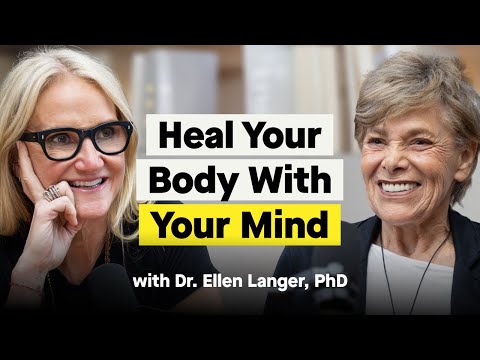
How to Use Your Mind to Heal Your Body With the #1 Harvard Psychologist
Dr. Ellen Langer (guest), Mel Robbins (host)
In this episode of The Mel Robbins Podcast, featuring Dr. Ellen Langer and Mel Robbins, How to Use Your Mind to Heal Your Body With the #1 Harvard Psychologist explores harvard psychologist reveals how mindset reshapes health, aging, and stress Harvard psychologist Dr. Ellen Langer explains her concept of mind–body unity, arguing that the mind and body are not separate systems but one integrated whole, meaning our thoughts and perspectives directly influence physical health and aging.
Harvard psychologist reveals how mindset reshapes health, aging, and stress
Harvard psychologist Dr. Ellen Langer explains her concept of mind–body unity, arguing that the mind and body are not separate systems but one integrated whole, meaning our thoughts and perspectives directly influence physical health and aging.
She distinguishes her version of mindfulness from meditation, defining it as an easy, moment-to-moment awareness of uncertainty and active noticing, contrasted with the robotic, habitual mindlessness that drives most personal and societal problems.
Through decades of studies—on elderly men, hotel housekeepers, diabetes patients, wound healing, and more—she shows how shifting beliefs and attention can measurably improve vision, strength, metabolism, symptoms of chronic illness, and even perceived aging.
Langer offers practical cognitive shifts to reduce stress, rethink diagnoses, stop agonizing over decisions, and reframe past regrets, emphasizing that events are neutral and that our interpretations—not circumstances—create suffering or growth.
Key Takeaways
Treat mind and body as one system, not two connected parts.
Langer argues that thoughts and physiology are aspects of the same process; when you change how you think about your body, illness, or capabilities, you directly influence physical outcomes such as pain, healing speed, and functional ability.
Get the full analysis with uListen AI
Redefine mindfulness as active noticing, not a meditation practice.
Her version of mindfulness is simply paying fresh attention—seeing uncertainty, noticing new things, questioning assumptions like “this is just how it is,” which instantly pulls you out of autopilot and into engagement.
Get the full analysis with uListen AI
Small mindset shifts can measurably change physical markers of health.
Studies show that men acting as if they were 20 years younger improved vision, strength, and appearance; hotel housekeepers who were told their work counted as exercise lost weight and lowered blood pressure without changing behavior; perceived time altered wound healing and blood sugar.
Get the full analysis with uListen AI
Stress comes from your interpretation and predictions, not from events themselves.
Stress requires believing something bad will happen and that it will be awful; by asking whether something is a tragedy or an inconvenience, generating reasons it might not happen, and finding advantages even if it does, you can sharply reduce stress and protect your health.
Get the full analysis with uListen AI
Challenge rigid medical labels and prognoses to reclaim agency.
Words like “remission,” “chronic,” and “fight” often create fear and helplessness; instead, see chronic as “medicine doesn’t have a solution yet,” frame remission as “cured for now,” and focus on living fully rather than waiting for the worst-case scenario.
Get the full analysis with uListen AI
Stop agonizing over making the “right” decision; make decisions right.
Because you can never truly compare alternative futures, over-analyzing choices just generates harmful stress; choose, then commit to seeing benefits in what you chose rather than torturing yourself with hypothetical paths not taken.
Get the full analysis with uListen AI
Notice variability in symptoms and emotions to weaken feelings of helplessness.
With chronic conditions or ongoing stress, track when symptoms or distress are a bit better or worse and ask “why might that be? ...
Get the full analysis with uListen AI
Notable Quotes
“Virtually all of our problems, whether personal, interpersonal, professional, global, are the direct or indirect consequences of our mindlessness.”
— Dr. Ellen Langer
“Everything that is was, at one time, a decision, which means it's mutable. Everything can be changed.”
— Dr. Ellen Langer
“You can either do things imperfectly mindfully or perfectly mindlessly.”
— Dr. Ellen Langer
“Rather than waste your time being stressed over making the right decision, what we should be doing is simply make the decision right.”
— Dr. Ellen Langer
“When we live a life that's mindful, we can't help but experience a personal renaissance, and health and well-being will follow.”
— Dr. Ellen Langer
Questions Answered in This Episode
Which unquestioned “truths” about my health, aging, or abilities might be limiting me, and how could I test seeing them differently?
Harvard psychologist Dr. ...
Get the full analysis with uListen AI
How would my experience of a current diagnosis or chronic condition change if I tracked symptom variability and looked for patterns instead of assuming it’s fixed?
She distinguishes her version of mindfulness from meditation, defining it as an easy, moment-to-moment awareness of uncertainty and active noticing, contrasted with the robotic, habitual mindlessness that drives most personal and societal problems.
Get the full analysis with uListen AI
In what areas of my life am I living like a robot—following inherited rules—rather than adjusting things to fit who I actually am now?
Through decades of studies—on elderly men, hotel housekeepers, diabetes patients, wound healing, and more—she shows how shifting beliefs and attention can measurably improve vision, strength, metabolism, symptoms of chronic illness, and even perceived aging.
Get the full analysis with uListen AI
What stressful situation in my life could I reframe from a “tragedy” into an “inconvenience,” and what genuine advantages might it hold?
Langer offers practical cognitive shifts to reduce stress, rethink diagnoses, stop agonizing over decisions, and reframe past regrets, emphasizing that events are neutral and that our interpretations—not circumstances—create suffering or growth.
Get the full analysis with uListen AI
If I stopped trying to make the perfect decision in one major area and instead focused on making any decision work, what would I choose today?
Get the full analysis with uListen AI
Transcript Preview
I can give you a test on any topic where you can do miserably. I can also give you a test on that same topic where you'll do well. It's all, who knows, right?
The whole thing's rigged.
It's rigged against many people who just accept it.
Hey, it's Mel, and today on The Mel Robbins Podcast, you're gonna learn how to use your mind to heal your body from the number one Harvard psychologist and professor, Dr. Ellen Langer. She has been researching this subject and teaching about it for over 50 years.
The control we have over our health and wellbeing is enormous. Everybody accepts that a placebo is effective. I think it's our most effective medicine. So, what's going on? You take this nothing, you think it's something, and then it acts like something. Everything that is was, at one time, a decision, which means it's mutable. Everything can be changed. If something doesn't work, change it. Close to 50 years of research has shown me virtually all of us are mindless almost all the time. And when you're mindless, you're not aware that you're not there. Okay, so, you're not there, but you don't know that you're not there. No matter what you're doing, you're doing it mindfully or mindlessly. Most of us are sealed in unlived lives and we're oblivious. As it is right now, we don't see what's right in front of us, we don't hear what's being said, we are oblivious to the choices that we have. Rather than waste your time being stressed over making the right decision, what we should be doing is simply make the decision right.
Hey, it's your friend Mel, and welcome to The Mel Robbins Podcast. Hey, it's Mel. My team was showing me that 57% of you who watch here on YouTube are not subscribed yet. Could you do me a quick favor? Hit subscribe. It's free. And that way, you don't miss any of the episodes that I post here on YouTube. It also lets me know that you're enjoying the guests and you love the content that I'm bringing you, because I wanna make sure you don't miss anything. So, thank you, thank you, thank you for hitting subscribe. All right, you ready? I bet you are. So, let's dive in. The legend.
(laughs)
Dr. Ellen Langer, welcome to The Mel Robbins Podcast.
Thanks for having me.
I am so thrilled you're here. I- I'm just, I- I can't wait to get into this, and I guess where I wanna start is the person who is with us right now has made time, they have no time, but they've made time to be here with you, Dr. Langer, to learn from you. What might change about their life?
Once you understand what I mean by mindfulness and how easy it is, it has nothing to do with meditation, no matter what you're doing, whether you're doing a podcast, reading, eating, taking care of a child, uh, playing tennis, you're doing it mindfully or mindlessly, and the consequences of being in one state of mind or the other are enormous. Everything changes. I- I had this slide when I used to give these, um, lectures. I still do. And, um, I say, uh, on the slide, "Virtually all of our problems, whether personal, interpersonal, professional, global, are the direct or indirect consequences of us- of our mindlessness." Now, it's interesting because then I tell them, "Just among us and the other 10 million people I've said this to, I really mean all." So, that's enormous, right? I'm saying all of our problems are a result of our mindlessness. So, if we're able to get people to understand how easy it is to change their mind to become more mindful, um, whatever ails them should, uh, dissipate.
Install uListen to search the full transcript and get AI-powered insights
Get Full TranscriptGet more from every podcast
AI summaries, searchable transcripts, and fact-checking. Free forever.
Add to Chrome