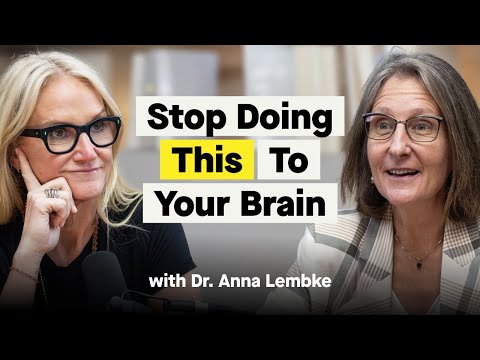
#1 Dopamine Expert: Find Motivation, Increase Your Focus, and Learn the Science of Self-Control
Mel Robbins (host), Dr. Anna Lembke (guest)
In this episode of The Mel Robbins Podcast, featuring Mel Robbins and Dr. Anna Lembke, #1 Dopamine Expert: Find Motivation, Increase Your Focus, and Learn the Science of Self-Control explores reset dopamine balance to regain motivation, joy, and lasting willpower Dr. Anna Lembke explains dopamine as a reinforcement signal that pushes humans to seek rewards, and how modern “drugified” life (phones, apps, ultra-processed food, shopping, porn, even relationships) overwhelms this system.
Reset dopamine balance to regain motivation, joy, and lasting willpower
Dr. Anna Lembke explains dopamine as a reinforcement signal that pushes humans to seek rewards, and how modern “drugified” life (phones, apps, ultra-processed food, shopping, porn, even relationships) overwhelms this system.
She introduces the “pleasure–pain balance” metaphor: pleasurable hits tilt the brain toward pleasure, but the brain rapidly counterbalances with an opponent pain response—craving, irritability, anxiety—especially with repeated use.
Overuse of instant rewards lowers baseline joy (a dopamine-deficit state), making ordinary tasks feel harder and reducing motivation for long-term goals.
The proposed solution is a planned “dopamine detox” (abstinence trial) long enough to reset homeostasis—often 3–4 weeks for digital media—plus intentional, right-sized discomfort (exercise, boredom, delaying phone use) supported by self-binding strategies rather than willpower alone.
Key Takeaways
Dopamine is a reinforcement currency, not just “feeling good.”
Lembke frames dopamine primarily as the brain’s “do that again” signal for survival-relevant rewards; higher and faster dopamine release increases reinforcing power and repeat behavior.
Get the full analysis with uListen AI
Pleasure and pain share circuitry—and the brain always counterbalances.
The “seesaw” model explains why every pleasurable spike is followed by an opponent pain response that restores balance; with repetition, pleasure weakens while the after-pain strengthens.
Get the full analysis with uListen AI
Repeated easy pleasures reset your baseline, making normal life feel flat.
As neuroadaptation accumulates (“gremlins” on the pain side), people need more stimulation to feel “normal,” and ordinary tasks (laundry, bills, studying) feel disproportionately painful.
Get the full analysis with uListen AI
Addiction is broader than drugs: behaviors and even attachment can become “a drug.”
She defines addiction as continued compulsive use despite harm, on a spectrum; examples include social media, gaming, shopping, porn, ultra-processed food, and reassurance-seeking/monitoring loved ones.
Get the full analysis with uListen AI
Tech becomes addictive through access, potency, and engineered uncertainty.
Phones provide constant availability, algorithmic personalization and interactivity amplify potency, and variable novelty (“mystery”) keeps users engaged—creating a powerful perception–action loop.
Get the full analysis with uListen AI
Motivation returns when you remove frictionless rewards and tolerate the empty space.
Without the default escape (scrolling, gaming), boredom and discomfort push people toward meaningful work; Lembke’s patient found classes “interesting again” after quitting video games.
Get the full analysis with uListen AI
A real “dopamine detox” requires enough time to clear withdrawal—often 3–4 weeks.
Short abstinence can leave people stuck in craving and conclude it “doesn’t work”; studies cited show teens feel less depressed/anxious/lonely only after weeks off social media.
Get the full analysis with uListen AI
Don’t rely on willpower—use self-binding strategies and pre-commitment.
Plan the night before: remove devices from the bedroom, delete apps, turn off notifications, delay first screen exposure, and create barriers so you can pause between urge and action.
Get the full analysis with uListen AI
Right-sized pain (exercise, mindfulness, boredom) can accelerate rebalancing.
Intentionally “pressing on the pain side” can upregulate endogenous feel-good chemicals; vigorous exercise can reduce withdrawal symptoms and lower relapse risk by shifting the balance back.
Get the full analysis with uListen AI
Boredom is not a bug—it’s a pathway to presence and creativity.
Lembke argues boredom is painful and existentially confronting, but it’s where people reacquaint with thoughts/feelings, regain mindfulness, and generate new ideas and deeper joy.
Get the full analysis with uListen AI
Notable Quotes
“It makes us the ultimate seekers, never satisfied with what we have, always wanting more.”
— Dr. Anna Lembke
“Pain and pleasure are actually co-located in the brain… they work through an opponent process mechanism.”
— Dr. Anna Lembke
“In the long run… it drives us down to the side of pain.”
— Dr. Anna Lembke
“Addiction at heart is really not about escape; it’s really about control.”
— Dr. Anna Lembke
“To be happier… we need to do the counterintuitive thing of moderating… instantaneous, easy pleasures, and intentionally leaning into right-sized pain.”
— Dr. Anna Lembke
Questions Answered in This Episode
In your “pleasure–pain balance” model, what are the clearest signs someone has shifted their hedonic set point (vs. just being stressed or tired)?
Dr. ...
Get the full analysis with uListen AI
You mention 3–4 weeks off social media often improves mood—what does “abstaining” practically mean (no apps at all, no scrolling, no posting, limited DMs)?
She introduces the “pleasure–pain balance” metaphor: pleasurable hits tilt the brain toward pleasure, but the brain rapidly counterbalances with an opponent pain response—craving, irritability, anxiety—especially with repeated use.
Get the full analysis with uListen AI
How would you design a dopamine detox for someone whose job requires constant online presence—what boundaries matter most (notifications, time blocks, device type)?
Overuse of instant rewards lowers baseline joy (a dopamine-deficit state), making ordinary tasks feel harder and reducing motivation for long-term goals.
Get the full analysis with uListen AI
You describe reassurance-seeking and checking locations as “drugified attachment.” What’s a healthy replacement behavior when anxiety spikes and you want to reach out?
The proposed solution is a planned “dopamine detox” (abstinence trial) long enough to reset homeostasis—often 3–4 weeks for digital media—plus intentional, right-sized discomfort (exercise, boredom, delaying phone use) supported by self-binding strategies rather than willpower alone.
Get the full analysis with uListen AI
How do access, potency, and uncertainty map onto specific app features (push notifications, infinite scroll, algorithmic feeds), and which single change reduces “potency” the most?
Get the full analysis with uListen AI
Transcript Preview
Today, we're talking about how to get motivated even when you don't feel like it, with the world's number one expert on dopamine. Dr. Anna Lembke is a professor and the medical director of addiction medicine at Stanford University School of Medicine. What is dopamine, and why is it important?
Dopamine is a chemical that we make in our brain. Dopamine has many different functions, but one of its most important functions is in pleasure, reward, and motivation. It makes us the ultimate seekers, never satisfied with what we have, always wanting more.
You're saying that in modern life, especially with a phone, especially with so many things that give you a quick, little novel hit, boom, boom, boom, boom, we are so out of whack.
Whether it's substances or behaviors or work or relationships, we've made it more accessible, more potent, more novel, such that now we're vulnerable to get addicted to just about anything: drugs and alcohol, all kinds of behaviors, gambling, social media, video games, online shopping. People can get addicted to other people.
Really?
Yes. To be happier, to experience more joy, we need to do the counterintuitive thing of moderating and greatly reducing our use of instantaneous, easy pleasures. By the end of the conversation, you can get out of the vortex of compulsive overconsumption and get to a place where you're not constantly seeking these rewards, but instead really showing up for your life.
Okay, before we jump in with the number one dopamine expert in the world and talk all things motivation, my team was showing me something. Fifty-seven percent of you who watch the Mel Robbins Podcast here on YouTube are not subscribers, so it's my goal that we get that number to 50%, and I know you're the kind of person that loves supporting people who support you. So if that subscribe button is lit up, it means you're not a subscriber. Do me a favor, just hit Subscribe. That's how you can show your friend Mel Robbins and my team here that you are supporting us, and you love that we support you. By the way, it's free to hit Subscribe, and that way you don't miss a thing, and it tells me and the team, "Oh, my gosh, I love these experts, Mel. Tell me more about dopamine and motivation," and we will keep bringing them to you here. Thank you, thank you, thank you. All righty, you ready? Let's get motivated and jump in. Please help me welcome Dr. Anna Lembke to the Mel Robbins Podcast.
Thank you for inviting me. I'm absolutely delighted to be here.
Dr. Lembke, could you tell me, if I take everything to heart that you're about to teach me today, and I truly apply all this research about dopamine and motivation and happiness and pain and pleasure centers, and I apply it to my life, how could my life change?
If you're like me, and you're like many of my patients, you are probably unconsciously organizing your entire life around reward and little dopamine hits. From the moment we wake up in the morning, we reach for our phones, we scroll, we go get our coffee with our caffeine. We get in the car, we're listening to our music. It's not interesting, we're flipping the stations. Then we get to work, and all of a sudden, we have to let go of those instantaneous pleasures. Now we're, like, bored, we're frustrated, we're restless, we're anxious. We can't concentrate. So then we're interrupting ourselves and saying, "Oh, I better check my phone," or, "Maybe I should look at that video," and we're doing that through the entirety of the day until we get to the end of the day where we go home. We can't wait till we get there to have a glass of wine, watch our shows, eat a cupcake, and then have difficulty falling asleep at night 'cause we're so wound up and restless. So what I'm saying to you is that I hope by the end of the conversation, you can get out of the vortex of compulsive overconsumption and get to a place where you're not constantly seeking these rewards, but instead really showing up for your life.
Install uListen to search the full transcript and get AI-powered insights
Get Full TranscriptGet more from every podcast
AI summaries, searchable transcripts, and fact-checking. Free forever.
Add to Chrome