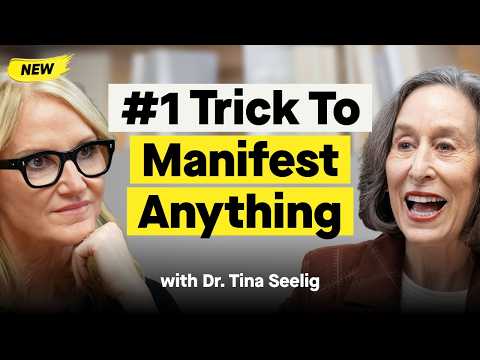
Stanford Luck Researcher: How to Manifest the Life You Want
Mel Robbins (host), Dr. Tina Seelig (guest)
In this episode of The Mel Robbins Podcast, featuring Mel Robbins and Dr. Tina Seelig, Stanford Luck Researcher: How to Manifest the Life You Want explores stanford expert reframes luck as controllable choices and behaviors daily Seelig distinguishes fortune (what happens to you) from luck (what you can influence through choices and responses).
Stanford expert reframes luck as controllable choices and behaviors daily
Seelig distinguishes fortune (what happens to you) from luck (what you can influence through choices and responses).
She argues that opportunities are “ubiquitous,” but people need a “sail” (prepared mind) to notice and capture them through deliberate action.
Her sailboat framework emphasizes three drivers of created luck: build your internal foundation, recruit a supportive crew, and hoist the sail through consistent, strategic effort.
The episode breaks risk into six types (physical, emotional, social, financial, intellectual, and moral/ethical) and shows how stretching specific risks expands future options.
Practical behaviors like asking for small favors, sending thank-you notes, making warm introductions, and “stirring the soup” are presented as repeatable tools for increasing lucky breaks.
Key Takeaways
Separate what happens to you from what you can control.
Seelig frames fortune as external circumstances (birth, disasters, discrimination, pandemics) and luck as the choices you make in response; reclaiming agency starts with this distinction.
Get the full analysis with uListen
Opportunities are everywhere, but you need a “sail” to capture them.
Luck is compared to wind—constant and available—while preparedness determines whether you notice and can act on openings.
Get the full analysis with uListen
Don’t just notice opportunities; move from ‘weathervane’ to ‘windmill’ to ‘sailboat.’
The metaphor highlights common traps: staying shut-in, observing without acting, drifting passively, then progressing to harnessing local opportunities and finally pursuing goals proactively.
Get the full analysis with uListen
Build your sailboat by clarifying core values before pressure hits.
Values act like a keel that stabilizes decisions; lacking them can lead to unethical choices (illustrated by Seelig’s early-career “spy” conference incident) and fewer good options later.
Get the full analysis with uListen
Map your risk profile and stretch the right category.
Risk tolerance is nuanced across physical, emotional, social, financial, intellectual, and moral/ethical domains; targeted stretching (e. ...
Get the full analysis with uListen
Make yourself easy to help—and follow up like a pro.
Asking for a small, specific favor (e. ...
Get the full analysis with uListen
Luck compounds like investing: small deposits create future choices.
Repeated actions—curiosity, introductions, appreciation, micro-risks—accumulate into stronger networks, skills, and optionality, making “breaks” more likely over time.
Get the full analysis with uListen
Notable Quotes
“Fortune is the things that happen to you. Luck is what you control.”
— Dr. Tina Seelig
“Opportunities are like the wind, but you need a sail to catch it.”
— Dr. Tina Seelig
“We are always one decision away from a completely different life.”
— Dr. Tina Seelig
“You don’t get a job, you get the keys to the building.”
— Dr. Tina Seelig
“Do something to stir the soup. Do something to add something new to your life.”
— Dr. Tina Seelig
Questions Answered in This Episode
How does Seelig recommend distinguishing ‘fortune’ from ‘luck’ without minimizing systemic barriers like racism or poverty?
Seelig distinguishes fortune (what happens to you) from luck (what you can influence through choices and responses).
Get the full analysis with uListen AI
In the wind metaphor, what concrete behaviors move someone from a ‘weathervane’ (seeing options) to a ‘windmill’ (capturing local luck) in a job they dislike?
She argues that opportunities are “ubiquitous,” but people need a “sail” (prepared mind) to notice and capture them through deliberate action.
Get the full analysis with uListen AI
What are the six risk categories on the ‘risk-o-meter,’ and how would you choose which one to stretch first if you feel stuck?
Her sailboat framework emphasizes three drivers of created luck: build your internal foundation, recruit a supportive crew, and hoist the sail through consistent, strategic effort.
Get the full analysis with uListen AI
Seelig says core values prevent ethical drift—what’s a step-by-step exercise to identify your values when they feel unclear or conflicting?
The episode breaks risk into six types (physical, emotional, social, financial, intellectual, and moral/ethical) and shows how stretching specific risks expands future options.
Get the full analysis with uListen AI
The ‘five-minute favor + thank-you note + offer help’ sequence worked for Oliver—what would a realistic version look like for someone job-hunting with no network?
Practical behaviors like asking for small favors, sending thank-you notes, making warm introductions, and “stirring the soup” are presented as repeatable tools for increasing lucky breaks.
Get the full analysis with uListen AI
Transcript Preview
Have you ever looked at someone else's life and thought, "How did they get so lucky?" If you could turn your luck around, wouldn't you? Today's guest is Dr. Tina Seelig. Her work is all about the science of luck. You can learn how to become a luckier person. Dr. Seelig earned her PhD in neuroscience at Stanford Medical School. She's also the author of 18 books.
Luck is success or failure apparently caused by chance.
Success or failure apparently? What, what is the apparently in there for?
And that's the point. I mean, this is really important. It looks on the surface as though it's chance, but really underneath, there are things that you have done to tempt good luck your way. There's something very, very important to keep in mind. Fortune is the things that happen to you. Luck is what you control.
You know, if somebody feels really unlucky right now, what's the first thing they should do this week?
I would say, if you were gonna pick one thing...
Hey, it's Mel, and before we get into this episode, my team was showing me 57% of you who watch The Mel Robbins Podcast here on YouTube are not subscribed yet. Could you do me a quick favor? Just hit subscribe so that you don't miss any of the episodes that we post here on YouTube. It lets me know you're enjoying the guests and the content that we're bringing you, because I wanna make sure you don't miss a thing, and I'm so glad you're here for this episode, 'cause this is a really good one. All right. Let's dive in. Dr. Tina Seelig, welcome to The Mel Robbins Podcast.
I could not be more delighted. Thank you so much for having me.
I am thrilled about the topic that we're gonna talk about. I love your research, and thank you for taking time out of your schedule to come and share all of this research around luck and how we can use it to improve our lives, and I think that's where I wanna start. So could you talk to me and the person that's here with us right now and just tell us what might change about our lives if we really apply everything you're about to teach us today?
I couldn't be more delighted to share this information, because when people understand that they have more agency in their lives, they realize that they have levers they can use every single day to make themselves luckier.
When you talk about luck, Dr. Seelig, what are you talking about? What does that mean?
Uh, first of all, please call me Tina. Uh, the definition of luck is success or failure apparently caused by chance.
Success or failure apparently-
Apparently
... caused by chance?
Exactly, and-
Wait, wait. What is the apparently in there for?
And that's the point. I mean, this is really important. The word apparently, it looks on the surface as though it's chance, but really underneath, there are things that you have done to tempt good luck your way.
Install uListen to search the full transcript and get AI-powered insights
Get Full TranscriptGet more from every podcast
AI summaries, searchable transcripts, and fact-checking. Free forever.
Add to Chrome