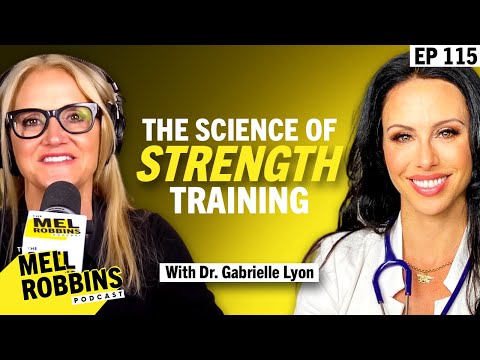
Simple Steps To Losing Weight & Feeling Better: The Science of Lifting Weights | Mel Robbins Podcast
Mel Robbins (host), Dr. Gabrielle Lyon (guest)
In this episode of The Mel Robbins Podcast, featuring Mel Robbins and Dr. Gabrielle Lyon, Simple Steps To Losing Weight & Feeling Better: The Science of Lifting Weights | Mel Robbins Podcast explores build Muscle, Not Diets: Protein And Lifting Rewire Lasting Weight Loss Mel Robbins and Dr. Gabrielle Lyon argue that most weight-loss advice is misdirected at shrinking fat instead of building and protecting skeletal muscle, which they frame as the body’s true “organ of longevity.”
Build Muscle, Not Diets: Protein And Lifting Rewire Lasting Weight Loss
Mel Robbins and Dr. Gabrielle Lyon argue that most weight-loss advice is misdirected at shrinking fat instead of building and protecting skeletal muscle, which they frame as the body’s true “organ of longevity.”
Lyon explains muscle-centric medicine: skeletal muscle regulates blood sugar, metabolism, hormones, brain health, and resilience to disease, and chronic yo-yo dieting actually destroys this critical tissue.
They lay out two core levers—eating a protein-forward diet and doing regular resistance training—as simple, research-backed ways to lose fat, gain muscle, improve energy, and age stronger.
The conversation also tackles mindset: shifting from weight-loss goals to strength standards, dropping comparison and social-media confusion, and using science-based habits to regain control over health at any age.
Key Takeaways
Stop focusing on losing fat and start focusing on gaining muscle.
Lyon’s core thesis is that obesity is often a disease of unhealthy, insufficient muscle; when you prioritize building and maintaining skeletal muscle, improved body composition and fat loss follow as a byproduct.
Get the full analysis with uListen AI
Adopt a protein-forward diet, aiming around 1 gram of protein per pound of ideal body weight.
Protein (20 amino acids, including key essential ones) is highly satiating, hard to overeat, and has a high thermic effect; research shows that higher-protein diets improve body composition even at the same total calories.
Get the full analysis with uListen AI
Anchor your day with 30–50 grams of high-quality protein at your first and last meals.
Front-loading and bookending the day with sufficient protein helps stimulate and preserve muscle, stabilize blood sugar, reduce cravings, and improve energy, especially in midlife and beyond.
Get the full analysis with uListen AI
Do resistance training at least two days per week, working the full body to near-fatigue.
Any movement against load—weights, machines, bands, or bodyweight—builds and protects skeletal muscle; beginners get fast benefits by doing 2–3 full-body sessions weekly and pushing sets to honest muscle fatigue.
Get the full analysis with uListen AI
Use small, frequent “muscle snacks” throughout the day to boost health.
Simple habits like 10–20 air squats every hour, brisk walks after meals, or quick band exercises meaningfully improve blood sugar, metabolism, and muscle stimulation without long workouts.
Get the full analysis with uListen AI
Women—especially peri- and post-menopausal—must actively protect muscle to avoid frailty and midlife weight gain.
Natural hormonal shifts reduce activity and muscle efficiency with age, but higher protein intake and resistance training can make older muscles behave more like younger ones, preventing sarcopenia and the stereotypical “menopause belly.”
Get the full analysis with uListen AI
Replace weight-loss goals with behavioral standards and a neutral mindset about food.
Instead of chasing an endless series of pounds-lost goals, Lyon recommends setting standards (e. ...
Get the full analysis with uListen AI
Notable Quotes
“The problem wasn’t that people were too fat. It was that they had unhealthy skeletal muscle.”
— Dr. Gabrielle Lyon
“There’s no such thing as a healthy sedentary person.”
— Dr. Gabrielle Lyon
“Muscle is the currency of health. You can’t buy it, you can’t sell it, you have to earn it.”
— Dr. Gabrielle Lyon
“How liberating would it be if instead of saying, ‘I need to lose 10 pounds,’ you said, ‘I need to put on five pounds of muscle’?”
— Mel Robbins
“We’re not chasing goals here. We’re setting standards for our life that allow us to live a life of longevity, strength, and resilience.”
— Dr. Gabrielle Lyon
Questions Answered in This Episode
If I’ve spent decades yo-yo dieting and feel like I’ve damaged my muscle, what is the safest, most realistic 90-day plan to start rebuilding it?
Mel Robbins and Dr. ...
Get the full analysis with uListen AI
How should people with existing metabolic issues (pre-diabetes, diabetes, or insulin resistance) modify the standard protein and resistance-training recommendations?
Lyon explains muscle-centric medicine: skeletal muscle regulates blood sugar, metabolism, hormones, brain health, and resilience to disease, and chronic yo-yo dieting actually destroys this critical tissue.
Get the full analysis with uListen AI
For someone who’s been conditioned to fear weight gain, what are some concrete first steps to mentally accept eating significantly more protein?
They lay out two core levers—eating a protein-forward diet and doing regular resistance training—as simple, research-backed ways to lose fat, gain muscle, improve energy, and age stronger.
Get the full analysis with uListen AI
How can vegetarians and vegans best hit the essential amino acid and leucine thresholds for optimal muscle health without overdoing carbs or calories?
The conversation also tackles mindset: shifting from weight-loss goals to strength standards, dropping comparison and social-media confusion, and using science-based habits to regain control over health at any age.
Get the full analysis with uListen AI
What specific strength and mobility benchmarks should a woman in her 40s, 50s, and 60s aim for to be truly ‘forever strong’ rather than just ‘normal for her age’?
Get the full analysis with uListen AI
Transcript Preview
If you're frustrated by going up and down and trying this diet and that diet and the other diet, and this thing and that thing and the other thing-
That stops today. Everybody listening to this, they are going to stop yo-yo dieting. That, this is our deal, right, Mel?
That's right. Did you hear Dr. Lyon? She's telling you, stop yo-yo dieting, put the soda down, pay attention, sit up, because we are going to give you the step-by-step way that you can take control. So if we're gonna stop yo-yo dieting, what are we gonna do? (upbeat music) Hey, it's your friend Mel, and welcome to the Mel Robbins podcast. So I've decided that you and I, uh, have been at this podcast thing for long enough that we can cover a topic that everybody talks about, everybody wants advice on, but for some reason, we're not supposed to talk about it. I don't know why this is so controversial, but it is, and today we're gonna go there. What's the topic? Weight loss. Weight loss. We're talking about weight loss. And the reason why I want to talk about this is because we've all been there. (laughs) You know, we've all been at that point in our lives where we're frustrated with how our clothes feel, where we feel like shit, where everything we're trying, uh, is not actually working, or the things that we've been doing forever, in my case, this is me, are no longer working and having the same impact, and you start to feel like your weight, your waistline, your attitude, everything's out of control, and I want to talk about it today. And so if you're like me, it probably means that you've spent most of your life trying to either lose weight or trying to stay in shape. And this goes all the way back to when I was a little kid. I mean, I can remember my mom on the living room floor and Jane Fonda was on the television. She had those leg warmers on and my mom was doing all the stuff, and then the next thing I remember, remember the ThighMaster, that thing that showed up at your house, where you were supposed to like squeeze it in and out? And then as I got older, I've tried everything, step class, spin class, Jazzercise, which I think we now call Zumba. I've gone to classes in person, online. I've done Pilates on a mat, on a Reformer. I've tried everything, and don't even get me started with the number of diets. Anybody remember the cabbage soup diet? Why on earth was that a thing? Eat for your blood type, I've done that. Low fat, high fat, no carbs, complex carbs. No wonder we are all yo-yo dieting. I mean, simply listing all of this off makes me start to feel like a human yo-yo. And as I've been thinking about this topic and researching it, it occurred to me, if this is such an enormous problem for almost all of us, maybe we've been thinking about it all wrong. In fact, the expert that you are about to spend an hour with says that you and I are going to stop talking about losing weight right now, no more, it's the wrong approach. You and I need to start leveraging what she calls a muscle-centric medical approach to our health. Dr. Gabrielle Lyon is a medical doctor. She has completed two research and clinical fellowships in nutritional science and one in the science of aging. She has spent 20 years conducting groundbreaking research and treating private patients in her clinical practice. Her first book, Forever Strong, is filled with evidence-based strategies, and you're going to learn a lot of them here during our conversation today. Doc G. is here to teach you about the largest organ in your body. I know you're thinking, "What is that? What is the largest organ in your body?" Believe it or not, that's your skeletal muscles, and your skeletal muscles are not only the largest organ in your body, they make up the entire architecture of your body and they are key to effective weight loss, to boosting your energy, burning fat, and she's going to talk to you today about how you can use a muscular-centric medical approach to reverse diabetes and to fight heart disease and cancer, and my job in all of this is to translate all that she's saying into simple, actionable takeaways. In fact, I'm going to try to reduce all this research to two changes that you can make starting today to leverage all of the things that she's going to teach us. So if you want to lose belly fat and live a strong, long, healthy life, there is no more important thing for you to do than to listen to this conversation right now. Get your pens out and get ready to change your life, 'cause Doc G. is in the house. All right, please help me welcome Dr. Gabrielle Lyon to the Mel Robbins podcast.
Install uListen to search the full transcript and get AI-powered insights
Get Full TranscriptGet more from every podcast
AI summaries, searchable transcripts, and fact-checking. Free forever.
Add to Chrome