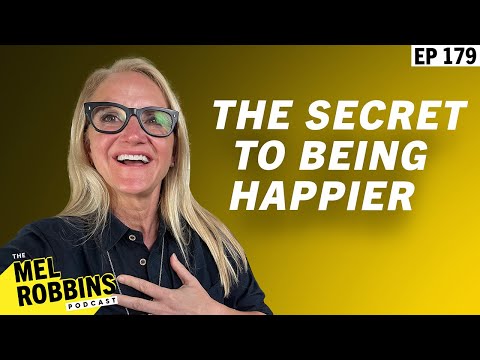
Transform Your Life at Any Moment: The Surprising Science of Happiness
Mel Robbins (host), Guest (Harvard Study of Adult Development researcher, brief clip) (guest), Judy Robbins (guest)
In this episode of The Mel Robbins Podcast, featuring Mel Robbins and Guest (Harvard Study of Adult Development researcher, brief clip), Transform Your Life at Any Moment: The Surprising Science of Happiness explores harness Unexpected Connections: How Small Hellos Transform Health and Happiness Mel Robbins explores the science and stories behind 'unexpected connections'—chance interactions with strangers that can significantly boost happiness, health, and life satisfaction. Drawing on the Harvard Study of Adult Development and additional research, she explains how both strong and weak social ties predict longevity and emotional well-being. Through five real-life stories—from hostel hallways and misdirected emails to wrong-number texts and poolside invitations—she illustrates how simple acts like saying hello, being curious, and 'going first' can lead to deep friendships and even business opportunities. The episode ends with a call to action: treat everyday moments as opportunities to connect, and intentionally initiate at least one new interaction each day.
Harness Unexpected Connections: How Small Hellos Transform Health and Happiness
Mel Robbins explores the science and stories behind 'unexpected connections'—chance interactions with strangers that can significantly boost happiness, health, and life satisfaction. Drawing on the Harvard Study of Adult Development and additional research, she explains how both strong and weak social ties predict longevity and emotional well-being. Through five real-life stories—from hostel hallways and misdirected emails to wrong-number texts and poolside invitations—she illustrates how simple acts like saying hello, being curious, and 'going first' can lead to deep friendships and even business opportunities. The episode ends with a call to action: treat everyday moments as opportunities to connect, and intentionally initiate at least one new interaction each day.
Key Takeaways
Prioritize building warm relationships to improve long-term health and happiness.
Harvard's 86-year study shows that people most satisfied with their relationships at 50 are the healthiest and happiest at 80; investing in relationships is as critical as diet or exercise.
Get the full analysis with uListen AI
Intentionally talk to strangers to boost daily mood and energy.
University of Chicago research with commuters found that people forced to talk to strangers enjoyed their ride far more than those who kept to themselves, despite predicting the opposite beforehand.
Get the full analysis with uListen AI
Treat weak ties—casual acquaintances and service interactions—as powerful happiness boosters.
Brief, everyday interactions with people you don’t know well trigger dopamine and oxytocin, creating a sense of belonging and spreading positive emotion through social contagion.
Get the full analysis with uListen AI
Go first, even when it feels awkward or vulnerable.
Robbins argues that the micro-moment before you say hello will always feel uncomfortable, but using tools like her 5-second rule and simple openers (compliments, questions) reliably leads to positive exchanges.
Get the full analysis with uListen AI
Reframe ‘inconveniences’ as potential doors to meaningful connection.
Stories like the misdirected email between Judy and Juliette or the mistaken Thanksgiving text show that what seems like a nuisance can become a 15-year friendship or a cherished annual tradition if you respond with warmth instead of irritation.
Get the full analysis with uListen AI
Small, consistent social gestures create a compounding positive ripple in your life.
Saying hi in elevators, chatting with baristas, or sincerely asking customer service reps about their day builds a habit of openness that gradually makes life feel more connected, less lonely, and more energizing.
Get the full analysis with uListen AI
View life as a ‘people scavenger hunt’ for future favorite friends and partners.
By believing that many of your future favorite people are total strangers right now, you’re more likely to notice and lean into chance encounters that can lead to friendships, collaborations, and new adventures.
Get the full analysis with uListen AI
Notable Quotes
“Some of your most favorite people that you'll ever meet, you haven't met yet.”
— Mel Robbins
“The people who live the longest, stay the healthiest, and are the happiest, are the people who have more relationships with other people and warmer relationships with other people.”
— Dr. Robert Waldinger
“If you wanna have a more meaningful life, then you have to start creating what researchers call warm relationships.”
— Mel Robbins
“Everything happens for a reason. She came into my life as another friend.”
— Judy Robbins
“There is a gift that you will not see beneath our tree this year… It is a gift of love wrapped in dreams… By giving, it becomes only stronger and everlasting.”
— Al (in his piece “The Gift”)
Questions Answered in This Episode
What specific fears or beliefs stop me from initiating conversations with strangers, and how can I test whether they’re actually true?
Mel Robbins explores the science and stories behind 'unexpected connections'—chance interactions with strangers that can significantly boost happiness, health, and life satisfaction. ...
Get the full analysis with uListen AI
How could I intentionally incorporate one or two ‘weak tie’ interactions into my daily routine starting this week?
Get the full analysis with uListen AI
Which past ‘chance encounter’ in my life ended up changing my trajectory, and what did I do in that moment that I could recreate more often?
Get the full analysis with uListen AI
How might my life look different in five years if I adopted a ‘go first’ rule in social situations?
Get the full analysis with uListen AI
In what ways can I, like Cheryl or Wanda, use my existing roles (work, family, community) to offer small acts of unexpected kindness that make others feel seen and included?
Get the full analysis with uListen AI
Transcript Preview
Some of your most favorite people are people you haven't met yet. I freaking love this topic. It's the idea that there is a stranger out there that you're meant to meet who could become one of your closest friends. Everyone that you love now in your life was once a stranger. Think about the number of people that pass by you every single day, or who you're sitting next to at the coffee shop, or who you sit down next to or across from in the train. Just imagine, one hello leads to one conversation that could lead to somebody that you have never met becoming a really good friend. I'm gonna prove to you today, through eight decades of research and five true life stories, that unexpected connections not only make your day better, but they do change your life. (clock ticking) Hey, it's Mel, and I am so excited because today, you and I are talking about unexpected connections. I freaking love this topic. It's the idea that there is a stranger out there that you're meant to meet who could become one of your closest friends, and when you stop and truly think about it, everyone that you love now in your life was once a stranger. No, really. Stop and think about this for a minute with me. How differently would you live your life if you knew with 100% certainty that many of your favorite people that you will know in your lifetime are people that you haven't met yet? I mean, doesn't your heart and mind just open up? I- it's so exciting to think about, isn't it? And if you're on a walk right now, you might be passing or walking by someone that could become one of your closest friends. If you're sitting at a cafe as you're listening to my voice, I want you to look around. There are potential friends or business partners all around you. Or even if you're driving in a car right now, who knows if the person that's about to pull into the parking spot next to you, and you get out of the car at the same time, and then you strike up a casual conversation as you're both walking into the grocery store, who knows where that might lead? And if you really stop and think about the possibility and the power in that, you'll go through life in a totally different way. And that's my mission today, to help you unlock what happiness researchers call the power of unexpected connections. Some of your most favorite people that you'll ever meet, you haven't met yet. And we're gonna dig into eight decades of research, and I'm gonna give you specific advice about how you can start tapping into the potential of these unexpected connections. And I also have five real life stories to warm your heart and to inspire you to lean into what's available to you right in front of your eyes, because the fact is, one of your most favorite friends could be standing right in front of you right now. You're gonna hear stories about sending a text message to the wrong person, mixing up an email address, and strangers who stand next to each other at a community pool, and even the power of someone that you've never met in person and only spoken to on the phone, and how they can change your life. You can think about this episode of The Mel Robbins Podcast as a mix of Harvard research meets chicken noodle Soup for the Soul done Mel Robbins style. Now, before we get into the stories, I- I want to start with some research, and I want to do that on purpose for a reason, because this isn't just about heartwarming stories. They're amazing and you're gonna absolutely love them. But I want you to take this seriously, because one of the single biggest reasons that most of us don't live our lives looking at other people as meaningful connections is because we don't understand how much this matters, and I'm gonna bottom line it for you. Do you wanna have a more meaningful life? Then you have to start creating what researchers call warm relationships, and warm relationships aren't necessarily with the people that you know. They're with the people all around you that you don't know. And so I wanna dig into the research. And to do that, I wanna introduce you to somebody named Dr. Robert Waldinger. Now, Dr. Robert Waldinger might sound familiar to you, because earlier this year, he appeared on the podcast. He's a researcher and medical doctor at Harvard, and what he shared with me was so eye-opening. Dr. Waldinger is the lead researcher of something called the Harvard Study of Adult Development. Now, the Harvard Study of Adult Development is the longest in-depth study of human happiness ever done. This study has been going on for 86 years, and it's still going on. And one of the things that researchers at Harvard found across generations of people from all different backgrounds is that there is this one truth about all human beings: positive relationships are essential to your well-being and happiness. And his team, in crunching all the data, bottom-lined their research this way, that good relationships keep you happier and healthier. And you wanna hear something even crazier? The team at Harvard can accurately predict who is gonna be happy at the age of 80. You wanna know how? Because they figured out in this study that when people were satisfied with their relationships when they were around the age of 50, they turned out to be the healthiest people, mentally and physically, when they were 80. And I want you to listen to Harvard's Dr. Waldinger, because he's gonna explain why this matters.
Install uListen to search the full transcript and get AI-powered insights
Get Full TranscriptGet more from every podcast
AI summaries, searchable transcripts, and fact-checking. Free forever.
Add to Chrome