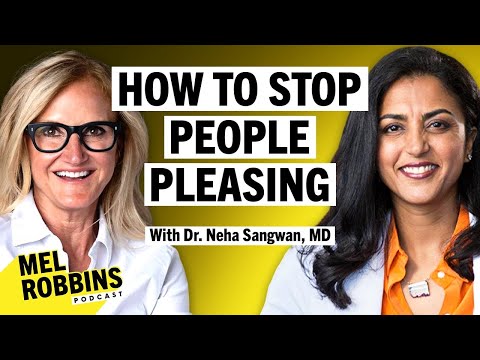
The Surprising Link Between People Pleasing & Your Health: MD’s Recommendation on How to Say “No”
Mel Robbins (host), Dr. Neha Sangwan (guest)
In this episode of The Mel Robbins Podcast, featuring Mel Robbins and Dr. Neha Sangwan, The Surprising Link Between People Pleasing & Your Health: MD’s Recommendation on How to Say “No” explores doctor Exposes How People Pleasing Quietly Destroys Your Health And Life Mel Robbins interviews internal medicine physician and researcher Dr. Neha Sangwan about the hidden connection between people pleasing, chronic stress, and physical illness. Dr. Neha explains that people pleasing is not a personality type but a coping behavior we adopt to feel safe, loved, and to belong—often rooted in childhood experiences. Over time, constantly saying yes when we mean no, avoiding conflict, and abandoning our own needs creates unresolved stress that contributes to burnout, anxiety, depression, and even medical conditions. The conversation offers a framework for recognizing these patterns, understanding their origins, and building the internal anchor and communication skills needed to set healthier boundaries and protect your health.
Doctor Exposes How People Pleasing Quietly Destroys Your Health And Life
Mel Robbins interviews internal medicine physician and researcher Dr. Neha Sangwan about the hidden connection between people pleasing, chronic stress, and physical illness. Dr. Neha explains that people pleasing is not a personality type but a coping behavior we adopt to feel safe, loved, and to belong—often rooted in childhood experiences. Over time, constantly saying yes when we mean no, avoiding conflict, and abandoning our own needs creates unresolved stress that contributes to burnout, anxiety, depression, and even medical conditions. The conversation offers a framework for recognizing these patterns, understanding their origins, and building the internal anchor and communication skills needed to set healthier boundaries and protect your health.
Key Takeaways
People pleasing is a learned survival strategy, not a fixed personality.
Dr. ...
Get the full analysis with uListen AI
Unmanaged people pleasing creates chronic stress that can make you physically ill.
Constantly overriding your own needs, avoiding conflict, and overextending yourself builds unresolved stress, which Dr. ...
Get the full analysis with uListen AI
Resentment is a powerful red flag that your boundaries are missing or broken.
Feeling a full-body “ugh” when someone asks for help, or resenting texts from friends or work, is a clue you’ve said yes when you meant no. ...
Get the full analysis with uListen AI
Your body’s discomfort is the trigger; your inability to tolerate it drives people pleasing.
The root problem is not just weak boundaries but low tolerance for internal unease—fear of criticism, conflict, or disappointing others. ...
Get the full analysis with uListen AI
Understanding your ‘Me/We/World’ role clarifies what you can change and what you can’t.
For any situation (e. ...
Get the full analysis with uListen AI
Reflecting on illness with the Awareness Prescription reveals the stress beneath symptoms.
Dr. ...
Get the full analysis with uListen AI
Saying no well starts with curiosity, clarity, and collaborative problem-solving.
Instead of reflexively agreeing or bluntly refusing, slow down: ask for time, clarify expectations (how long, how often, what’s changing), and discuss fit with your life and role. ...
Get the full analysis with uListen AI
Notable Quotes
“People pleasing is the moment that you give up what matters to you in order to appease or please somebody else so that you can belong.”
— Dr. Neha Sangwan
“You’re taking the short-term high, and you’re gonna end up with the long-term yuck.”
— Dr. Neha Sangwan
“Resentment is like me drinking poison hoping that you die.”
— Dr. Neha Sangwan
“I learned from my patients that their inability to communicate with themselves and each other makes them physically ill.”
— Dr. Neha Sangwan
“The root cause of 80% of the diseases and the health issues that people have can be traced back to the stress in their life.”
— Mel Robbins (summarizing Dr. Neha’s findings)
Questions Answered in This Episode
Where in my life do I feel the strongest resentment, and what does that reveal about unspoken boundaries or outdated agreements?
Mel Robbins interviews internal medicine physician and researcher Dr. ...
Get the full analysis with uListen AI
When I feel that surge of discomfort before saying yes, what would it look like to pause and tolerate it instead of automatically pleasing?
Get the full analysis with uListen AI
How did my childhood experiences teach me to prioritize attachment over authenticity, and how is that still playing out today?
Get the full analysis with uListen AI
If I used the Awareness Prescription on a current health issue or burnout, what honest answers would I uncover about what needs to change?
Get the full analysis with uListen AI
In my current work or family system, what is truly my responsibility (me), what belongs to others (we), and what is a structural or cultural problem (world) that needs to be addressed differently?
Get the full analysis with uListen AI
Transcript Preview
Is everybody on the planet a people pleaser?
What I would say to you as a doctor is, people pleasing makes you physically ill. (upbeat music)
Dr. Neha Sangwan, a lot of people-
Mm-hmm.
... feel compelled for a variety of, of reasons to say yes, yes, yes, yes, yes. For probably almost 50 years, I was actively saying yes when I meant no, and feeling a lot of anxiety and a lot of resentment.
Resentment is one of those big clues that you have overextended yourself.
It's just easier to make everybody else happy, it's just easier to do it myself, it's just easier not to say something.
I overheard my dad. He just made a comment like, "I wanted a son who was an engineer," and then I heard my mom saying, "Wow, I missed my calling to become a doctor." I became an engineer and a doctor, and I blamed my parents. Like, "Oh, my parents made me do this."
How did you come to realize that you were a people pleaser?
Um... (upbeat music)
Hey, it's your friend Mel, and welcome to the Mel Robbins Podcast. So, a couple weeks ago, I was invited to go down to the Today Show, and I love being on the Today Show 'cause, first of all, I love Hoda and Jenna. Secondly, I just love going on the Today Show 'cause it's always super fun, and it's a really fun morning, and it's everything that you would imagine it would be. And when you're backstage at the Today Show, you are in these hallways where tons of people are coming and going, whether it's the folks that are working on the show or it's the people that are appearing on the show, and so you just never know who you're going to bump into. And so I'm standing back there, and the first person that walks by is Charlotte Tilbury, who is this very famous makeup, uh, entrepreneur and artist, and this fabulous woman who always talks like this, darling. And I am a huge fan of Charlotte Tilbury. And so she stops, and I'm like, "Ah," and she's like, "Ah." And then I go, "Oh, my God, my daughters love you and I love you," and she's like, "I love you." And so we have this hug, and she was so fun, and then she leaves. And so I'm like, "Oh, my God, that was Charlotte Tilbury." All of a sudden around the corner comes this other extraordinary woman, and she is so striking. She's tall, and she is wearing this vibrant, I don't even know what color it was. It was like this chartreuse meets kelly green silk blazer and matching wide-leg pants, and she comes breezing around the corner, having just got off the television with the Today Show, and she comes around, and she's so striking in terms of her presence. Like, there's just this, like, confidence and this warmth to her, and it's the kind of person that you immediately are like, "I'd like to be that person's friend." So I see her coming. I look her in the eyes. I do the 10-5 game that I've told you about. She's 10 feet away, I smile. She's five feet away, I'm like, "Hi," and she goes, (gasps) "Hi. Oh, my gosh. Mel," and I'm like, "Oh, my gosh. Hi. I don't know you, but I feel like I should know you." (laughs) And she walks up and says, "Can I hug you?" And I'm like, "Of course. Nothing is better than a hug," and so we hug and she introduces herself, and her name is Dr. Neha Sangwan. And we start chatting, and I'm like, "What did you just talk about?" And she was talking about people pleasing on the Today Show and how your inability to say no is making you ill. And I stopped in my tracks, and I was like, "Wait. What?" And she goes on to explain that she is a medical doctor. She practices internal medicine. She sees private clients. She is also a researcher, and she was on the Today Show to explain that your habit of people pleasing, always looking at other people, always being worried about what their reaction is going to be, couching what you're gonna say, the fact that you say yes when you actually mean no, that's what she talks about. And I said, "Uh, we gotta get you on the Mel Robbins Podcast, because I've certainly struggled with people pleasing." I absolutely get worried about what other people are going to think. She is here today. So get ready to get control of your life, to learn how to say no, and to get better connected with what you actually want, which is where all of this is gonna begin. Please help me welcome Dr. Neha Sangwan to the Mel Robbins Podcast.
Install uListen to search the full transcript and get AI-powered insights
Get Full TranscriptGet more from every podcast
AI summaries, searchable transcripts, and fact-checking. Free forever.
Add to Chrome