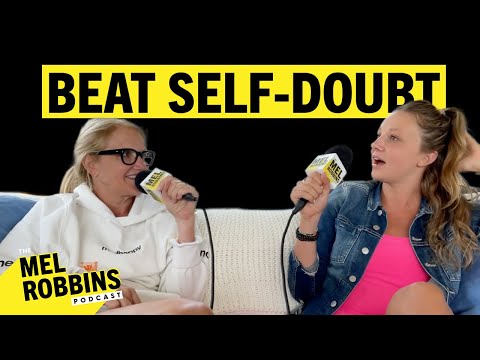
These 4 Words Will Silence Your Self-Doubt: A Life-Changing Conversation | The Mel Robbins Podcast
Mel Robbins (host), Guest (guest)
In this episode of The Mel Robbins Podcast, featuring Mel Robbins and Guest, These 4 Words Will Silence Your Self-Doubt: A Life-Changing Conversation | The Mel Robbins Podcast explores transforming Imposter Syndrome: Why You’re Not Faking, Just Beginning Mel Robbins and her 23-year-old daughter Kendall dissect a raw, recent experience of imposter syndrome at a major music festival, where Kendall held an artist pass despite having no released music or fanbase. Through the story, they reframe imposter syndrome not as proof you don’t belong, but as a signal you deeply care about the arena you’re entering. Kendall describes how shifting to gratitude, adopting a ‘learner’s posture,’ and openly owning her beginner status dissolved the shame and led to meaningful connections, a surprise performance, and collaboration offers. Together they offer a practical, human roadmap for turning self-doubt into motivation, connection, and forward movement.
Transforming Imposter Syndrome: Why You’re Not Faking, Just Beginning
Mel Robbins and her 23-year-old daughter Kendall dissect a raw, recent experience of imposter syndrome at a major music festival, where Kendall held an artist pass despite having no released music or fanbase. Through the story, they reframe imposter syndrome not as proof you don’t belong, but as a signal you deeply care about the arena you’re entering. Kendall describes how shifting to gratitude, adopting a ‘learner’s posture,’ and openly owning her beginner status dissolved the shame and led to meaningful connections, a surprise performance, and collaboration offers. Together they offer a practical, human roadmap for turning self-doubt into motivation, connection, and forward movement.
Key Takeaways
Reframe imposter syndrome as proof you care deeply about this arena.
You don’t feel like an imposter in rooms you don’t want to be in; the anxiety shows up precisely where your dreams live, signaling there’s meaningful work you want to do there.
Get the full analysis with uListen AI
Replace “I’m a fraud” with “I’m a beginner” to diffuse shame.
Kendall’s pivotal realization—“I’m not an imposter if I’m a beginner”—transformed her experience. ...
Get the full analysis with uListen AI
Enter every intimidating room with a ‘learner’s posture.’
Instead of leading with ego or defensiveness, show up grateful, curious, and ready to absorb. ...
Get the full analysis with uListen AI
Beat everyone to your ‘inconvenient truths’ by saying them out loud.
Openly admitting things like “I don’t have anything out yet” or “I feel out of place” disarms your fear and builds trust; vulnerability becomes a bridge instead of a liability.
Get the full analysis with uListen AI
Anchor yourself in the belief: “There’s a reason I’m in this room.”
If you can’t yet believe you ‘deserve’ to be there, lean on faith that you’re there to learn something, contribute something, or discover something about yourself, even if the purpose isn’t obvious yet.
Get the full analysis with uListen AI
Lead with your humanity, not just your résumé or talent.
Kendall’s first real contributions weren’t her unreleased songs but her humor, energy, and passion—which seasoned artists found inspiring and refreshing. ...
Get the full analysis with uListen AI
Don’t leave the room when discomfort peaks; stay and let it grow you.
Both Mel and Kendall emphasize that walking out of intimidating spaces reinforces self-doubt. ...
Get the full analysis with uListen AI
Notable Quotes
“You’re not an imposter. You’re just a beginner.”
— Kendall Robbins
“You become one of the most powerful people in the room when you beat everybody to your inconvenient truths.”
— Kendall Robbins (advice from mentor Sean Holt)
“You only feel imposter syndrome in situations that you care about.”
— Mel Robbins
“If you can’t muster up the belief that you deserve to be here, anchor yourself in the idea that there’s something for you to learn and something for you to give.”
— Mel Robbins
“I’m not an imposter as a beginner, because that’s what I am.”
— Kendall Robbins
Questions Answered in This Episode
In which specific ‘rooms’ of my own life do I currently feel like an imposter, and what does that reveal about what I really want?
Mel Robbins and her 23-year-old daughter Kendall dissect a raw, recent experience of imposter syndrome at a major music festival, where Kendall held an artist pass despite having no released music or fanbase. ...
Get the full analysis with uListen AI
If I honestly introduced myself as a beginner in those spaces, what ‘inconvenient truths’ would I need to say out loud—and what am I afraid would happen?
Get the full analysis with uListen AI
How would my behavior change if I walked into intimidating situations with a learner’s posture and a mindset of gratitude rather than performance?
Get the full analysis with uListen AI
What might I uniquely have to give—beyond credentials or accomplishments—that could actually benefit people who are further along than I am?
Get the full analysis with uListen AI
Can I identify a past moment of imposter syndrome that, in hindsight, was a turning point or catalyst for growth, and what did it teach me about staying in the room?
Get the full analysis with uListen AI
Transcript Preview
(ticking clock) (upbeat music) First of all, every human being struggles with moments of imposter syndrome, where you enter a situation, and in your own mind, you start doubting yourself, and you start feeling worried that people are gonna find out that you have no idea what you're talking about. The situation that you found yourself in on Friday morning, just a few days ago, is not only so relatable, and I know that you have a lot of value to share. Why don't we unpack this moment where your imposter syndrome got triggered? (upbeat music) Hey, it's your friend Mel, and welcome to the Mel Robbins Podcast. Today, we are gonna get right into it, we're gonna talk about imposter syndrome. And the reason why I wanted to talk about this is because our daughter, Kendall, who is 23 years old, just had a situation this weekend that triggered imposter syndrome, and I thought, "Why don't we unpack this moment where your imposter syndrome got triggered?" And then more importantly, the incredible things that you shared with me that helped you turn it around. So, ladies and gentlemen, everybody who's listening, Kendall Robbins.
Hey, everybody.
All right. So, tell us what happened.
Okay. So, this past weekend, I had my first experience as an artist in the real artist world, is what I'm gonna call it.
What does artist mean?
I am pursuing a career as a professional recording and touring artist, and I'm a singer-songwriter. I've started to write my own music. I'm moving out to LA in a few weeks time, and this past weekend was my first experience surrounded by people that are really successful artists that have- are doing the thing that I wanna do. Um, and as somebody that's been in school for the past four years, I've had very few experiences like this, and so this past weekend was my first few days fully existing in that world without the label of a student on my back. I didn't have that sort of shadow to hide in anymore.
Mm-hmm.
I was feeling embarrassed, I was feeling awkward, I was feeling like an imposter, like I don't belong because I don't have music out, and I don't have f- fans, and I don't have a social media following, but I was just me.
Okay. Well, let's just back the truck up a minute. So let's just set the table. First of all, every human being struggles with moments of imposter syndrome. I'm looking at the research right here, everybody. (fingers tapping) I've got my research. Psychologists call this fear of being found out imposter syndrome. It was coined in the 1970s by two female researchers. In fact, Harvard Business Review, Kendall, says that executives worldwide agree that their number one fear is being found to be incompetent.
Oh, okay.
So this is a very normal thing for everybody to experience, and it is what is called intellectual self-doubt, where you enter a situation, or you enter a room, or you think about doing something, and in your own mind, you start doubting yourself, you start doubting whether or not you're able to do something, you start doubting whether or not you deserve to be in a certain place, and you start feeling worried that people are gonna find out that you have no idea what you're talking about. And one thing that I will say from the get-go is the reason why I wanted to have you on is because the situation that you found yourself in on Friday morning, just a few days ago, is not only so relatable, but I was pretty impressed by how you coached yourself through it, and turned it around, and had one of the coolest, most affirming weekends of your life, and I know that you have a lot of value to share. So, with that, are you willing-
Install uListen to search the full transcript and get AI-powered insights
Get Full TranscriptGet more from every podcast
AI summaries, searchable transcripts, and fact-checking. Free forever.
Add to Chrome