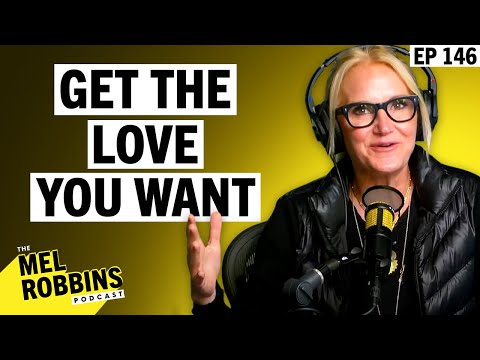
3 Simple Ways to Get the Love You Want
Mel Robbins (host), Narrator
In this episode of The Mel Robbins Podcast, featuring Mel Robbins and Narrator, 3 Simple Ways to Get the Love You Want explores mel Robbins Redefines Love And Shows You How To Share It Mel Robbins explores why her simple sign-off—“I love you, and I believe in you”—has become the most controversial thing she says, and uses that backlash to unpack how narrowly most people define love. Drawing inspiration from principal Linda Cliatt-Wayman and long-term research on relationships, she reframes love as making people feel they matter and believing in their potential, not just romance or family ties. Robbins argues that love is abundant, not transactional or earned, and that withholding it is often rooted in painful, conditional experiences from childhood. She then offers three practical, science-backed ways to give and receive more love daily: intentional acts that show others they matter, deep attention and listening, and explicitly telling people you love and believe in them.
Mel Robbins Redefines Love And Shows You How To Share It
Mel Robbins explores why her simple sign-off—“I love you, and I believe in you”—has become the most controversial thing she says, and uses that backlash to unpack how narrowly most people define love. Drawing inspiration from principal Linda Cliatt-Wayman and long-term research on relationships, she reframes love as making people feel they matter and believing in their potential, not just romance or family ties. Robbins argues that love is abundant, not transactional or earned, and that withholding it is often rooted in painful, conditional experiences from childhood. She then offers three practical, science-backed ways to give and receive more love daily: intentional acts that show others they matter, deep attention and listening, and explicitly telling people you love and believe in them.
Key Takeaways
Redefine love as making people feel they matter.
Robbins argues love is not just affection or romance; it’s any action that communicates, “You matter to me,” such as thoughtfulness, kindness, or showing up, which massively broadens where and how you can experience love.
Get the full analysis with uListen AI
You don’t have to know or even like someone to love them.
She distinguishes love from liking, suggesting you can believe in someone’s potential and treat them like they matter—even amid conflict or distance—allowing you to extend love far beyond your inner circle.
Get the full analysis with uListen AI
Be intentionally generous with small acts that show others they matter.
Daily, simple gestures—sending an old photo and a kind text, complimenting a grocery clerk’s care, acknowledging a bus driver’s effort—trigger powerful feelings of connection and tap into the law of reciprocity, where kindness begets kindness.
Get the full analysis with uListen AI
Give people your full attention to make them feel loved.
Drawing on long-term relationship research, Robbins highlights that focused listening and putting your phone away are among the most basic yet profound forms of love because attention signals, “You are seen and important.”
Get the full analysis with uListen AI
Say the words: explicitly tell people you love and believe in them.
Robbins emphasizes that many people go decades without hearing “I love you” or “I’m proud of you”; breaking that silence—especially in families where it’s never said—can transform relationships and often unlocks a flood of reciprocal expression.
Get the full analysis with uListen AI
Question your belief that love must be earned or is transactional.
She links resistance to receiving love from strangers to childhood experiences of conditional affection, inviting listeners to consider that they matter inherently, not because of performance, mood, or compliance.
Get the full analysis with uListen AI
Use everyday interactions, even with strangers, to combat isolation.
Referencing research on social interactions, Robbins notes that brief, genuine conversations with strangers (like a server or barista) are far more uplifting than we expect and help both people feel less invisible and more valued.
Get the full analysis with uListen AI
Notable Quotes
“If nobody told you they loved you today, you remember I do, and I always will.”
— Linda Cliatt-Wayman (via Mel Robbins)
“Love is simply making people know that they matter to you.”
— Mel Robbins
“You do not need to know someone in order to truly know someone.”
— Mel Robbins
“Every child who winds up doing well has had at least one stable and committed relationship with a supportive adult.”
— Mel Robbins, summarizing Harvard’s National Scientific Council on the Developing Child
“Why are we so stingy with love?”
— Mel Robbins
Questions Answered in This Episode
How has my own upbringing shaped what I think I have to do to ‘earn’ love or attention?
Mel Robbins explores why her simple sign-off—“I love you, and I believe in you”—has become the most controversial thing she says, and uses that backlash to unpack how narrowly most people define love. ...
Get the full analysis with uListen AI
In what small, specific ways can I start making people in my daily life feel like they truly matter to me?
Get the full analysis with uListen AI
Who in my life has quietly been that ‘one supportive adult’ or person who believed in me, and have I ever told them?
Get the full analysis with uListen AI
What fears or assumptions stop me from saying “I love you” or “I believe in you” more often, even when I feel it?
Get the full analysis with uListen AI
How might my life change if I treated love as abundant and unconditional, rather than limited and transactional?
Get the full analysis with uListen AI
Transcript Preview
(instrumental music plays) I'm addressing one of the most controversial things I have ever said on the Mel Robbins podcast. That one sentence has been a lightning rod. It's- it's incredible. Every single day, listeners from around the world write in and they tell me, "I love it when you say that." And there are those of you that freaking hate it, loathe it. You have a visceral, like, (gagging sound) kind of reaction when you hear me say it. So, maybe we should talk about love. Why are we not telling more people in our life that we love them? Why are we so stingy with love? And I think we make the mistake of assuming people know how we feel about them. I want you to expand your definition of love, because it is all around you. Hey, it's Mel, and I am so glad you're here. It is an honor to be able to spend some time with you today. Thank you, thank you, thank you for tuning in. Welcome to the Mel Robb pod- (laughs) . I can't even get it out, I'm so excited to talk to you. Thank you for... What am I even talking about? Welcome to the Mel Robbins podcast family. Um, I'm Mel Robbins, and after that it's gonna be hard to believe that I'm a New York Times best-selling author and one of the world's most trusted experts on confidence and motivation, but I am, and I still screw up. I am so glad that you're here. I love that you could listen to a ton of different things but you chose to listen to this podcast, and the reason why you did is because you know it could help you improve your life, and I think that's really cool. So, I wanna acknowledge you for taking time for yourself. I love that about you, and in fact, you're gonna love today's topic, because today I'm addressing one of the most controversial things I have ever said on the Mel Robbins podcast. And if you've been a long-time listener you're probably thinking, "What could that be?" Well, it's gonna surprise you. It's really gonna surprise you. I had no idea how controversial it would be for me to say "I love you" on the Mel Robbins podcast. I kid you not, the most controversial thing I have ever said on the Mel Robbins podcast is when I end every single podcast by saying, "And in case no one else tells you this today, I wanted to be sure to tell you that I love you, and I believe in you, and I believe in your ability to create a better life." That one sentence and those three words, "I love you," has been a lightning rod. It's- it's incredible. Every single day, listeners from around the world write in and they tell me, "I love it when you say that. You are the only person that says that to me in my life. I listen all the way to the end just to hear you tell me that, Mel." And there are those of you that freaking hate it, loathe it. You have a visceral, like, (gagging sound) kind of reaction when you hear me say it. And in fact, I am going to read some of the, uh, comments that listeners have sent to us about the fact that they hate it when I tell them, "I love you." And for me, it's kind of mind-blowing that it's controversial to say "I love you" to somebody. It's- it's just mind-blowing. I- I did not expect that response. And so today, I want to address it. I'm gonna tell you the story about why I end the show by telling you I love you, why I end every newsletter that I write with the words "I love you, and I believe in you and your ability to create a better life," why I end every YouTube video that I put up with those exact same words to you, and I'm also gonna make the case as to why I mean it. See, I think the issue is that you have "love" defined in a very narrow way, and when you define love in a very narrow way, you limit your ability to experience it and to express it. And today, I want to expand your definition of love, and there's a simple reason why I want to do that, because if you are able to embrace a more expansive experience of love in your life you will feel it more, and in my opinion, that's why we're here. You and I are here on this planet, living this life, because we are meant to give and receive love. You are meant to experience it, and it is all around you, just waiting for you to be open to how it shows up, and to be open to giving it more freely. And I used to have a very, very narrow definition of love, and I'm gonna get into what that was and how it's evolved and how that's changed my life, but first I wanna tell you the story of how I even came to sign off the podcast and sign off my newsletters and sign off my YouTube videos by saying, "And in case nobody else tells you, I wanted to be sure to tell you that I love you and I believe in you," because I was inspired by somebody else. So in order to tell you the origin story of how I became inspired to tell you that I love you and that I believe in you, I gotta take you all the way back to, uh, gosh, 2013. I was at one of my very, very, very first ever speaking events. I mean, I was not getting paid. I was brand new to this whole motivational speaking world, and I had been asked to come down and speak at this huge women's conferences, and one of the main keynote speakers was a woman that I had never seen before. I had never heard her name, but I'm gonna tell you something. After hearing her speak-I was never the same again. Her name is Linda Cliatt Wayman, and she was giving a keynote address to about 12,000 women at the Pennsylvania Convention Center. Now let me tell you a little bit about Linda. So Linda is a former special education teacher who was teaching in Philadelphia, and as she, uh, kind of grew through her career, she went from being a special education teacher up into, you know, working in the, uh, superintendent's office and being an assistant superintendent. And there was this school in the district called Strawberry Mansion, and it was considered one of the most dangerous, failing schools in the entire state of Pennsylvania. In fact, this school had gone through four principals in four years. Like, just wrap your brain around that. The school was so tough that a principal would come in, be there for a year, "I'm out." Next principal, "I'm out." Next principal, "I'm out." Next principal, "I'm out." I mean, just think about the message that sends, in and of itself, to the teachers and to the students that are in this school. And so, nobody would take the job, so Linda volunteered, and she stepped in as principal. And she was telling the story about how she turned that school around, and about her philosophy of leadership and her philosophy of hope, and what she said is that the biggest thing that is missing for students who struggle with disadvantage is hope. That students, any students, even students at the most dangerous, failing schools, they are capable of achieving, they are capable of learning, and they are capable of greatness. And I'm here to tell you, the same is true with adults. I don't care what the circumstances are of your life, I don't care what you're dealing with right now, you are capable of achieving, you are capable of learning, and you are capable of greatness. And I hope that when you listen to this podcast, you are reminded of that fact, because it is true. And as she's telling her story and she's talking about her philosophy of hope and of being the person that holds out the possibility and the potential that is inside you, that her belief is something that you can borrow from, her belief in you is something that she wants to communicate. So she's up here telling this story, and it's almost like listening to a sermon. You know when somebody speaks like that and there's just a rhythm to their voice, and you're just like, "Yes. Yes. We are capable of achieving. Absolutely everybody has potential inside them. Yes. Yes. Yes." And she goes on to talk about this ritual that she had of how she ended every single day. Now mind you, this was like a decade ago. I don't know if schools have this anymore, but there was a PA system where you could make an announcement over the loudspeakers in every single one of the classrooms and in the hallways, and she would end every day by picking up the microphone and using that microphone as her pulpit, and this is what she would say at the end of every school day.
Install uListen to search the full transcript and get AI-powered insights
Get Full TranscriptGet more from every podcast
AI summaries, searchable transcripts, and fact-checking. Free forever.
Add to Chrome