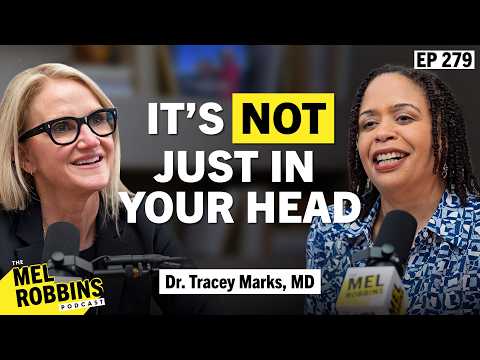
The Truth About Anxiety & ADHD: Life-Changing Tools From Renowned Psychiatrist Dr. Tracey Marks
Dr. Tracey Marks (guest), Mel Robbins (host), Guest caller (guest), Alyssa (production assistant) (guest)
In this episode of The Mel Robbins Podcast, featuring Dr. Tracey Marks and Mel Robbins, The Truth About Anxiety & ADHD: Life-Changing Tools From Renowned Psychiatrist Dr. Tracey Marks explores anxiety, ADHD, And Rewiring Your Brain: Practical Tools To Cope Mel Robbins and psychiatrist Dr. Tracey Marks unpack the modern surge in anxiety, its physical and mental symptoms, and how it intertwines with ADHD and executive function challenges.
Anxiety, ADHD, And Rewiring Your Brain: Practical Tools To Cope
Mel Robbins and psychiatrist Dr. Tracey Marks unpack the modern surge in anxiety, its physical and mental symptoms, and how it intertwines with ADHD and executive function challenges.
Dr. Marks explains how the brain’s threat system (amygdala) and braking system (vagus nerve, prefrontal cortex) work, emphasizing that you can’t stop anxiety from arising but you can learn to stop accelerating it.
They cover specific tools—like interoceptive exposure, breathing and vagal techniques, grounding, habit reversal, and graded exposure—as well as lifestyle levers such as sleep, diet, and exercise that biologically reduce anxiety.
The conversation also explores overlooked signs like body picking, tics, procrastination, and perfectionism, reframing conditions like anxiety and ADHD from “defects” to differences you can understand and manage effectively.
Key Takeaways
You can’t prevent anxiety from arising, but you can stop accelerating it.
Dr. ...
Get the full analysis with uListen AI
Separate physical sensations from catastrophic interpretations to break the anxiety loop.
Many people, like Mel’s son Oakley, experience a bodily sensation (nausea, dizziness, dissociation) that then triggers fear about the sensation itself; recognizing these as anxiety-related and not inherently dangerous is the first step to reducing their power.
Get the full analysis with uListen AI
Use interoceptive exposure to retrain your brain not to fear bodily sensations.
By intentionally inducing mild versions of feared sensations (e. ...
Get the full analysis with uListen AI
Tap your body’s braking system with breathwork and vagal maneuvers in anxious moments.
Techniques like box breathing, 4–7–8 breathing, slow deep exhales, humming, and even cold-water splashes stimulate the parasympathetic (vagal) system, slowing heart rate and reducing the physiological intensity of anxiety so your thoughts are easier to manage.
Get the full analysis with uListen AI
Avoidance makes phobias and social anxiety worse; graded exposure makes them smaller.
Whether it’s emetophobia (fear of vomiting), fear of flying, or social situations, reorganizing your life to avoid triggers enlarges the problem; instead, building a stepwise exposure ladder (show up, walk in, speak to one person, etc. ...
Get the full analysis with uListen AI
ADHD and anxiety are deeply linked through executive function and emotion regulation.
Low dopamine and impaired prefrontal control in ADHD make it harder to manage time, emotions, and attention, which can create secondary anxiety, rumination, and a feeling of life being out of control—understanding this helps you treat the root, not just the anxiety symptoms.
Get the full analysis with uListen AI
Lifestyle choices—especially sleep, diet, and exercise—biologically change how anxious you feel.
Poor sleep, high-sugar/ultra-processed diets, and inactivity increase inflammation, alter gut bacteria, and shift gene expression (epigenetics) and stress hormones in ways that heighten anxiety, whereas consistent sleep, whole foods, and regular movement boost brain repair (BDNF) and resilience.
Get the full analysis with uListen AI
Notable Quotes
“Your brain is changeable, and regardless of what condition you may have, you can improve the quality of your life with simple behaviors and habits.”
— Dr. Tracey Marks
“You cannot stop the initial response. What you can stop is the propagation of the response.”
— Dr. Tracey Marks
“The avoidance behaviors become the bigger problem than the thing that you fear.”
— Dr. Tracey Marks
“We’ve got to change the focus from trying to prevent the reaction to controlling the reaction.”
— Dr. Tracey Marks
“If you have struggles, you’re not defective, you’re just different—and that’s okay.”
— Dr. Tracey Marks
Questions Answered in This Episode
How do I map my own specific physical anxiety sensations and design an interoceptive exposure plan around them?
Mel Robbins and psychiatrist Dr. ...
Get the full analysis with uListen AI
If I suspect my ‘anxiety’ is actually rooted in undiagnosed ADHD, what evaluation steps and practitioners should I pursue first?
Dr. ...
Get the full analysis with uListen AI
What realistic sleep, diet, and exercise changes can I commit to over the next 90 days that would most powerfully reduce my anxiety?
They cover specific tools—like interoceptive exposure, breathing and vagal techniques, grounding, habit reversal, and graded exposure—as well as lifestyle levers such as sleep, diet, and exercise that biologically reduce anxiety.
Get the full analysis with uListen AI
How can I tell the difference between being introverted and having clinically significant social anxiety that needs treatment?
The conversation also explores overlooked signs like body picking, tics, procrastination, and perfectionism, reframing conditions like anxiety and ADHD from “defects” to differences you can understand and manage effectively.
Get the full analysis with uListen AI
What habit-reversal or replacement behaviors could I use to address my own body-focused repetitive behaviors like nail biting or skin picking?
Get the full analysis with uListen AI
Transcript Preview
There's been a, a huge uptick in anxiety. It all started with the pandemic. (instrumental music plays) The World Health Organization reported a 25% increase in an- anxiety globally, and sadly, it's still continuing to rise. It's not like it got better after things settled down. We're still having increases in incidents of anxiety. Probably the most common ones are social anxiety and generalized anxiety disorder.
There are also factors that you're gonna teach us today that can help you get your anxiety under control.
That's absolutely right. Your brain is changeable, and regardless of what condition you may have, you can improve the quality of your life with simple behaviors and habits. You have control over this, and you have agency over your mental health. (clock ticking)
Hey, it's your friend Mel, and welcome to The Mel Robbins Podcast. I am so excited to be here with you. It is always such an honor to spend time together, to be together, but today in particular, I am fired up for this conversation because it has deeply personal meaning for me, and so I'm glad to be learning together with you. And if you're a new listener, I just wanna take a moment and personally welcome you to The Mel Robbins Podcast family. Thrilled that you're here. And because you hit play and found the time to listen to this particular episode, here's what I know about you. You love to learn, you love feeling inspired, and you also want to understand yourself better, and that's exactly what this amazing conversation is gonna help you do today. And if somebody sent this to you, let me just point out that that's really cool because it means you have people in your life that deeply care about you, and they wanted you to hear something that could potentially make your life better, and that's awesome. And today, the conversation, it's not gonna just blow your mind, it's gonna change your mind because we're gonna dig into the surprising connection between anxiety, ADHD, and symptoms that people with these two conditions experience that you may not be aware of. I certainly wasn't. And more importantly, you're gonna get a lot of tools on exactly what to do if this is how you feel or if it's impacting somebody that you care about. So let me introduce you to the amazing Dr. Tracey Marks who is an absolute powerhouse. Dr. Marks graduated from Duke and then got her medical degree from the University of Florida College of Medicine. She did a residency in psychiatry at NewYork-Presbyterian Hospital. She has been a practicing clinical psychiatrist for over 25 years, specializing in anxiety, ADHD, and mood disorders. She's also the author of three best-selling books on mental health, including the one I'm holding right now, Why Am I So Anxious? She also has two million subscribers on YouTube, making her channel one of the biggest mental health and wellness channels online today. Her YouTube videos break down complicated topics like ADHD and anxiety into simple, relatable strategies that help people like you and me who are struggling with ADHD and anxiety learn how to thrive. So without further ado, please help me welcome Dr. Tracey Marks to The Mel Robbins Podcast. Dr. Tracey Marks, welcome to The Mel Robbins Podcast.
Install uListen to search the full transcript and get AI-powered insights
Get Full TranscriptGet more from every podcast
AI summaries, searchable transcripts, and fact-checking. Free forever.
Add to Chrome